July 9, 2026·5 min read·GHRP-2, growth hormone secretagogues, ghrelin, pralmorelin, research peptides
GHRP-2 — a research overview
A measured research overview of the GHRP-2 peptide (pralmorelin): its ghrelin-receptor mechanism, the growth hormone, cortisol, and appetite data, and how it compares to GHRP-6 and ipamorelin.
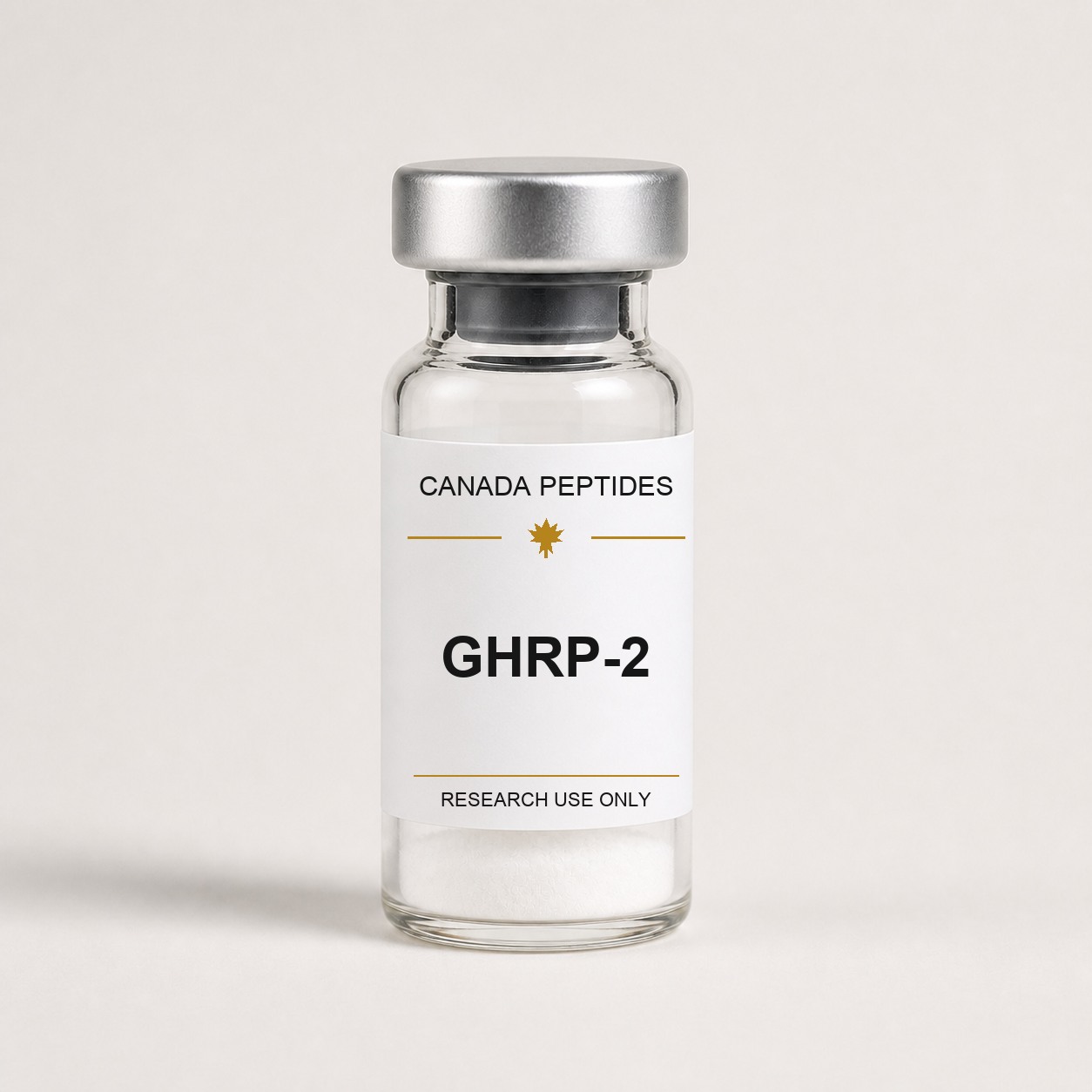
GHRP-2 (growth hormone releasing peptide-2), known in the pharmaceutical literature as pralmorelin, is one of the earliest and most studied synthetic growth hormone secretagogues. It is a synthetic hexapeptide — D-Ala-D-2-Nal-Ala-Trp-D-Phe-Lys-NH2 — that mimics the endogenous hormone ghrelin at its receptor. Among the GHRP family, it sits between the older GHRP-6 and the more selective ipamorelin, and it is unusual in having reached formal clinical use as a diagnostic agent.
Mechanism
GHRP-2 is an agonist of the growth hormone secretagogue receptor type 1a (GHS-R1a), the same G-protein-coupled receptor activated by ghrelin. GHS-R1a is expressed on somatotroph cells of the anterior pituitary and in the hypothalamic arcuate nucleus. Binding drives Gq/11 signaling — phospholipase C activation, IP3 and diacylglycerol generation, and downstream calcium mobilization — which triggers pulsatile release of growth hormone (GH) from the pituitary.
Because it works through the ghrelin pathway rather than the growth-hormone-releasing-hormone (GHRH) receptor, GHRP-2 acts on a distinct arm of GH regulation. This is why the research literature often examines GHRPs and GHRH analogs together: they engage separate receptors and, in study settings, produce a larger combined GH response than either alone. For the broader category, see our growth-hormone secretagogues explainer.
What the research shows
GH release. GHRP-2 is a potent GH secretagogue. In stimulation-test studies it has produced GH responses that meet or exceed those of maximal-dose GHRH. That potency is the basis of its best-documented application.
Diagnostic use. GHRP-2 is approved in Japan as pralmorelin for diagnosing adult growth hormone deficiency (GHD). The GHRP-2 stimulation test uses a 100-µg intravenous bolus with GH sampled at 15, 30, and 60 minutes. In one clinical series of patients with hypothalamic-pituitary disorder, peak GH above roughly 16 ng/mL was treated as non-deficient, 9–16 ng/mL as moderate GHD, and at or below 9 ng/mL as severe GHD. The same work noted that GHRP-2 also stimulates ACTH and cortisol, and the authors recommended measuring ACTH alongside GH to catch concurrent adrenal insufficiency — a reminder that this receptor is not GH-selective.
Appetite. Because it is a ghrelin mimetic, GHRP-2 increases food intake. In a randomized, double-blind trial in healthy men (Laferrère and colleagues, published in the Journal of Clinical Endocrinology & Metabolism), a subcutaneous infusion of 1 µg/kg/h raised ad libitum food intake by about 36% versus placebo, with every participant eating more. GH rose sharply over the same infusion. The appetite effect is real but reported as more modest than GHRP-6's characteristic strong hunger.
Where it sits vs related compounds
GHRP-2's defining trade-off is potency versus selectivity. It reliably drives GH, but it also nudges cortisol, prolactin, and ACTH upward — effects that are described as mild at low doses and more pronounced as doses climb into the low-hundreds-of-micrograms range in the research record.
Compound
Receptor
GH potency
Cortisol / prolactin
Appetite
GHRP-2
GHS-R1a (ghrelin)
High
Mild, dose-dependent
Moderate
GHRP-6
GHS-R1a (ghrelin)
High
Mild–moderate
Strong
Ipamorelin
GHS-R1a (ghrelin)
Moderate
Minimal
Minimal
Ipamorelin is the more selective member of the family, prized in research contexts precisely because it raises GH with little effect on cortisol or prolactin. GHRP-6 is the closest analog to GHRP-2 but with a stronger appetite signal. GHRP-2 is often positioned as the middle option — more potent and less hunger-driving than GHRP-6, less clean than ipamorelin.
Data maturity — an honest caveat
The GHRP-2 evidence base is real but bounded. Its diagnostic pharmacology is well characterized, and short-term GH, cortisol, and appetite responses have been measured in controlled human studies. What is thin is long-term data: sustained multi-week or multi-month administration, chronic safety, and the kind of large-scale outcome trials that exist for, say, the GLP-1 agonists. Much of what circulates outside the diagnostic literature is short-duration or preclinical. Claims about body-composition or anti-aging outcomes should be read against that gap, not as settled findings.
Frequently asked questions
What is GHRP-2?
GHRP-2, or pralmorelin, is a synthetic six-amino-acid peptide that activates the ghrelin receptor (GHS-R1a) to stimulate growth hormone release from the pituitary. It is one of the original growth hormone releasing peptides.
How is GHRP-2 different from ghrelin?
It targets the same receptor as ghrelin and reproduces ghrelin's core effects — GH release and increased appetite — but as a stable synthetic peptide designed for potent, reproducible receptor activation in research settings.
Does GHRP-2 affect cortisol and prolactin?
Yes. The research literature reports mild, dose-dependent increases in cortisol, ACTH, and prolactin. These are generally small at low doses and more pronounced at higher doses, which is one reason ipamorelin is considered the more selective option.
How does GHRP-2 compare to ipamorelin and GHRP-6?
All three act on the ghrelin receptor. GHRP-2 and GHRP-6 are both potent; GHRP-6 produces stronger appetite stimulation. Ipamorelin is less potent for GH but far more selective, with minimal cortisol and prolactin effect.
Is GHRP-2 approved for anything?
As pralmorelin, it is approved in Japan as a diagnostic agent for growth hormone deficiency. It is not an approved therapeutic, and the compounds referenced here are for laboratory research only.