April 5, 2026·5 min read·ghrp, growth-hormone, compound-overview
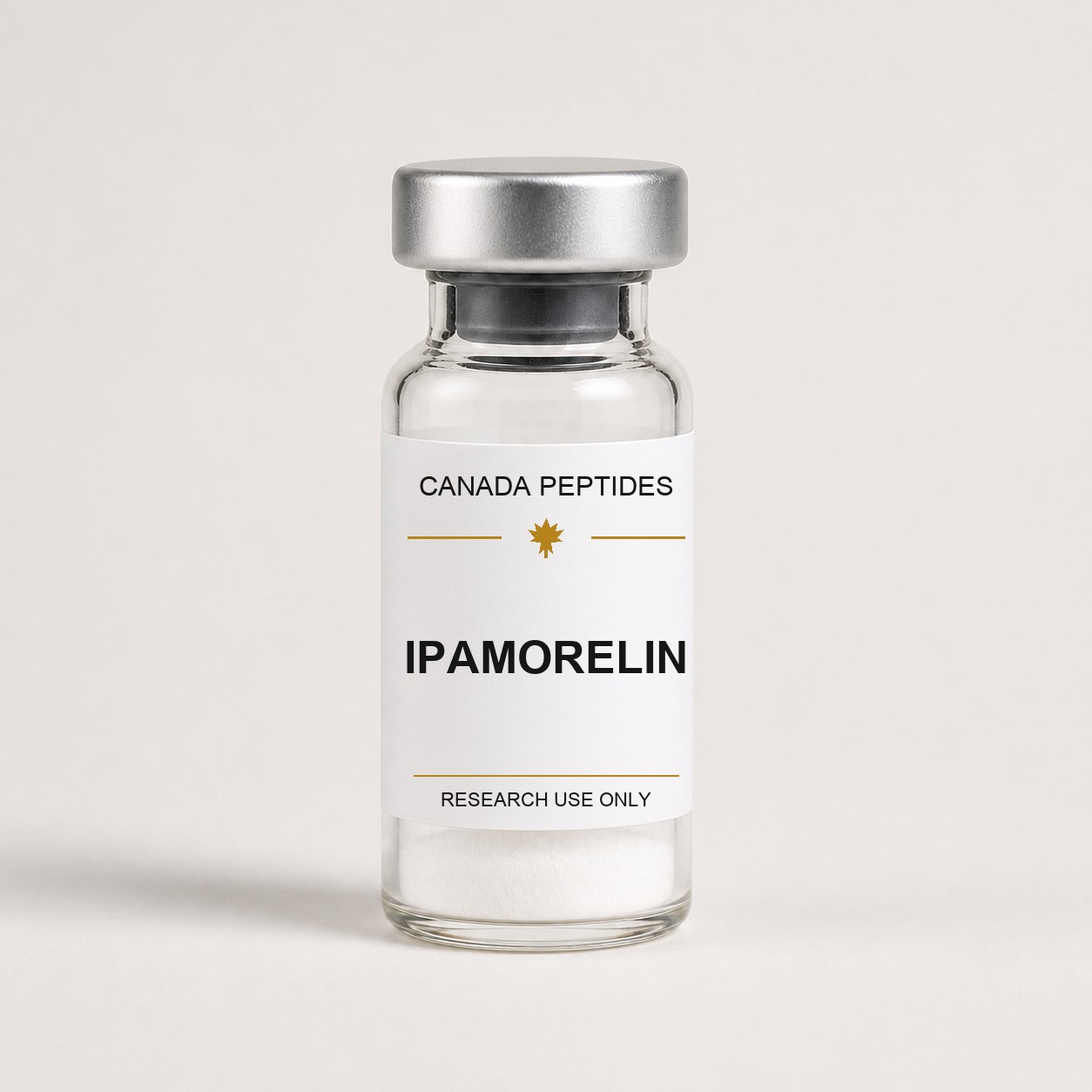
Ipamorelin — a research overview
Selective GHRP/ghrelin agonist with GH-pulse amplification, minimal cortisol spillover, and common stacking protocols.
Selective GHRP/ghrelin agonist with GH-pulse amplification, minimal cortisol spillover, and common stacking protocols.
Ipamorelin is a 5-amino-acid synthetic peptide that functions as a ghrelin-receptor agonist (GHSR1a), driving amplitude amplification of endogenous growth-hormone pulses without triggering significant cortisol or prolactin elevation. This selectivity distinguishes it from earlier ghrelin mimetics like GHRP-2 and GHRP-6, which all produce secondary hormone spillover. For users interested in growth-hormone axis stimulation without collateral endocrine burden, Ipamorelin has occupied a distinctive niche in research protocols for over two decades. Understanding the growth-hormone secretagogue landscape provides context for comparing ipamorelin to related compounds.
Ipamorelin binds the growth-hormone secretagogue receptor type 1a (GHSR1a), a G-protein coupled receptor predominantly expressed on hypothalamic and pituitary gonadotropin-releasing hormone (GnRH) neurons. Activation drives pulsatile GH secretion by amplifying the endogenous GnRH pulse — essentially increasing the amplitude of the system's native rhythm rather than creating artificial spikes. This pulse-amplification mechanism, distinct from exogenous HGH replacement, preserves somatostatin feedback inhibition and endogenous GH-pulse architecture.
The selectivity for GHSR1a over other ghrelin-responsive pathways appears to reduce the secondary hormonal effects (cortisol, prolactin, ACTH) that make earlier GHRPs less tolerable. The mechanisms underlying this selectivity are incompletely characterized, but the empirical consequence — cleaner GH elevation with less off-target signaling — is reproducible in research literature.
Ipamorelin has a short terminal plasma half-life of approximately 2 hours. This necessitates frequent dosing or timing-specific administration to align with endogenous GH-pulse windows — typically pre-sleep (to amplify the major nighttime pulse) or immediately post-workout (to exploit the exercise-induced GH pulse). The short half-life is often cited as a practical advantage: any untoward effects are rapid to resolve, and pulse amplification can be precisely timed rather than creating a constant circulating hormone level.
Subcutaneous injection is standard. Bioavailability is presumed near-complete, though formal pharmacokinetic studies in humans are limited.
Ipamorelin-driven GH elevation produces downstream insulin-like growth factor-1 (IGF-1) elevation. The magnitude of IGF-1 rise depends on pulse amplitude, frequency, and baseline GH status — younger users with higher endogenous GH typically see larger IGF-1 responses than older users starting from lower baselines. This is useful for dose-response thinking: a "Ipamorelin dose" that significantly elevates IGF-1 in a 25-year-old may produce a minimal response in a 55-year-old.
Research cycles typically span 8–12 weeks, with on-off cycling employed to preserve pituitary sensitivity. Continuous dosing without breaks often leads to tachyphylaxis — diminishing IGF-1 response over weeks — which can be reversed by a 2–4 week cessation period.
Ipamorelin is rarely used in isolation. The standard stack pairs it with a GHRH analogue — most commonly CJC-1295 or its variants. The mechanistic logic is straightforward: Ipamorelin drives GH amplitude via GHSR1a; GHRH analogues drive GH secretion via the GHRH receptor on a different pituitary cell population. The two peptides act on distinct receptors and have additive, not redundant, effects on GH pulse amplitude. Cycles combining Ipamorelin and GHRH typically run 8–12 weeks with similar on-off cycling.
Some research protocols add a third axis — a SARM (selective androgen receptor modulator) or other anabolic agent — but this moves beyond peptide monoclass discussion and into polypharmacy territory.
Ipamorelin research protocols typically employ doses in the range of micrograms per injection, with frequency varying from daily to every other day depending on cycle design and IGF-1 endpoint targets. The short half-life means that timing relative to endogenous pulse rhythms is practical: pre-sleep injections amplify the major nighttime GH pulse, while post-workout dosing captures the exercise-induced pulse. This timing-specificity is one reason Ipamorelin appears in many research designs — the user can theoretically optimize the pharmacology to endogenous biology rather than imposing a constant circulating level.
Dose-response studies in humans are limited, so translating research protocols across individuals requires careful baseline monitoring and IGF-1 measurement.
Ipamorelin's selectivity translates to a relatively benign side-effect profile relative to other GHRPs. Cortisol elevation (a concern with GHRP-6 and Hexarelin) is minimal. Prolactin spillover is rare. Hunger stimulation is present (ghrelin agonism drives appetite) but moderate and generally reversible. The primary practical limitation is tachyphylaxis if used continuously; cycling resolves this.
Ipamorelin is the foundational GHRP for users interested in growth-hormone axis modulation without the secondary hormonal burden of earlier ghrelin mimetics. It is almost always stacked with a GHRH analogue (such as CJC-1295) in the NeuroForge catalog. Together, these two compounds represent the primary non-exogenous-HGH approach to GH-pulse amplification in research protocols.
What is ipamorelin and how does it work? Ipamorelin is a 5-amino-acid synthetic peptide that acts as a ghrelin-receptor agonist (GHSR1a), amplifying the amplitude of endogenous growth-hormone pulses without creating artificial spikes or triggering significant cortisol or prolactin elevation.
Why is ipamorelin paired with CJC-1295? Ipamorelin and CJC-1295 act on distinct receptors: ipamorelin drives GH amplitude via GHSR1a, while CJC-1295 drives GH secretion via the GHRH receptor. Their effects are additive, making the combination mechanistically synergistic for GH-pulse amplification.
How long does ipamorelin stay in your body? Ipamorelin has a short terminal plasma half-life of approximately 2 hours, necessitating frequent dosing or timing-specific administration. The short half-life allows precise timing relative to endogenous GH pulses (pre-sleep, post-workout) and rapid resolution of any unwanted effects.
What is tachyphylaxis and how does it apply to ipamorelin? Continuous ipamorelin dosing without breaks often leads to tachyphylaxis—diminishing IGF-1 response over weeks. This can be reversed by a 2–4 week cessation period, making on-off cycling a standard research protocol practice.
How does ipamorelin compare to GHRP-6 or GHRP-2? Ipamorelin's selectivity for GHSR1a over other ghrelin pathways reduces secondary hormonal effects (cortisol, prolactin, ACTH) that make earlier GHRPs like GHRP-6 and GHRP-2 less tolerable. Ipamorelin provides cleaner GH elevation with less off-target signaling.