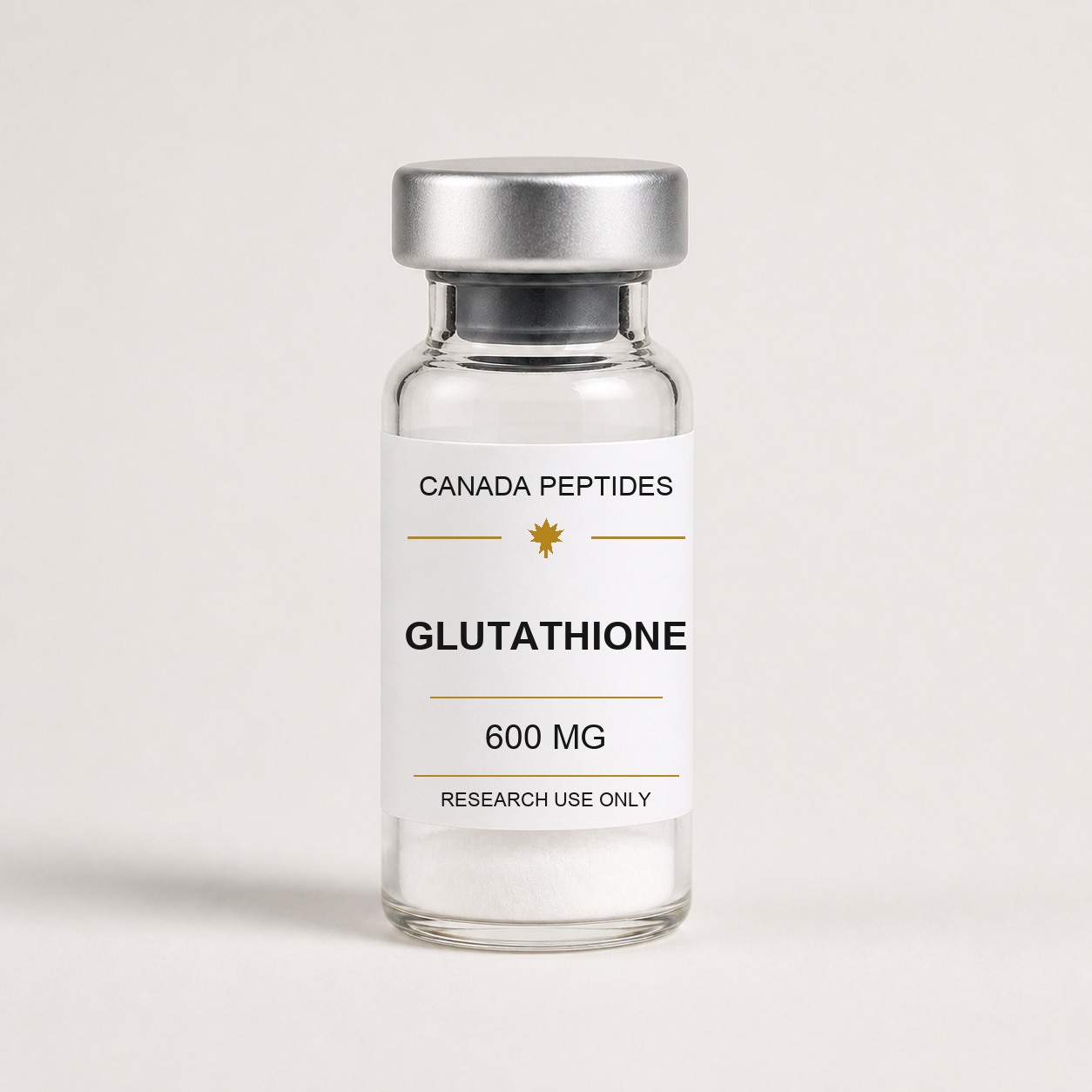
July 4, 2026·5 min read·glutathione, antioxidants, redox, research overview, peptides
Glutathione — a research overview
A measured research overview of the glutathione injection: its antioxidant biochemistry, the intravenous bioavailability rationale, and what Parkinson's and skin-lightening trials actually show.
Glutathione — a research overview — Canada Peptides
Glutathione is the body's most abundant intracellular thiol antioxidant, and among the compounds sold for research use, it is one of the few whose endogenous biology is thoroughly mapped. Interest in glutathione injection as a research format stems from a single, well-documented problem: the molecule is poorly bioavailable by mouth. This overview covers what glutathione is, how it functions in the cell, what the injectable-route literature actually shows, and where the data remain thin.
What glutathione is
Glutathione (GSH) is a tripeptide assembled from three amino acids — glutamate, cysteine, and glycine. Its defining structural feature is an unusual gamma-glutamyl peptide bond linking glutamate to cysteine, which resists the standard cellular peptidases and gives the molecule its intracellular stability. The reactive centre is the cysteine thiol (-SH) group, which does the redox work.
Cells synthesize glutathione in two ATP-dependent steps. The first, catalyzed by glutamate-cysteine ligase, is rate-limiting, and cysteine availability is the rate-limiting substrate. This is why cysteine precursors such as N-acetylcysteine (NAC) are studied as indirect ways to raise glutathione, rather than administering the intact tripeptide.
How it works
Glutathione's central role is maintaining the cell's redox balance. It neutralizes reactive oxygen species by donating electrons through the enzyme glutathione peroxidase, which converts reduced glutathione (GSH) into its oxidized disulphide form (GSSG). GSSG is then recycled back to GSH by glutathione reductase in an NADPH-dependent reaction — a continuously cycling system rather than a one-shot buffer.
The GSH:GSSG ratio is a widely used marker of cellular redox state. Under normal conditions it sits near 100:1; under oxidative stress it can fall toward 10:1 or lower. Beyond antioxidant defence, glutathione participates in xenobiotic detoxification (it conjugates to reactive metabolites in the liver, where it is especially concentrated) and influences signalling processes tied to cell growth and apoptosis.
Why the injectable route is studied
The recurring theme across the glutathione literature is bioavailability. Standard oral glutathione is largely degraded in the gut by gamma-glutamyltransferase and undergoes first-pass metabolism, so conventional oral dosing produces minimal measurable increases in circulating levels. Intravenous administration, by contrast, bypasses that barrier — one pharmacokinetic characterization reported plasma glutathione rising roughly 47-fold above baseline after IV dosing. This bioavailability gap is the entire rationale for the parenteral research formats, and it is worth noting that most of the injectable evidence base is specifically intravenous, not subcutaneous; subcutaneous glutathione is comparatively under-studied.
What the research shows
Neurodegeneration. Because glutathione depletion is implicated in the mitochondrial dysfunction and dopaminergic vulnerability seen in Parkinson's disease, IV glutathione has been examined as an adjunct. A randomized, double-blind, placebo-controlled pilot (Hauser et al., 2009) assigned 21 subjects to IV glutathione 1,400 mg or placebo three times weekly for four weeks. Glutathione was well tolerated with no withdrawals for adverse events, but there were no statistically significant differences in Unified Parkinson's Disease Rating Scale scores versus placebo — the numeric trend favoured glutathione but did not reach significance in a study this small. The precursor approach has parallel support: intravenous NAC has been shown by magnetic resonance spectroscopy to raise brain glutathione concentrations.
Skin pigmentation. Glutathione is marketed widely as a skin-lightening agent, on the mechanistic basis that it inhibits tyrosinase — the copper-dependent, rate-limiting enzyme of melanin synthesis — shifting production away from darker eumelanin. Narrative and controlled reviews report measurable decreases in melanin index in some small trials (oral capsules, disulphide lotion, buccal lozenges), but the overall evidence is repeatedly described as limited, short-term, and inconclusive. Regulatory bodies have specifically flagged intravenous glutathione for skin lightening as having inadequate safety data, with case reports of serious reactions.
Liver and oxidative-stress conditions. Glutathione's concentration in hepatocytes and its role in detoxification have driven interest in liver disease and other oxidative-stress states, but here too the human injectable data are preliminary rather than definitive.
Where it sits among antioxidant compounds
Glutathione occupies a different niche from precursor strategies (NAC, glycine + NAC combinations) that push the cell to make its own GSH, and from redox cofactors like NAD+, which operate on the NADPH/NADH side of the same electron economy that recycles glutathione. Mitochondrial-signalling peptides such as MOTS-c are sometimes grouped alongside it under a broad "cellular resilience" heading, but the mechanisms are distinct and should not be conflated.
Data maturity — the honest caveat
Glutathione's endogenous biochemistry is textbook-settled. Its value as an administered therapeutic is not. The injectable clinical literature is dominated by small pilots, short durations, and mixed or null efficacy endpoints, with the strongest, most reproducible finding being simply that the IV route raises plasma levels where oral does not. Anyone designing research around it should treat efficacy claims — particularly the cosmetic ones — as hypotheses, not established outcomes.
Frequently asked questions
Why is glutathione given by injection rather than orally?
Oral glutathione is largely broken down in the gut and cleared by first-pass liver metabolism, so it produces little measurable rise in circulating levels. Intravenous dosing bypasses this and has been shown to raise plasma glutathione many-fold, which is why the research literature on administered glutathione is overwhelmingly parenteral.
Does the research support glutathione for Parkinson's disease?
Not conclusively. The main randomized, double-blind pilot found IV glutathione was well tolerated but showed no statistically significant benefit over placebo on standard Parkinson's rating scales. It remains an area of investigation, not an established treatment.
Is glutathione the same as NAC?
No. NAC (N-acetylcysteine) is a cysteine precursor — cysteine is the rate-limiting building block for glutathione synthesis — so NAC is studied as an indirect way to raise glutathione. Glutathione itself is the intact tripeptide.
What does the GSH:GSSG ratio measure?
It reflects cellular redox state: the balance between reduced (GSH) and oxidized (GSSG) glutathione. A high ratio (around 100:1) indicates a healthy antioxidant reserve; the ratio falls under oxidative stress and is used as a laboratory marker.
Is the skin-lightening evidence solid?
No. Some small trials report a lower melanin index, but reviews consistently describe the evidence as limited and inconclusive, and regulators have flagged intravenous glutathione for cosmetic use as lacking adequate safety data.