April 20, 2026·5 min read·ghrh, growth-hormone, metabolic, compound-overview
Tesamorelin — a research overview
Stabilized GHRH analogue with FDA approval for HIV lipodystrophy, selective visceral fat reduction, and pulse-amplification mechanism.
Stabilized GHRH analogue with FDA approval for HIV lipodystrophy, selective visceral fat reduction, and pulse-amplification mechanism.
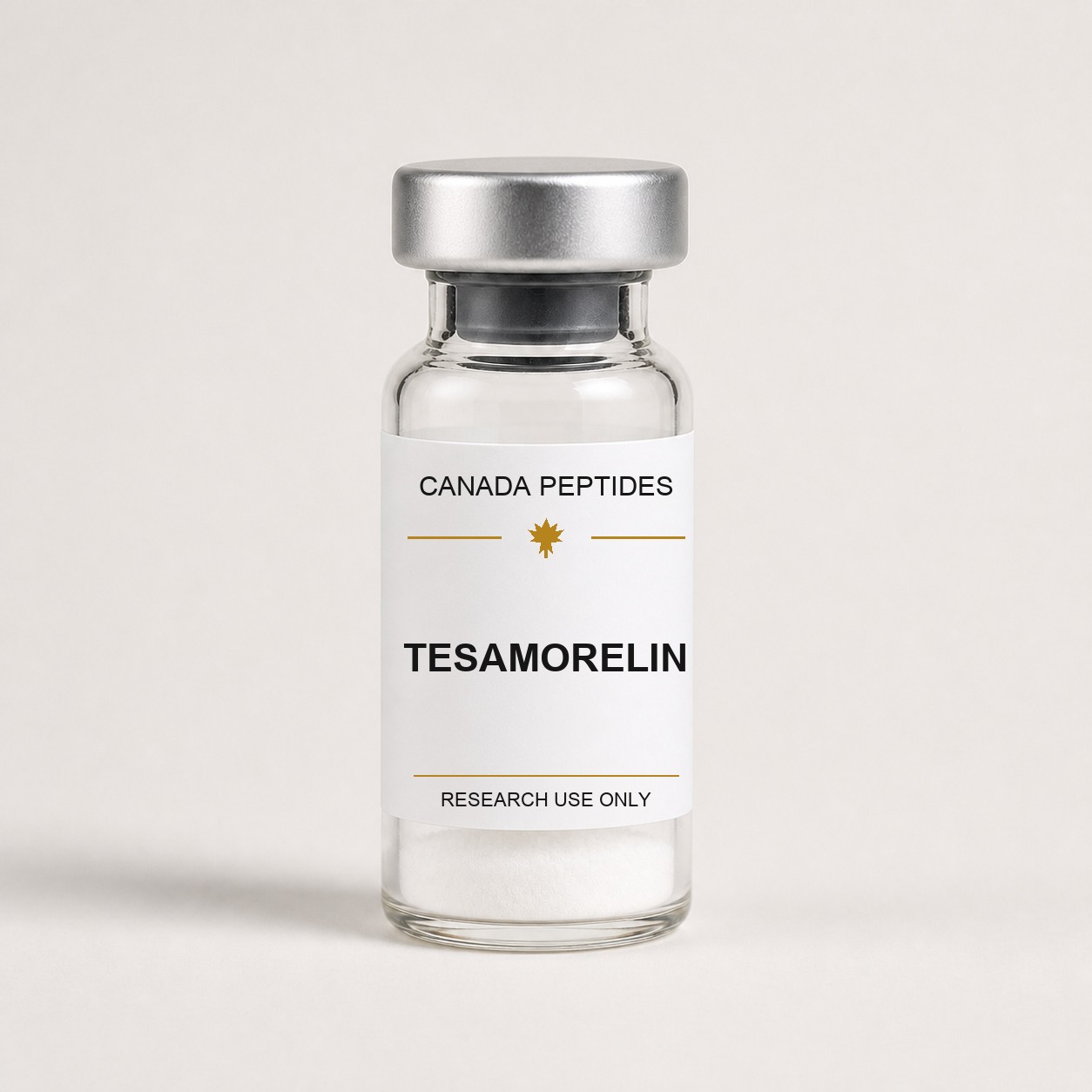
Tesamorelin is a 44-amino-acid synthetic peptide that functions as a growth-hormone releasing hormone (GHRH) analogue with resistance to DPP-4 enzymatic cleavage. It is one of the rare peptides in the NeuroForge catalog with explicit FDA regulatory approval — marketed as Egrifta for HIV-associated lipodystrophy, a condition characterized by pathological visceral fat accumulation and metabolic dysfunction. The regulatory stamp reflects genuine clinical benefit in a defined population, and the research literature characterizes a specific, replicable effect: selective reduction in visceral adipose tissue (VAT) with minimal impact on subcutaneous fat. See the growth-hormone secretagogue comparison to understand Tesamorelin's place in the GH-axis toolkit.
Tesamorelin carries a stabilizing hexenoyl-trans-3 modification at the N-terminus that prevents rapid DPP-4 degradation, extending plasma half-life and allowing once-daily dosing rather than more-frequent GHRH administration. Like other GHRH analogues, it binds the GHRH receptor on anterior pituitary somatotrophs, driving pulsatile GH secretion. The critical distinction from exogenous HGH is that Tesamorelin works via endogenous GH-pulse machinery — somatostatin negative feedback remains intact, which is argued to be a safety advantage relative to exogenous HGH replacement. This endogenous-pulse model is shared with Ipamorelin, distinguishing both from direct hormone replacement.
The mechanistic story of why GHRH-driven GH elevation selectively mobilizes visceral fat rather than subcutaneous fat is incompletely characterized, but the empirical observation is robust in the literature. The effect may relate to differential adrenergic receptor expression in VAT versus subcutaneous depots, or to metabolic signaling specific to growth-hormone-mediated lipolysis in central fat compartments.
Tesamorelin has a short terminal plasma half-life of 26 to 38 minutes — notably shorter than Semaglutide or Tirzepatide. Once-daily subcutaneous injection is standard, with dosing windows of 1.4 to 2 mg daily in the published clinical literature. The short half-life means the physiological effect depends on the amplitude of the induced GH pulse, not on maintaining a constant circulating Tesamorelin level. Peak GH secretion typically occurs 30 to 60 minutes post-injection.
The landmark literature on Tesamorelin comes from a series of randomized controlled trials led by Steven Stanley and colleagues at Massachusetts General Hospital (Harvard system). In HIV-associated lipodystrophy populations, 12 to 26 weeks of once-daily Tesamorelin produced measurable reductions in visceral adipose tissue as quantified by CT imaging, with minimal change in subcutaneous fat and preserved or improved lean mass. The effect sizes are moderate — roughly 10–25% VAT reduction depending on baseline and trial — but specific to the VAT compartment.
Subsequent work extended the observations to non-HIV populations with metabolic dysfunction, though regulatory approval remains limited to the HIV lipodystrophy indication. The consistency of VAT selectivity across multiple independent trials is notable; this is not a spurious finding but a reproducible effect of the GHRH axis on fat distribution.
The selectivity for VAT raises a mechanistic question: why doesn't GHRH-driven GH elevation mobilize subcutaneous fat equally? Current evidence suggests the answer lies in differential adrenergic and GH-receptor expression in VAT versus subcutaneous adipose tissue, combined with metabolic differences in blood flow and lipolytic enzyme activity. Growth hormone acts synergistically with the sympathetic nervous system to mobilize lipid; this synergy appears more pronounced in visceral fat depots. The precise mechanism remains incompletely characterized, which is a useful reminder that mechanism trumps teleology — empirical observation (VAT selective reduction) matters more than intuitive story.
Clinical trials have employed Tesamorelin for 12 to 26 weeks at a time, with endpoints reassessed post-cycle. Unlike Semaglutide or Tirzepatide, which are often run indefinitely, Tesamorelin research cycles have a defined endpoint window — typically driven by the hypothesis that VAT mobilization will reach a plateau, and that extended use without breaks may trigger tachyphylaxis similar to other GHRH agents.
Baseline and on-cycle IGF-1 measurement is standard practice in research protocols. VAT can be monitored via DEXA scan, bioimpedance, or CT imaging depending on protocol depth and available resources.
Tesamorelin's mechanism — amplifying endogenous pulses rather than replacing HGH — is often contrasted with direct HGH administration. The theoretical safety advantage is that feedback inhibition via somatostatin remains intact, which may reduce some of the long-term risks of sustained supraphysiologic HGH levels. The practical difference is that Tesamorelin produces a smaller absolute GH elevation than exogenous HGH, but the selectivity for VAT reduction is a distinct advantage if that is the specific endpoint. Understanding the four-phase research cycle helps contextualize how Tesamorelin fits into longer-term metabolic protocols.
Tesamorelin is generally well-tolerated. Injection-site reactions are minimal. Systemic side effects are uncommon at approved doses. The major limiting factor in research protocols is access — regulatory status varies by jurisdiction, and off-label use in non-lipodystrophy populations operates in a gray zone depending on local regulations.
Tesamorelin is the GHRH approach to selective VAT reduction, distinct from Ipamorelin (GHSR1a agonist) in both mechanism and endpoint focus. For users interested in metabolic remodeling with a specific focus on central fat compartments, Tesamorelin offers empirical support that exogenous GHRPs lack. It is often compared to and sometimes stacked with Ipamorelin in research designs targeting comprehensive GH-axis stimulation.
Is tesamorelin FDA-approved? Yes. Tesamorelin is marketed as Egrifta and FDA-approved for HIV-associated lipodystrophy, one of the rare peptides in the catalog with explicit regulatory approval. This reflects genuine clinical benefit in a defined population.
What makes tesamorelin different from ipamorelin? Tesamorelin is a GHRH analogue that drives GH secretion via the GHRH receptor; Ipamorelin is a ghrelin-agonist (GHSR1a) that amplifies GH pulse amplitude. Both preserve endogenous GH-pulse machinery, but they work on distinct receptors with complementary effects.
Does tesamorelin specifically reduce belly fat? Yes. Tesamorelin shows selective reduction in visceral adipose tissue (VAT) with minimal change in subcutaneous fat. Clinical trials documented 10–25% VAT reduction depending on baseline and duration, making it distinct from other GH-axis agents.
What is the mechanism of tesamorelin's VAT selectivity? The exact mechanism remains incompletely characterized, but likely involves differential adrenergic and GH-receptor expression in VAT versus subcutaneous adipose tissue, combined with metabolic differences in blood flow and lipolytic enzyme activity.
How long are tesamorelin research cycles? Clinical trials employed Tesamorelin for 12 to 26 weeks. Unlike some indefinite-use compounds, Tesamorelin cycles have a defined endpoint window, partly due to the hypothesis that VAT mobilization reaches a plateau and extended use without breaks may trigger tachyphylaxis.