September 23, 2026·6 min read·tesofensine, dosage, triple reuptake inhibitor, obesity research, canada
Tesofensine dosage — research dosing notes
What the tesofensine trials administered: the 0.25–1.0 mg once-daily oral doses of TIPO-1 and the Mexican Phase 3, the nine-day half-life and weeks-long accumulation, and titration.
Tesofensine dosage — research dosing notes — Canada Peptides
Tesofensine (NS2330) is a small-molecule triple monoamine reuptake inhibitor — a tropane that blocks the noradrenaline, dopamine and serotonin transporters — and it is not a peptide. NeuroSearch developed it for Parkinson's and Alzheimer's disease and redirected it to obesity after trial participants lost weight. This page is a research reference on how the published trials administered it: the oral doses, the once-daily cadence, the nine-day half-life that makes accumulation the central kinetic fact, and what the trials did about titration. It is not a protocol and not medical advice. The Tesofensine profile is the reference entry.
Why there is no reconstitution section
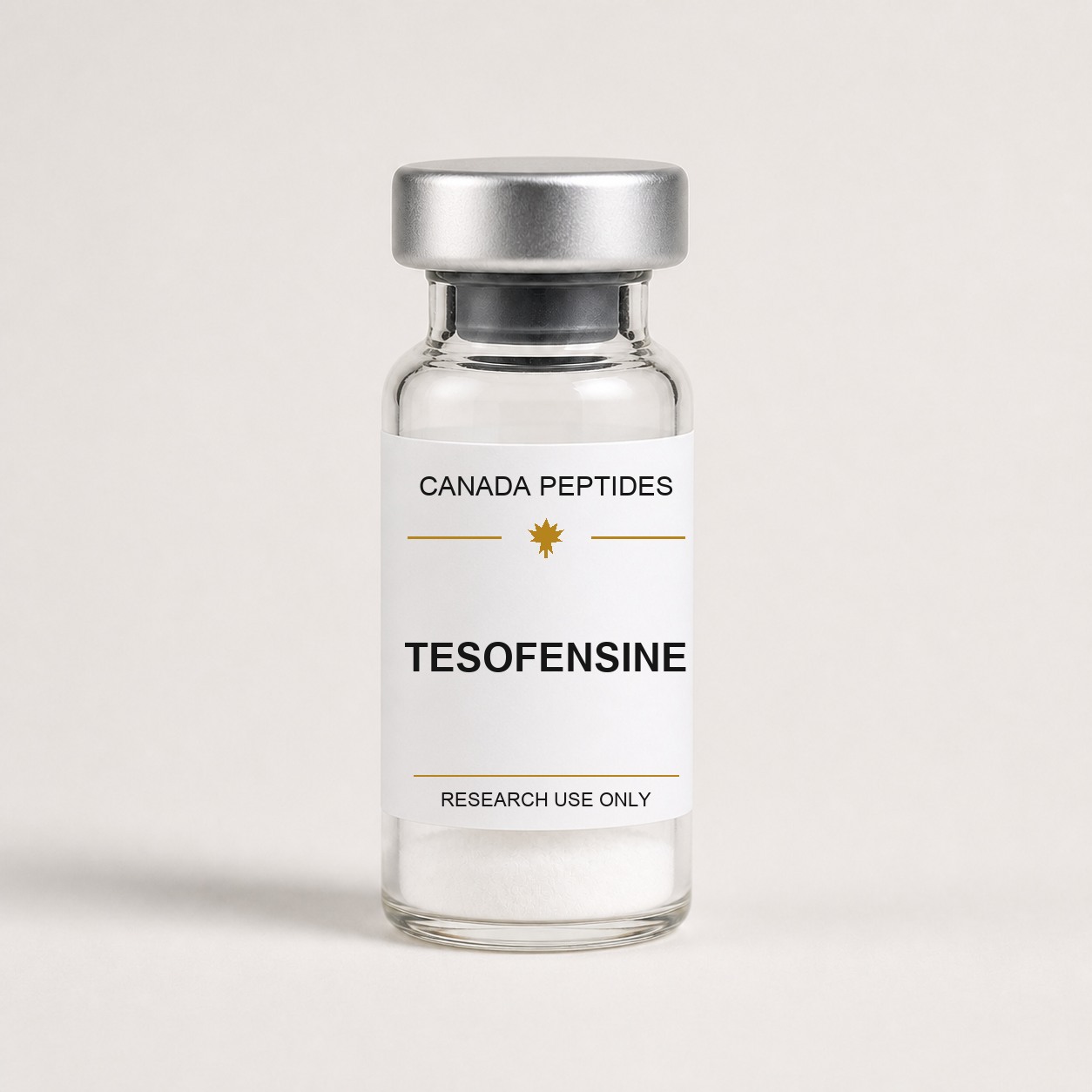
Tesofensine has no reconstitution arithmetic, because every human trial gave it orally, as a tablet or capsule, in sub-milligram amounts. It ships as a dry solid, and laboratory handling follows small-molecule practice — weigh on an analytical balance, dissolve in DMSO or ethanol to a stock of known concentration, dilute into the assay medium — rather than the bacteriostatic-water reconstitution used for a lyophilised peptide. There is no syringe-unit conversion to do. Because every dose ever studied is below one milligram, weighing accuracy is the practical problem. The tesofensine product page states the format and quantity supplied.
The Phase 2 doses: TIPO-1
The trial that defines the compound is TIPO-1 (Astrup and colleagues, The Lancet, 2008). It randomised 203 obese adults to placebo or tesofensine at 0.25, 0.5 or 1.0 mg once daily for 24 weeks, all on a hypocaloric diet. Placebo-subtracted weight loss was about 4.5%, 9.2% and 10.6% respectively. The dose–response was steep between 0.25 and 0.5 mg and nearly flat above it: the 1.0 mg arm added roughly one percentage point of weight loss and a significant rise in blood pressure, which is why it became the dose the sponsor abandoned.
The Lancet paper reports fixed doses assigned at randomisation and no up-titration schedule. The dose range came from the neurological programme: a pooled analysis of the Parkinson's and Alzheimer's trials (Astrup and colleagues, Obesity, 2008) had already quantified weight loss at 0.125–1.0 mg daily over 14 weeks.
Mechanistic and Phase 3 regimens
Two Copenhagen studies characterised the mechanism at a dose outside the efficacy range. Sjödin and colleagues (International Journal of Obesity, 2010) gave 2.0 mg daily for 14 days to overweight and obese men and attributed most of the weight loss to reduced energy intake, with a modest rise in 24-hour energy expenditure; that dose doubled the highest Phase 2 dose and was never used in an efficacy trial. Gilbert and colleagues (Obesity, 2012) reported reduced hunger and increased post-meal satiety from the same group's appetite ratings.
The Phase 3 programme, run by Saniona with its Mexican partner (the Viking trial), carried forward 0.25 and 0.5 mg once daily and dropped 1.0 mg. The sponsor reported positive top-line weight-loss results aimed at a Mexican marketing authorisation; no Phase 3 has been run in Canada, the United States or Europe. The Tesomet programme, in hypothalamic obesity and Prader–Willi syndrome, paired 0.5 mg tesofensine with 50 mg metoprolol, the beta-blocker being there to blunt the heart-rate increase. The neurological trials — early Parkinson's disease (2007), ADVANS (Rascol and colleagues, Archives of Neurology, 2008) and the Alzheimer's studies — used 0.125–1.0 mg daily over 14 weeks and were negative on their primary endpoints.
A nine-day half-life changes the meaning of "once daily"
Population pharmacokinetic modelling from the Alzheimer's trials (Lehr and colleagues, British Journal of Clinical Pharmacology, 2007) estimated a half-life of roughly 220 hours — about nine days — for tesofensine, and longer still for its active metabolite NS2360. That sets the arithmetic:
With a 24-hour dosing interval and a 220-hour half-life, the accumulation ratio is 1 ÷ (1 − e^(−0.693 × 24 ÷ 220)) ≈ 13.7. Steady-state exposure is roughly fourteen times the exposure produced by the first dose.
Steady state arrives after four to five half-lives — five to six weeks. Half of the eventual steady-state level is present after about nine days and 90% after about a month.
Elimination is equally slow: effects and adverse effects persist for weeks after the last dose.
The half-life calculator is pre-loaded with the 220-hour figure and plots the accumulation and washout curves. Week-24 outcomes therefore reflect a steady-state exposure the participants only reached around week six, and any fixed dose was in effect self-titrating: exposure ramped over weeks even though the milligram amount never changed.
Titration: what the trials did and did not do
The published obesity trials did not use an escalation schedule the way GLP-1 agonist trials do. Titration in this programme happened between trials rather than within them: the 1.0 mg arm's blood-pressure signal led the sponsor to select 0.25 and 0.5 mg for Phase 3. Vendor copy that speaks of "titrating slowly" is not describing a published regimen. The contrast with retatrutide and the other GLP-1 agonists is instructive: those are escalated over months because gastrointestinal tolerance tracks the rate of escalation, whereas tesofensine's dose-limiting signal was cardiovascular and tracked the steady-state dose, not the speed of reaching it.
Data maturity and Canadian status
The dosing literature belongs to one sponsor, and the efficacy data run 14–24 weeks. There is no independent Phase 2 replication, no long-term cardiovascular-outcome trial and no published dose-finding beyond the three TIPO-1 arms. Every figure above is a fact about a trial design, not a validated regimen, and the research-grade solid sold here is not the tablet the trials used. In Canada, tesofensine has no Health Canada market authorisation or DIN, no FDA or EMA approval, and is not scheduled under the Controlled Drugs and Substances Act; it is supplied for research use only. It is not named on the WADA Prohibited List but may fall under the S6 stimulant catch-all. The tesofensine research overview covers the development history.
Frequently asked questions
What doses of tesofensine were used in the trials?
Oral, once daily: 0.25, 0.5 or 1.0 mg for 24 weeks in the Phase 2 TIPO-1 trial (The Lancet, 2008), 0.25 or 0.5 mg in the Mexican Phase 3, 2.0 mg for 14 days in the 2010 mechanistic study, and 0.125–1.0 mg over 14 weeks in the neurological trials. These are trial parameters, not validated doses.
Was tesofensine titrated in the trials?
No published obesity trial used an up-titration schedule; doses were fixed at randomisation, and dose selection happened between trials when the 1.0 mg arm's blood-pressure signal led the sponsor to carry only 0.25 and 0.5 mg into Phase 3.
How long does tesofensine take to reach steady state?
Four to five half-lives, or five to six weeks, from the 220-hour estimate in the 2007 population pharmacokinetic study. Steady-state exposure is roughly fourteen times the first-dose exposure with once-daily dosing, and the compound washes out just as slowly after the last dose.
Is tesofensine reconstituted like a peptide?
No. It is a lipophilic small molecule, taken orally in every human trial and never injected. Laboratory handling means weighing the solid and preparing a stock solution in an organic solvent such as DMSO; bacteriostatic-water reconstitution and syringe-unit arithmetic do not apply.
Is this medical advice?
No. This page reports what published clinical trials administered, for researchers reading the literature. Tesofensine is unapproved in Canada and sold here for laboratory research only, not for human or veterinary use.