September 23, 2026·6 min read·cerebrolysin, dosage, neurotrophic peptide fraction, stroke research, canada
Cerebrolysin dosage — research dosing notes
How the Cerebrolysin trials administered it: 30 mL IV daily for 10 days in CASTA, 21 days in CARS, the dementia and TBI regimens, the labelled routes, and why there is no reconstitution or half-life.
Cerebrolysin dosage — research dosing notes — Canada Peptides
Cerebrolysin is a standardised mixture of short peptides and free amino acids produced by enzymatic hydrolysis of porcine brain protein, manufactured by EVER Neuro Pharma in Austria, where it has been an approved medicine since 1996, and registered in Russia, China and other markets — but not in Canada or the United States. It is not a single peptide and not a defined molecule. This page is a research reference on how the licensed labelling and the published trials administered it: the millilitre doses, the routes, the course lengths, and why the reconstitution and half-life sections of every other dosage note on this site do not exist here. It is not a protocol and not medical advice. The Cerebrolysin profile is the reference entry.
Why there is no reconstitution arithmetic
The licensed product is a clear amber aqueous solution of porcine brain peptide hydrolysate at 215.2 mg/mL, pH-adjusted with sodium hydroxide, supplied in ampoules of 1, 2, 5, 10 and 20 mL and vials of 20, 30 and 50 mL. No authorised lyophilised presentation exists anywhere that we have been able to identify. So there is no mass-divided-by-diluent step, no bacteriostatic water and no insulin-syringe-unit conversion.
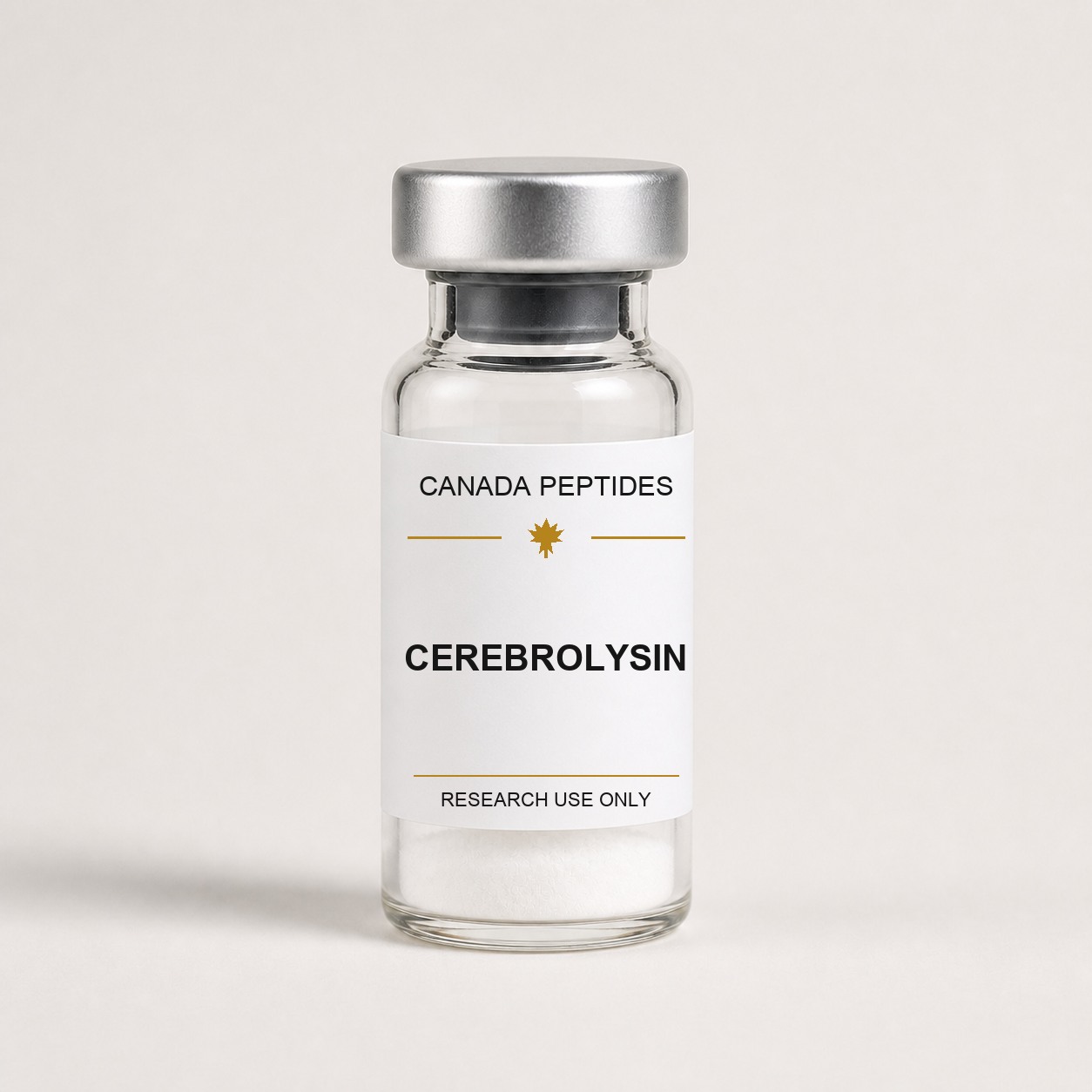
That matters for the research market, where "Cerebrolysin 60 mg" powder vials are widely advertised. Sixty milligrams corresponds to no authorised strength; the most plausible origin is a separate, China-approved cerebroprotein hydrolysate for injection, a freeze-dried porcine brain hydrolysate with added amino acids and mannitol, standardised by total nitrogen. It is a different product from the one the trials studied, and the regimens below do not transfer to it. The Cerebrolysin product page states what is supplied and in what form.
The labelled regimens
The labelling gives 10–50 mL daily by intravenous infusion for neurological indications, with intramuscular injection of up to 5 mL and undiluted intravenous injection of up to 10 mL; larger volumes are diluted in 0.9% sodium chloride, Ringer's solution or 5% glucose and infused over 15–60 minutes, in courses of 10–20 days that may be repeated.
The mass arithmetic is worth doing once. At 215.2 mg/mL, a 30 mL daily dose contains about 6.5 g of peptide fraction, and a 10-day course about 65 g. A 60 mg vial is roughly one hundredth of a single trial day.
What the stroke trials gave
CASTA (Heiss and colleagues, Stroke, 2012) randomised 1,070 patients with acute ischaemic stroke in Asia to 30 mL daily by intravenous infusion for 10 days, starting within 12 hours of onset, or placebo, and found no difference on its primary outcome. CARS (Muresanu and colleagues, Stroke, 2016) randomised 208 patients to 30 mL daily for 21 days, starting 24–72 hours after onset, alongside standardised rehabilitation, and reported better upper-limb motor recovery at day 90; a second, smaller CARS trial did not reach significance on its own.
The 2023 Cochrane review (Cochrane Database of Systematic Reviews) pooled seven randomised trials in 1,773 participants and concluded, with moderate certainty, that Cerebrolysin probably has no beneficial effect on all-cause death after acute ischaemic stroke, alongside an increase in non-fatal serious adverse events (risk ratio 2.39). The 30 mL daily regimen is both the best-studied dose and the one those safety data attach to; the Cerebrolysin research overview covers the trial history.
Dementia and brain-injury regimens
The vascular dementia and Alzheimer's trials mostly gave 10–30 mL by infusion five days a week for four weeks, sometimes repeated. The 2019 Cochrane review of vascular dementia (six trials, 597 participants) rated every primary outcome as very-low-certainty evidence, and the Alzheimer's evidence is a 2015 meta-analysis (Gauthier and colleagues, Dementia and Geriatric Cognitive Disorders) of small trials with manufacturer involvement. Both Cochrane reviews identified inconsistent dosing across trials as a limitation of the literature itself.
The traumatic-brain-injury protocol is the most intensive: CAPTAIN II (Poon and colleagues, Neurological Sciences, 2020) gave 50 mL daily for 10 days, followed by cycles of 10 mL daily, in a literature that rests substantially on cohort rather than randomised data.
Route: the volume decides it
Every trial and every line of the labelling used intravenous infusion or intramuscular injection. Subcutaneous administration appears nowhere, and the reason is arithmetic: a 10–50 mL daily volume cannot be given under the skin. The subcutaneous versus intramuscular article explains why route follows volume.
Rate matters too. The labelling attributes palpitations, arrhythmia, dizziness and a sensation of heat to too-rapid administration, which is why larger volumes were diluted and infused over 15–60 minutes, and it lists physical incompatibilities with lipid-containing solutions, balanced amino-acid solutions and any solution outside pH 5.0–8.0.
No half-life, and storage that inverts the peptide rules
The labelling states that conventional pharmacokinetics cannot be determined because the constituent peptides are indistinguishable from endogenous ones once in circulation. No half-life, clearance or volume of distribution exists for the preparation, so the trial cadences — daily courses of 10, 21 or 28 days — are empirical rather than derived from kinetics.
Storage is the other inversion. The licensed solution is kept below 25 °C, protected from light, and the labelling says explicitly not to refrigerate and not to freeze; ampoules are single-use. That is the opposite of the cold-chain rules in the cold-chain and shelf-life guide, and vendor advice to reconstitute Cerebrolysin with bacteriostatic water and refrigerate it for 28 days is peptide guidance copied onto a product it does not fit.
Data maturity and Canadian status
Both Cochrane reviews describe the trial base as geographically concentrated, largely manufacturer-supported and inconsistent in dose and outcome measures. Every figure here is a fact about a licensed product or a trial design, not a validated regimen, and none of it applies to a powder of unstated provenance. In Canada, Cerebrolysin has no Health Canada market authorisation or DIN and is not FDA-approved; it is listed here for research use only. It is not named on the WADA Prohibited List, though the S2 growth-factor catch-all is decided case by case.
Frequently asked questions
What doses of Cerebrolysin were used in the trials?
CASTA gave 30 mL daily by intravenous infusion for 10 days; CARS 30 mL daily for 21 days; the dementia trials mostly 10–30 mL five days a week for four weeks; CAPTAIN II 50 mL daily for 10 days then cycles of 10 mL. The labelling spans 10–50 mL daily. These are trial and labelling facts, not validated doses.
Was Cerebrolysin ever given subcutaneously?
No. Every trial and the labelling used intravenous infusion or intramuscular injection of up to 5 mL; daily volumes of 10–50 mL rule out the subcutaneous route.
How is Cerebrolysin reconstituted?
It is not. The licensed product is a ready-to-use solution at 215.2 mg/mL, drawn from a single-use ampoule or vial and diluted in saline, Ringer's or 5% glucose for infusion. A powder sold under the name is not the licensed product.
What is the half-life of Cerebrolysin?
It has not been determined and, according to the labelling, cannot be: the preparation's peptides cannot be distinguished from endogenous ones in plasma. Trial cadences were set empirically.
Is this medical advice?
No. This page reports what the licensed labelling and published trials administered, for researchers reading the literature. Cerebrolysin is unapproved in Canada and listed here for laboratory research only, not for human or veterinary use.