August 20, 2026·6 min read·cerebrolysin, neuro-peptides, research overview, clinical evidence, nootropics
Cerebrolysin — a research overview
A research overview of the cerebrolysin peptide preparation: what the porcine brain hydrolysate actually is, what its mechanism claims do and don't support, and how its contested stroke, vascular dementia and TBI trial data reads.
Cerebrolysin occupies an unusual position in the neuro-peptide category: it is the only widely studied entry in it that is not a molecule. Semax and Selank are defined synthetic sequences with a known structure and molecular weight. Cerebrolysin is a porcine brain-derived enzymatic hydrolysate — a mixture standardised by manufacturing process rather than by chemical structure. That single distinction shapes how every claim about it, and every trial of it, should be read.
What the preparation actually is
Cerebrolysin is produced by controlled enzymatic breakdown of purified porcine brain protein. The resulting solution is characterised as roughly one quarter low-molecular-weight peptides — generally described as under 10 kDa — and roughly three quarters free amino acids. It has held an Austrian marketing authorisation since 1996 and is registered in Russia, China and a number of other markets. It is not approved in Canada or the United States.
Because it is a hydrolysate rather than a single entity, there is no sequence to publish and no conventional pharmacokinetic profile. The approved labelling states directly that standard pharmacokinetic measurement is not possible, on the grounds that the constituent peptides resemble endogenous ones too closely to be tracked apart from them. Any source quoting a half-life for Cerebrolysin is quoting something that has not been measured.
Mechanism: neurotrophic-like, not neurotrophin-containing
The labelling describes neurotrophic activity — short-chain peptides characterised as acting in a manner similar to endogenous neurotrophic factors. Vendor copy routinely escalates this into a claim that the preparation contains BDNF, NGF, CNTF or GDNF. It does not say that, and the claim is implausible on its face: those factors are large proteins, not the short-chain peptides the labelling describes, and an enzymatic hydrolysis step is precisely the process that would degrade them. Treat "contains BDNF" as unsupported marketing.
The preclinical literature proposes anti-apoptotic activity, attenuation of oxidative stress, effects on neurogenesis, and modulation of synaptic plasticity — mechanistic hypotheses generated largely in animal and cell models, not demonstrated clinical effect. The gap between the two is where most of the confusion about this compound lives.
The clinical record, area by area
Acute ischaemic stroke is the largest and most contested dataset. CASTA (2012) randomised 1,070 patients and returned a neutral primary result; a post hoc subgroup of more severely affected patients showed benefit, but post hoc subgroups generate hypotheses rather than conclusions. CARS (2015), a smaller multicentre trial of roughly 200 patients given 30 mL daily for 21 days starting 24–72 hours after onset, reported a substantial effect on upper-limb function at day 90. Against that, the Cochrane systematic review of Cerebrolysin for acute ischaemic stroke — seven trials, 1,773 participants — concluded on moderate-certainty evidence that it probably has no effect on all-cause death, and found an increase in non-fatal serious adverse events.
Worth noting: later meta-analyses covering twelve and then fourteen randomised trials have reported more favourable neurorecovery and safety conclusions than Cochrane did. These are not independent confirmations. They largely re-analyse the same small pool of trials with different inclusion rules and different endpoints, and they reach opposite safety conclusions from the same underlying data — which is itself a signal about how thin and heterogeneous that data is.
Vascular dementia has a Cochrane review of six trials in 597 participants reporting improvement in general cognition (MMSE and ADAS-cog+) and in global clinical response. The reviewers rated the primary outcomes as very-low-certainty, cited high risk of bias and unexplained heterogeneity, and noted that the included studies were industry-supported where funding was disclosed. A favourable point estimate at very low certainty is a weak result, not a strong one.
Traumatic brain injury has no Cochrane review. The CAPTAIN II trial in moderate-to-severe TBI reported safety and tolerability comparable between groups, and a 2023 three-arm randomised trial combining Cerebrolysin with repetitive transcranial magnetic stimulation in 93 patients reported the combination was well tolerated. Both are informative on tolerability and underpowered for efficacy. Aphasia is the newest thread: a 2025 randomised pilot in Stroke paired speech therapy with Cerebrolysin in non-fluent aphasia after ischaemic stroke — a feasibility signal, not an efficacy result.
Where it sits relative to the defined neuro-peptides
Cerebrolysin
Semax / Selank
Identity
Porcine brain hydrolysate — a mixture
Defined synthetic sequences
Characterisation
By process, not structure
By sequence and mass
Pharmacokinetics
Not conventionally measurable
Measurable
Route in the literature
IM, IV, or slow infusion
Intranasal and parenteral
Trial base
Multiple RCTs, contested reviews
Smaller, geographically narrow
The comparison cuts both ways. Cerebrolysin has been through far more randomised controlled trials than most compounds in this catalogue — over a thousand patients in a single stroke trial, more than the entire published human literature for many research peptides. But its evidence base is also more heavily contested by independent review, and its batch-to-batch identity rests on a manufacturing process rather than on an analytical certificate you can read. For background on weighing that kind of evidence, see how to read a peptide study; for a defined-molecule contrast, see the Semax research overview.
The honest summary
Cerebrolysin is a decades-old, regionally approved preparation with a real randomised trial base, an unresolved disagreement between systematic reviewers about both efficacy and safety, and a mechanistic story frequently overstated in retail copy. It is neither the breakthrough nootropic it is marketed as nor a compound without evidence. The equivocation is the finding.
Frequently asked questions
Does Cerebrolysin contain BDNF or NGF?
No. The approved labelling describes neurotrophic-like activity of short-chain peptides. It does not claim the preparation contains intact BDNF, NGF, CNTF or GDNF, and those are large proteins that would not survive the enzymatic hydrolysis used to make it.
What is Cerebrolysin's half-life?
It does not have a published one. The labelling states that conventional pharmacokinetic measurement is not possible because the constituent peptides resemble endogenous peptides. Any specific half-life figure you find for it is not derived from measurement.
Is the evidence for Cerebrolysin positive or negative?
Both, depending on the review. Individual trials such as CARS reported benefit; the Cochrane review of acute ischaemic stroke found no effect on mortality and more non-fatal serious adverse events; later meta-analyses of overlapping trial sets reached more favourable conclusions. That disagreement between reviewers is the most accurate one-line summary available.
Is Cerebrolysin approved in Canada?
No. It has no DIN and does not appear in Health Canada's Drug Product Database, and it has no US marketing authorisation. It is an approved prescription medicine in Austria and registered in several other markets. Material supplied here is for laboratory research use only.
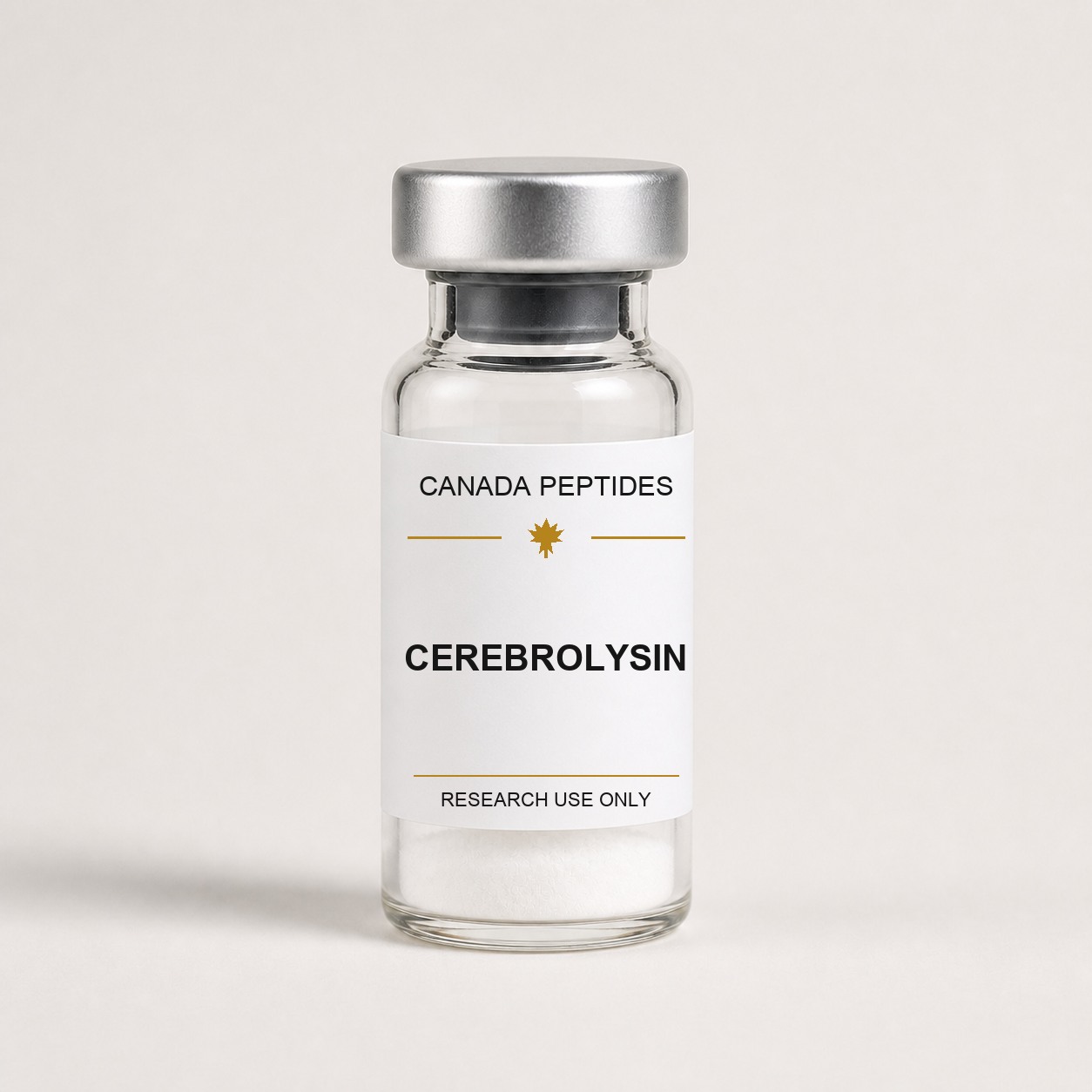
Is it a lyophilised powder like the other peptides here?
The licensed medicine is a ready-to-use sterile solution, not a freeze-dried powder. Research-supply powders advertised under the name are a different presentation from the one the clinical literature studied, and dosing, route and storage guidance from the trials does not transfer to them automatically. The product page covers this in detail.