July 29, 2026·6 min read·GHK-Cu, copper peptide, dosage, reconstitution, pharmacokinetics, skin
GHK-Cu dosage — research dosing notes
A research overview of GHK-Cu dosage: the 0.1–2% topical concentrations used in published trials, the preclinical injected figures, the short circulating half-life, and reconstitution math for lyophilized vials. Literature summary only, not medical advice.
GHK-Cu is the copper(II) complex of glycyl-L-histidyl-L-lysine, a tripeptide first isolated from human plasma in the early 1970s. It is an awkward compound to discuss in dosage terms: its published record is mostly topical, expressed as a formulation percentage, while the systemic literature is almost entirely preclinical and expressed in mg/kg of animal body weight. The two number systems are not interchangeable, and neither maps onto a validated human protocol. What follows summarizes the concentrations in the published work plus the reconstitution arithmetic for lyophilized research vials — a literature overview for laboratory research context only, not a protocol, and not medical, veterinary, or human-dosing advice.
Two different "doses": topical percentage vs. systemic mass
Almost every GHK-Cu clinical result comes from a cream, gel, or serum applied to skin, where the reported variable is the peptide's weight percentage in the vehicle — not a delivered mass. Formulations in the literature and on the market generally sit between roughly 0.1% and 2% GHK-Cu. The controlled wound-healing work used gels toward the higher end: Mulder and colleagues (Wound Repair and Regeneration, 1994) ran a multicentre, randomized, evaluator-blinded, placebo-controlled trial of a GHK-Cu gel in diabetic neuropathic foot ulcers and reported a median area closure of 98.5% versus 60.8% for control care.
The systemic literature is a different animal, literally. Rodent work summarized in Pickart and Margolina's 2018 review (International Journal of Molecular Sciences) used injected doses on the order of 0.5 mg/kg for anti-nociceptive effects in mice and 0.5 mcg/kg for anxiolytic effects in rats — a thousandfold spread across two endpoints, which is itself a warning against reading any single number as "the dose." No registrational human trial anchors a systemic figure.
The concentration-response is not monotonic
More is not simply more. Badenhorst and colleagues exposed human adult dermal fibroblasts to GHK-Cu at 0.01, 1, and 100 nM and measured MMP1, MMP2, TIMP1, and TIMP2 gene expression. The matrix metalloproteinases and their tissue inhibitors moved together in a concentration-dependent way, with the net TIMP-to-MMP ratio — rather than any single transcript — tracking the collagen and elastin synthesis signal. The remodeling behaviour is a balance between matrix breakdown and matrix protection, and that balance shifts with concentration; extrapolating linearly from a low-concentration result to a high one is not supported.
For endogenous context: circulating GHK measures roughly 200 ng/mL (about 10⁻⁷ M) at age 20 and declines to about 80 ng/mL by age 60. Cell-culture effect concentrations sit in that same broad neighbourhood — part of why the compound is framed as a signaling molecule rather than a pharmacological lever.
Half-life and why cadence is poorly defined
GHK-Cu carries no half-life-extending modifications — no fatty-acid acylation, no DAC linker, no PEGylation — and is cleared quickly. Circulating half-life is reported on the order of minutes to about an hour, with degradation via ordinary plasma and tissue aminopeptidases and carboxypeptidases, after which the copper ion dissociates and redistributes onto albumin and ceruloplasmin. Copper(II) redox activity is silenced while the ion is complexed by the tripeptide — the complex has a very high stability constant (log₁₀ ≈ 16.44) — the mechanistic basis for describing it as a non-toxic copper carrier.
The gap, plainly: formal ADME studies of exogenously administered GHK-Cu in humans are sparse, and half-life figures in secondary sources vary by route and species. A short half-life is well supported; a precise number is not. That short residence time is also why topical and locally applied formats dominate the literature — sustained systemic exposure is not something the unmodified molecule provides.
Reconstitution math for lyophilized vials
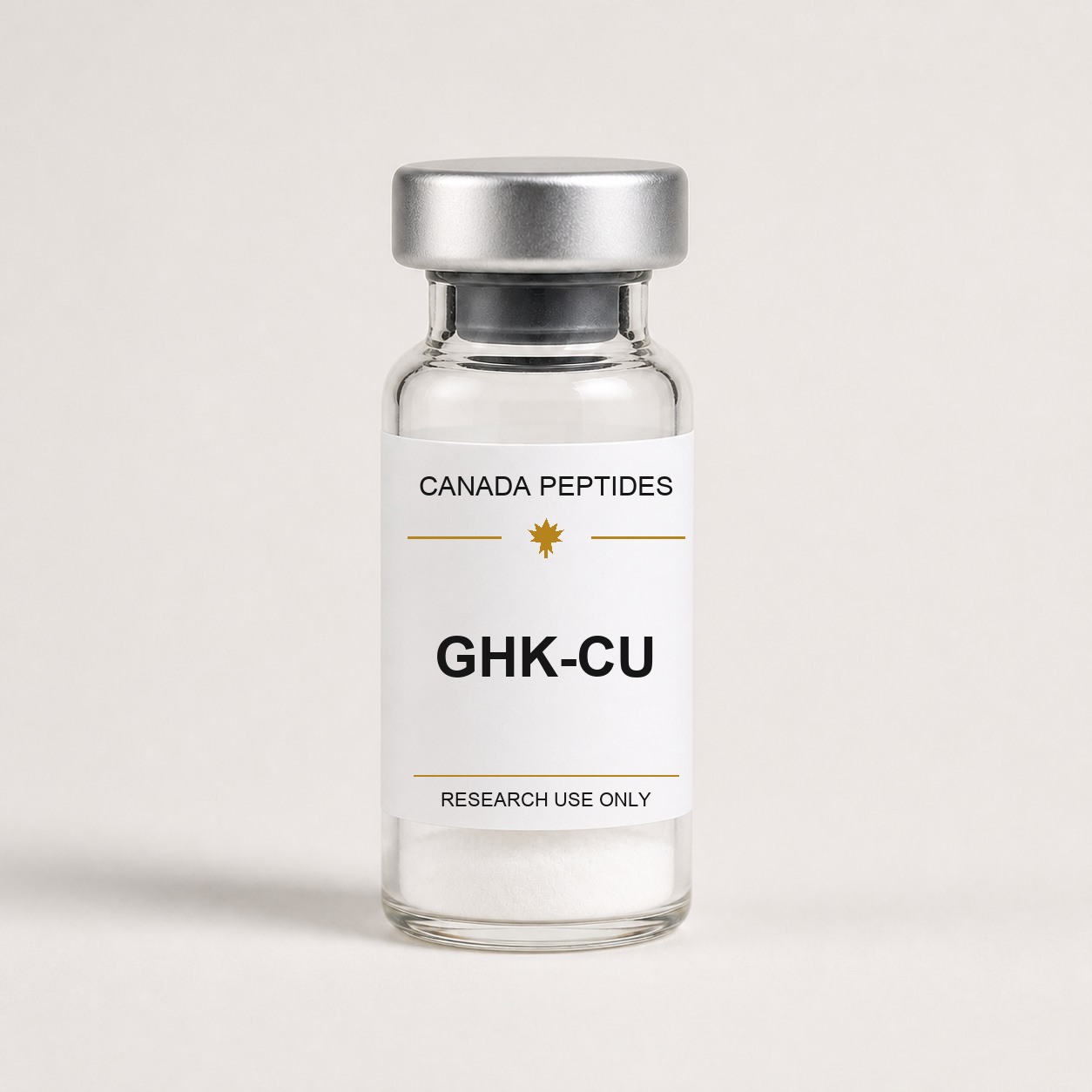
Research-grade GHK-Cu ships as a lyophilized powder reconstituted with bacteriostatic water before any measured handling. The arithmetic is the same as for any peptide: concentration equals total peptide mass divided by solvent volume added.
A worked example, illustrative rather than tied to any particular vial: 50 mg of lyophilized peptide in 5 mL of bacteriostatic water yields 10 mg/mL, so each 10 units on a U-100 insulin syringe (0.1 mL) contains 1 mg. Reconstitute the same 50 mg with 2.5 mL and the concentration doubles to 20 mg/mL, putting 2 mg in that same 10-unit mark. Solvent volume changes only concentration per marked volume, never total peptide present — a bookkeeping choice, so pick a volume that puts working quantities at readable graduations, and use your own vial's stated mass rather than the example. Our dosing math guide covers the mg/mcg/IU conversions, and reconstitution 101 covers solvent selection, swirling versus shaking, and storage. GHK-Cu solutions are characteristically blue from the copper complex, and chelation is sensitive to vehicle pH and composition — formulation choices that disturb it are not cosmetic details.
Data maturity and caveats
GHK-Cu has a long research history and a large descriptive literature, but the dosing record is far less mature than the publication count suggests. Topical percentages are formulation conventions supported by a handful of controlled trials, not a titrated therapeutic range; systemic figures come from rodent models at doses differing by orders of magnitude between endpoints. Decades of topical cosmetic use have not produced reports of serious adverse events, but "no signal in cosmetic use" is not a characterized systemic safety profile, and no formal toxicology package appears in the peer-reviewed reviews. Treat every number here as a description of what has been studied, not as a target.
Frequently asked questions
What concentrations of GHK-Cu appear in the topical literature?
Roughly 0.1% to 2% by weight in the vehicle, with controlled wound-healing trials using gels toward the upper end of that band. These are formulation percentages, not delivered doses.
Is there an established injectable GHK-Cu dose?
No. The injected literature is preclinical — rodent studies at figures such as 0.5 mg/kg (mice, anti-nociception) and 0.5 mcg/kg (rats, anxiolytic endpoints). No registrational human trial establishes a systemic dose.
What is the half-life of GHK-Cu?
Short — reported on the order of minutes to about an hour in circulation, consistent with an unmodified tripeptide cleared by ordinary peptidases. Formal human ADME data is limited, so treat any single figure as approximate.
Does a higher concentration produce a stronger effect?
Not reliably. Fibroblast work at 0.01, 1, and 100 nM showed MMPs and their TIMP inhibitors shifting together, so the remodeling balance changes with concentration rather than scaling linearly with it.
How do I calculate concentration after reconstitution?
Divide total peptide mass by solvent volume. 50 mg in 5 mL gives 10 mg/mL; the same 50 mg in 2.5 mL gives 20 mg/mL. See the dosing math guide. None of this is medical or dosing advice — the compound is for laboratory research use only.