July 17, 2026·5 min read·ipamorelin, dosage, growth hormone secretagogue, peptide research, CJC-1295
Ipamorelin dosage — research dosing notes
A research overview of ipamorelin dosage: the reconstitution math, the intravenous doses and twice-daily cadence reported in the literature, and the ~2-hour half-life context — framed strictly as a laboratory-research reference, not medical advice.
Ipamorelin is a pentapeptide growth-hormone secretagogue (GHS) — a ghrelin-receptor (GHS-R1a) agonist first characterized by Raun and colleagues in 1998 as "the first selective growth hormone secretagogue." Its defining feature in the research literature is selectivity: in preclinical work it stimulated GH release without the elevations in ACTH, cortisol, or prolactin seen with earlier GHRPs such as GHRP-6 and GHRP-2. This page is a research-oriented overview of the dosing parameters reported in the published literature — reconstitution arithmetic, the cadences investigators have used, and the half-life context that shapes them. It is not a protocol and not medical advice.
Half-life and why cadence matters
Human pharmacokinetic work (Gobburu et al., Pharmaceutical Research, 1999) reported a short terminal half-life of roughly 2 hours, a clearance of about 0.078 L/h/kg, and a steady-state volume of distribution near 0.22 L/kg. Growth-hormone release after a dose was pulsatile and transient: a single GH episode peaking at roughly 0.67 hours and declining to negligible concentrations thereafter. Pharmacokinetics were dose-proportional across the range tested.
The short half-life is the single most important fact for understanding reported cadences. Because ipamorelin produces one brief GH pulse rather than a sustained elevation, research protocols that aim to model repeated pulsatility tend to use divided administrations rather than a single daily exposure. This is also the rationale behind co-administration with a longer-acting GHRH analog — see the combination note below.
Doses reported in the literature
Human PK studies administered ipamorelin intravenously across a wide range — approximately 1 to 100 mcg/kg — with a linear (dose-proportional) GH response. The escalation study used infusion rates spanning 4.21 to 140.45 nmol/kg over 15 minutes, with eight healthy male subjects per dose level.
The Phase II postoperative-ileus trial (Beck et al., International Journal of Colorectal Disease, 2014; ClinicalTrials.gov NCT00672074) used intravenous 0.03 mg/kg twice daily in bowel-resection patients over postoperative days 1–7 or until discharge. That trial was terminated for insufficient efficacy on its motility endpoint — a reminder that a dose appearing in a trial reflects what was studied, not what was shown to work.
Note that the human data used the intravenous route, whereas most bench and animal research with GHSs uses subcutaneous administration. Route changes absorption and the effective exposure profile, so IV milligram-per-kilogram figures do not translate directly to subcutaneous work.
Reconstitution arithmetic
Ipamorelin ships lyophilized and must be reconstituted with bacteriostatic water before any measured handling. The arithmetic is identical to any peptide: concentration = peptide mass ÷ diluent volume. Worked example for a common vial size:
A 5 mg vial reconstituted with 2 mL of bacteriostatic water yields 2500 mcg/mL (2.5 mg/mL).
On a U-100 insulin syringe (100 units = 1 mL), each 10-unit mark then corresponds to 250 mcg (0.10 mL × 2500 mcg/mL).
Reconstituting the same 5 mg vial with 1 mL instead doubles the concentration to 5000 mcg/mL, so each 10-unit mark becomes 500 mcg.
Changing the diluent volume changes every downstream measurement, which is why the reconstitution volume should be recorded before any dosing math is done. For the full method and unit conversions, see the dosing math guide and the reconstitution 101 guide.
The CJC-1295 combination in the literature
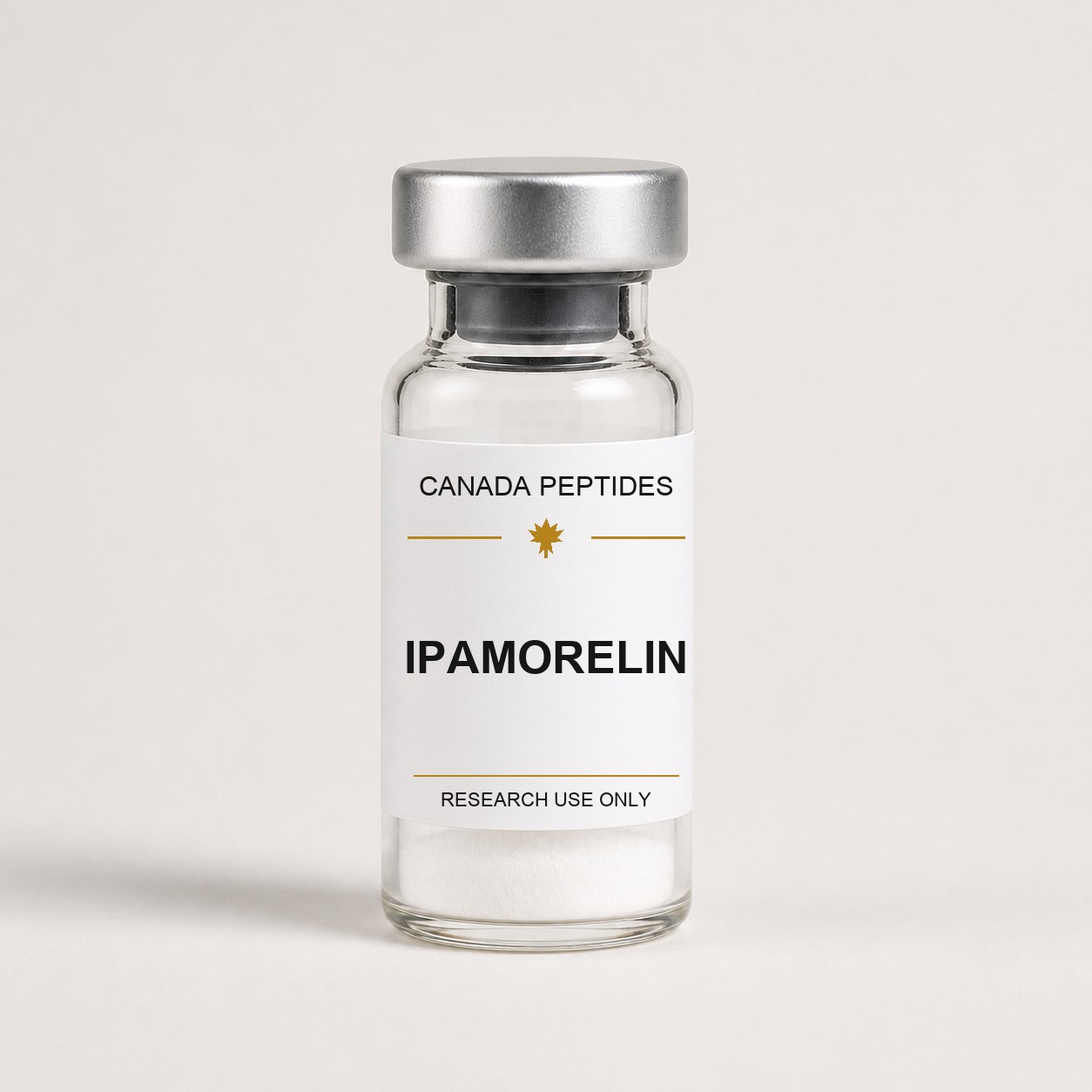
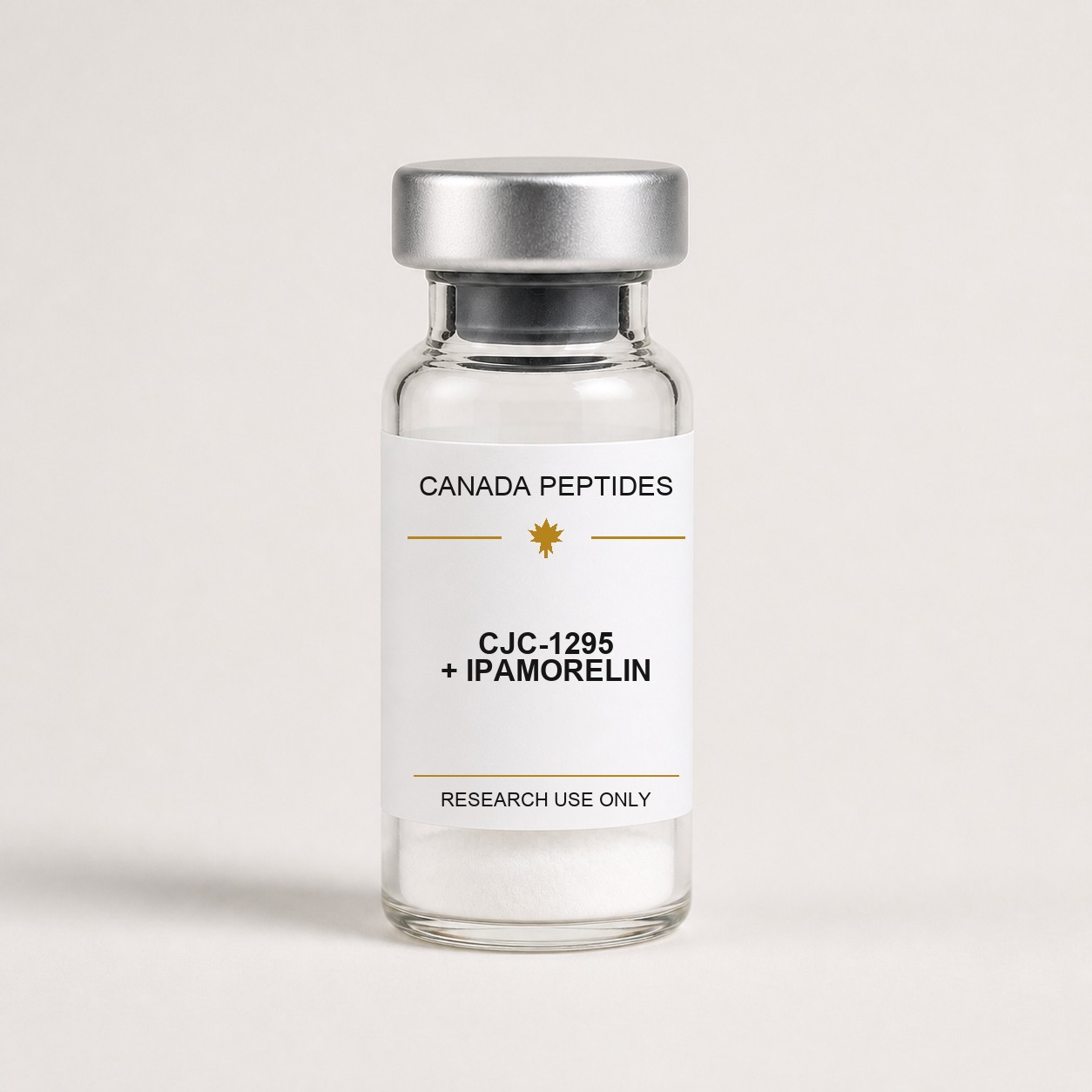
Ipamorelin is frequently studied alongside CJC-1295, a growth-hormone-releasing-hormone (GHRH) analog. The pairing reflects two complementary mechanisms: a GHRH analog raises the GH set-point while a ghrelin-mimetic GHS like ipamorelin triggers a discrete pulse, and the two act on different receptors. Because CJC-1295 (particularly the DAC-bearing form) has a far longer half-life than ipamorelin's ~2 hours, the compounds sit at opposite ends of the duration spectrum — which is exactly why they are combined in research settings. Our pre-blended CJC-1295 + Ipamorelin SKU and the standalone Ipamorelin are both listed for laboratory research use. For the mechanism-level context, see the ipamorelin research overview and the growth-hormone secretagogues category guide.
Data maturity — read this before drawing conclusions
The ipamorelin dosing literature is thin by clinical standards. The human evidence base is essentially a set of single-dose PK/PD studies plus one discontinued Phase II efficacy trial; there are no large, long-term, dose-finding studies establishing a validated regimen for any indication. Where numbers appear precise, that precision reflects a specific study's design, not a settled consensus. Treat every figure here as a literature data point to be verified against the primary source, not a recommendation.
Frequently asked questions
What is ipamorelin's half-life?
Human pharmacokinetic data report a terminal half-life of roughly 2 hours, with a single, transient GH pulse peaking under an hour after administration. This short duration is why the compound is characterized as producing brief, pulsatile GH release rather than sustained elevation.
What doses appear in the published research?
Human PK studies used intravenous doses from about 1 to 100 mcg/kg with a dose-proportional GH response, and a Phase II trial used 0.03 mg/kg intravenously twice daily. These are study parameters, not validated or recommended doses, and the trial route was intravenous rather than subcutaneous.
How is ipamorelin reconstituted?
It arrives lyophilized and is reconstituted with bacteriostatic water. A 5 mg vial in 2 mL of diluent gives 2500 mcg/mL. The general method — and the milligram/microgram/IU conversions behind it — is covered in the dosing math and reconstitution 101 guides.
Why is ipamorelin combined with CJC-1295?
The two act on different receptors — CJC-1295 is a GHRH analog, ipamorelin a ghrelin-receptor agonist — and have very different half-lives, so research protocols pair them to model both a raised GH set-point and a discrete pulse. It is a mechanistic rationale described in the literature, not an endorsed protocol.
Is any of this a dosing recommendation?
No. Ipamorelin is a research-grade material for laboratory use only, not for human or veterinary consumption. Every number here describes what has appeared in scientific studies; none of it is medical advice or a protocol to follow.