August 15, 2026·6 min read·NAD+, dosage, reconstitution, mitochondrial, pharmacokinetics, research
NAD+ dosage — research dosing notes
What the literature actually reports on NAD+ dosage: the 750 mg six-hour intravenous protocol from Grant 2019, the oral NR and NMN dose-ranging trials, why infusion rate matters more than total milligrams, and reconstitution math for a 500 mg vial.
NAD+ dosage — research dosing notes — Canada Peptides
NAD+ dosage is one of the harder numbers to pin down in this catalog. The controlled human data sits almost entirely in two places: slow intravenous infusion of NAD+ itself, and oral precursor trials using nicotinamide riboside (NR) or nicotinamide mononucleotide (NMN). Injectable NAD+ by the subcutaneous route — the format most benchtop protocols use — has essentially no published pharmacokinetic characterisation at all. This page reports what the literature contains, and is explicit about where it stops.
What NAD+ is, and why route dominates the dosing question
NAD+ (nicotinamide adenine dinucleotide) is not a peptide. It is a dinucleotide cofactor — the redox carrier that shuttles electrons through glycolysis, the TCA cycle and oxidative phosphorylation, and the substrate consumed by sirtuins, PARPs and CD38. That biochemistry drives the dosing problem. Extracellular NAD+ is not taken up intact in any meaningful quantity; ectoenzymes, principally CD38, hydrolyse it at the cell surface into nicotinamide and ADP-ribose, which is then re-salvaged intracellularly. Dosing NAD+ is therefore closer to dosing a precursor pool than dosing a receptor ligand, and the dose that matters is the one the salvage pathway can absorb without saturating.
This is why infusion rate, not just total milligrams, appears throughout the literature.
The intravenous data
The most-cited human pharmacokinetic work is Grant et al. (2019), a pilot study in eleven healthy men aged 30–55 (eight test, three saline control). The test group received 750 mg NAD+ intravenously over six hours at roughly 3 μmol/min — about 2 mg/min — for a total of approximately 1,080 μmol delivered.
The result worth carrying forward is the shape of the curve, not the number. No change in plasma NAD+ or its metabolites was detectable for the first two hours; by the six-hour endpoint plasma NAD+ had risen roughly 398% above baseline, with nicotinamide, ADP-ribose and methylnicotinamide rising in parallel at similar magnitudes. Urinary NAD+ and methylnicotinamide excretion increased by six hours, while urinary nicotinamide did not. The authors interpret the pattern as rapid tissue sequestration and metabolism early, followed by saturation and spillover into plasma and urine once uptake capacity is exceeded.
Two readings follow. The six-hour window was reported as what was required to deliver 750 mg without adverse events — a tolerability constraint, not an incidental design choice. And a substantial fraction of an infused dose is metabolised and excreted rather than retained, which caps the return on escalating a single administration.
A more recent retrospective tolerability pilot compared intravenous NAD+ against intravenous NR in a real-world clinic setting, with reported protocols in the 500 mg range over consecutive days. It is retrospective and uncontrolled, so it speaks to tolerability patterns rather than to efficacy or to an optimal dose.
The oral precursor data
Precursor trials are where dose-response is actually characterised, and the endpoint — whole-blood NAD+ — is the one injectable protocols implicitly target.
NR, open-label PK: eight healthy volunteers escalated from 250 mg on days 1–2 to a peak of 1,000 mg twice daily by days 7–8, establishing dose-dependent blood NAD+ elevation.
NR, randomised: an 8-week placebo-controlled trial in overweight adults compared 100, 300 and 1,000 mg daily and reported whole-blood NAD+ increases of roughly 22%, 51% and 142% within two weeks — dose-dependent, and clearly non-linear.
NMN, dose-ranging: a 60-day double-blind trial in 80 middle-aged adults compared placebo against 300, 600 and 900 mg daily, with blood NAD+ highest in the 600 mg and 900 mg arms.
NMN, upper-bound safety: 31 healthy adults, 1,250 mg once daily for up to four weeks, reported safe and well tolerated with haematology, biochemistry and urinalysis within normal variation.
The pattern across all four is the same: blood NAD+ responds to dose, but with diminishing returns as the salvage pathway saturates. Nothing in this set validates a milligram-equivalent conversion to an injected NAD+ dose — the routes, the molecules and the first-pass handling all differ.
Where the data stops: subcutaneous NAD+
There is no published pharmacokinetic study characterising subcutaneous NAD+ in humans comparable to Grant 2019. Figures circulating for that route — small starting quantities titrated upward, divided across several administrations per week rather than given as one bolus — come from clinic practice notes and vendor material, not peer-reviewed pharmacokinetics. Treat them as convention, not evidence.
The mechanistic point that is well supported: the rate-limiting problem with NAD+ is delivery speed. Rapid intravenous administration is consistently associated with flushing, nausea, chest tightness and cramping during infusion, and slowing the rate is the standard mitigation. A depot route spreads absorption over hours by construction — but "plausible mechanism" is not "characterised pharmacokinetics," and that distinction should survive into any protocol design.
Reconstitution math for a 500 mg vial
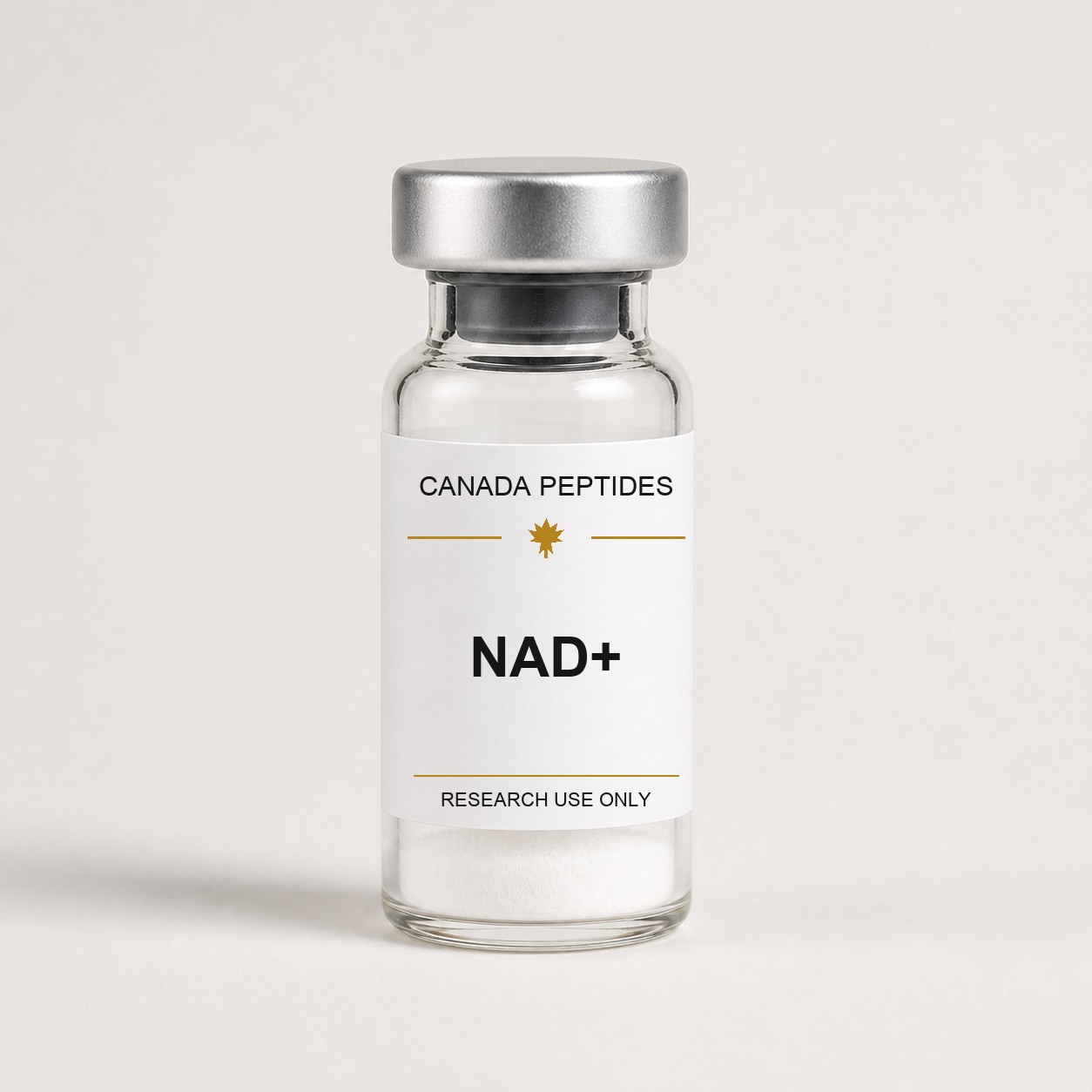
NeuroForge supplies NAD+ 500 mg as a lyophilised vial. The arithmetic is the same as for any lyophilised compound — see Peptide dosing math and Reconstitution 101 for the full method and technique.
With 500 mg reconstituted in 5 mL of bacteriostatic water, concentration is 100 mg/mL:
0.10 mL (10 units on a U-100 syringe) = 10 mg
0.25 mL (25 units) = 25 mg
0.50 mL (50 units) = 50 mg
1.00 mL (100 units) = 100 mg
At 100 mg/mL small volume errors carry large absolute error; reconstituting the same vial in 10 mL gives 50 mg/mL and halves that sensitivity at the cost of injection volume. NAD+ solutions are less stable than most peptide solutions and pH-sensitive — refrigerate immediately, protect from light, and treat working solutions as short-lived rather than assuming multi-week stability. Route selection carries its own pharmacokinetic consequences: see subcutaneous vs intramuscular injection.
For mechanism, the sirtuin and CD38 biology, and where NAD+ sits against the mitochondrial peptides, see the NAD+ research overview.
Frequently asked questions
What NAD+ dosage is used in published human research?
The best-characterised human protocol is 750 mg intravenously over six hours at approximately 2 mg/min (Grant et al., 2019, n=11). Retrospective clinic data describes infusions in the 500 mg range over consecutive days. Oral precursor trials use different molecules entirely — 100–1,000 mg daily for nicotinamide riboside, 250–1,250 mg daily for NMN.
Is there a subcutaneous NAD+ dosage supported by published pharmacokinetics?
No. No peer-reviewed study characterises subcutaneous NAD+ pharmacokinetics in humans at a level comparable to the intravenous data. Figures circulating for that route are practice convention, not published evidence, and should be labelled as such in any protocol documentation.
Why is infusion rate emphasised more than total dose?
Because extracellular NAD+ is hydrolysed at the cell surface and salvaged intracellularly, and that pathway saturates. Grant et al. observed no plasma change for two hours — consistent with tissue uptake — followed by a sharp rise and increased urinary excretion once capacity was exceeded. Delivering the same milligrams faster increases the metabolised-and-excreted fraction and is associated with worse acute tolerability.
How does the 500 mg vial reconstitute?
500 mg in 5 mL of bacteriostatic water gives 100 mg/mL; 500 mg in 10 mL gives 50 mg/mL. The lower concentration is easier to measure accurately at small target volumes. See the dosing math guide.
Is NAD+ a peptide?
No. It is a dinucleotide cofactor, not a peptide, and it does not act through a receptor in the way the growth-hormone secretagogues or GLP-1 analogues do. It is grouped with research peptides commercially, not biochemically.