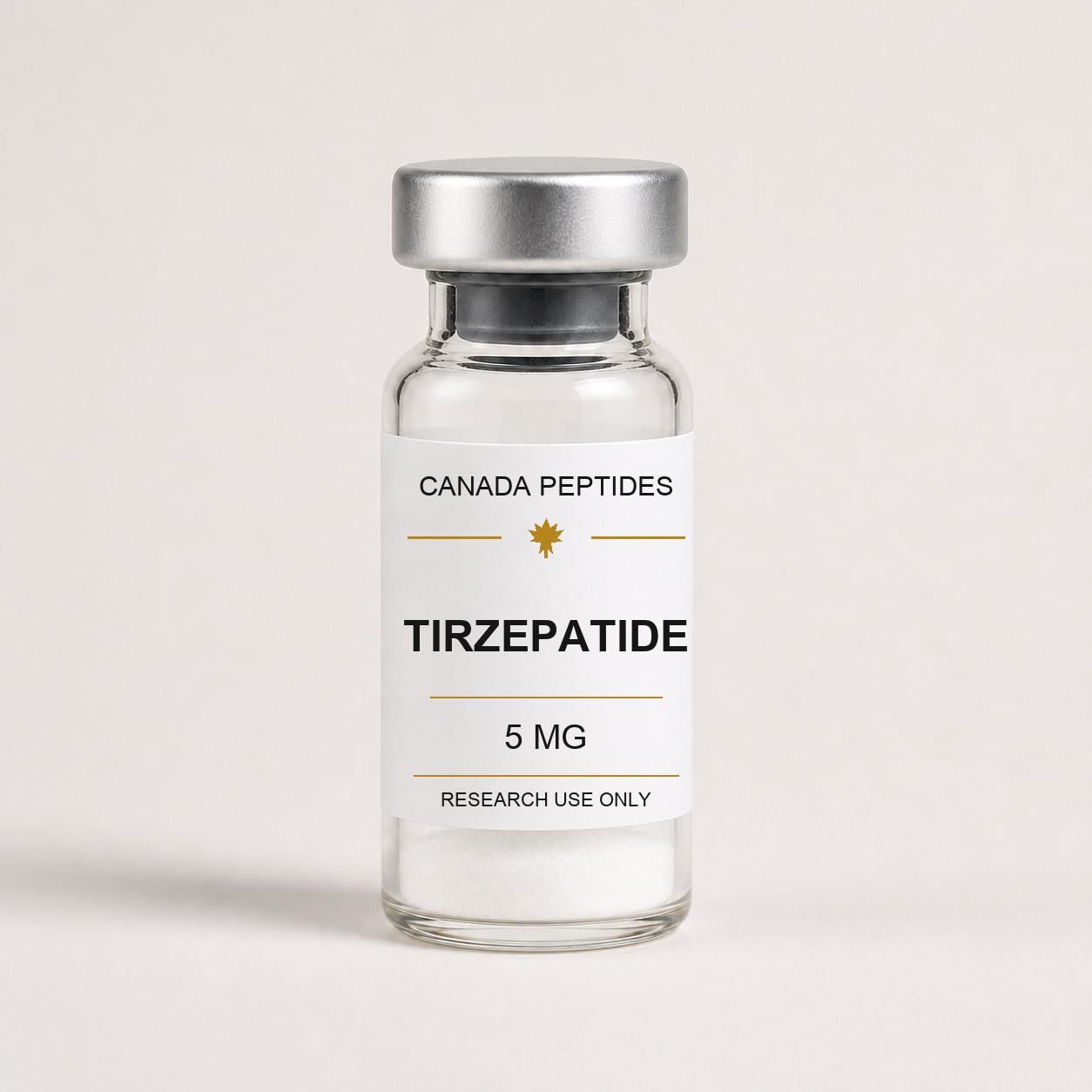
What is tirzepatide?
Tirzepatide is a dual agonist — a single peptide that binds both the GLP-1 receptor and the GIP (glucose-dependent insulinotropic polypeptide) receptor. That second receptor is what separates it from semaglutide, which acts on GLP-1 alone. It is the molecule that Eli Lilly markets under the brand names Mounjaro and Zepbound.
That is a statement of fact about the molecule, and it's worth being precise about what it doesn't mean. This vial is not Mounjaro, not Zepbound, and not a generic of either. It is research-grade tirzepatide supplied for laboratory research use only.
Prescription medicine and research-grade material are not the same thing
Approved tirzepatide is a prescription medicine. It carries a DIN, a Health Canada-approved product monograph, and pharmacist dispensing against a prescription, and every lot is manufactured under GMP with regulatory oversight.
Research-grade tirzepatide — what this vial is — has none of that: no DIN, no monograph, no prescribing information, no regulatory review. It is sold for laboratory research. It is not a substitute for a prescription product, not a cheaper route to the same thing, and not something to self-administer. If you're looking for tirzepatide as a medicine, the route is a licensed prescriber and a pharmacy.
What's in this vial
| Spec | Detail |
|---|
| Contents | 5 mg tirzepatide, lyophilised (freeze-dried) powder |
| Form | Sealed single vial, sterile stoppered |
| Purity | ≥98% by HPLC |
| Receptors | GLP-1 / GIP (dual agonist) |
| Ships | Canada-wide, priced in CAD |
| Not included | Bacteriostatic water, syringes — ordered separately |
A 5 mg tirzepatide vial is not a 5 mg semaglutide vial
This is the single most useful thing to understand before buying, and it catches people cross-shopping the two.
Tirzepatide is handled in amounts roughly ten times larger than semaglutide. Research cadences for semaglutide start around 0.25 mg; for tirzepatide they start around 2.5 mg. The vials look identical and the prices are close, but they do not last remotely the same length of time:
| Semaglutide 5 mg | Tirzepatide 5 mg |
|---|
| Typical starting amount | 0.25 mg | 2.5 mg |
| Aliquots at that amount | ~20 | 2 |
A 5 mg tirzepatide vial holds about two aliquots at the low end of its range. That is what it is — a small vial of a compound used in large amounts. Buy accordingly, and don't assume it behaves like the semaglutide vial sitting next to it.
Reconstituting a 5 mg vial — the water volume matters here
The default 2 mL produces workable but awkward arithmetic:
5 mg ÷ 2 mL = 2.5 mg/mL
At that concentration a 2.5 mg amount is 1.0 mL — a full 100-unit insulin syringe, drawn to the very top of the barrel. It works, but there is no headroom, and anything above 2.5 mg needs more than one syringe.
Using 1 mL of bacteriostatic water instead gives 5 mg/mL, which halves every volume:
| Amount | At 2.5 mg/mL (2 mL water) | At 5 mg/mL (1 mL water) |
|---|
| 2.5 mg | 1.00 mL — 100 units | 0.50 mL — 50 units |
| 5 mg | 2.00 mL — two syringes | 1.00 mL — 100 units |
The trade-off is resolution: at 5 mg/mL a single syringe unit is 0.05 mg, versus 0.025 mg at 2.5 mg/mL. For amounts this large that rarely matters, which is why the smaller water volume is usually the more practical choice for this vial.
Decide before you add water — it can't be undone once the powder dissolves. Run your figures through the dosage calculator first, and see the dosing-math guide if unit conversion isn't second nature.
Storage and handling
Refrigerate the lyophilised vial at 2–8 °C; it ships dry because the powder tolerates ambient transit. Once reconstituted, refrigerate and use within about 30 days — though at two aliquots per vial, this one usually empties long before the window closes.
Bacteriostatic water (0.9% benzyl alcohol) permits multiple draws; sterile water has no preservative and is single-use. Don't freeze reconstituted solution, keep vials out of light, and discard anything cloudy or containing particulate. See the storage guide and the reconstitution walkthrough.
Is tirzepatide legal in Canada?
Tirzepatide as a medicine is legal and approved — Health Canada has authorised it, and it is dispensed on prescription.
Research-grade tirzepatide sits elsewhere. It has no marketing authorisation, and it may be sold and shipped domestically for laboratory research use only. It may not be marketed, supplied, or represented as a therapeutic product for human use, and nothing here does so. We ship within Canada only.
Tirzepatide and anti-doping
Athletes subject to anti-doping rules should verify tirzepatide's status against the current WADA Prohibited List before use, and confirm with their anti-doping officer rather than relying on a vendor's page — including this one. The list is revised annually.
Note this is a different question from the one that applies to retatrutide, which has no regulatory approval anywhere and therefore falls inside WADA's S0 (non-approved substances) category.
Where tirzepatide sits
Receptor breadth is the variable that usually distinguishes the incretin peptides in a research protocol:
- Semaglutide — single agonist, GLP-1 only.
- Tirzepatide — dual agonist, GLP-1 and GIP.
- Retatrutide — triple agonist, GLP-1, GIP, and glucagon.
Side-by-side breakdowns: tirzepatide vs semaglutide and retatrutide vs tirzepatide. For the compound in full, see the tirzepatide hub.
Frequently asked questions
Is research-grade tirzepatide the same as Mounjaro?
No. Mounjaro is an approved prescription medicine with a DIN, a Health Canada-approved product monograph, and regulatory oversight of every lot. Research-grade tirzepatide has none of those and is supplied for laboratory research use only. They are different categories of product, not two versions of the same one.
How many doses are in a 5 mg tirzepatide vial?
About two, at the 2.5 mg starting amount typical of tirzepatide research cadences. Tirzepatide is handled in roughly ten times the amounts semaglutide is, so a 5 mg tirzepatide vial goes about a tenth as far as a 5 mg semaglutide vial despite looking identical.
How much bacteriostatic water should I use for a 5 mg tirzepatide vial?
2 mL gives 2.5 mg/mL, which puts a 2.5 mg amount at a full 100-unit syringe. 1 mL gives 5 mg/mL and halves that to 50 units, at the cost of coarser resolution (0.05 mg per unit rather than 0.025 mg). For amounts this large the smaller volume is usually more practical. Decide before adding water — it cannot be undone.
What is the difference between tirzepatide and semaglutide?
Tirzepatide is a dual agonist acting on both the GLP-1 and GIP receptors; semaglutide is a single agonist acting on GLP-1 only. They are also handled in very different amounts — tirzepatide roughly ten times higher. See the tirzepatide vs semaglutide comparison.
Is tirzepatide legal in Canada?
Tirzepatide is approved by Health Canada as a prescription medicine and is legal in that form. Research-grade tirzepatide has no marketing authorisation and may be sold domestically for research use only — it cannot be supplied or represented as a therapeutic product.
How should tirzepatide be stored?
Keep the lyophilised vial refrigerated at 2–8 °C. Once reconstituted, refrigerate and use within about 30 days, keep it out of light, and do not freeze it. Discard any solution that turns cloudy or shows particulate.
Do you ship tirzepatide across Canada?
Yes — Canada-wide, priced in CAD, with a flat $25 shipping rate. We do not ship to the United States or internationally.