August 15, 2026·7 min read·glutathione, dosage, reconstitution, antioxidant, pharmacokinetics, research
Glutathione dosage — research dosing notes
What the literature reports on glutathione dosage: the ~14-minute intravenous half-life, the 600 mg and 1,400 mg IV Parkinson's protocols, the six-month oral dose-response trial, and reconstitution math for a 600 mg vial.
Glutathione dosage is hard to reason about for pharmacokinetic rather than clinical reasons. Infused glutathione clears from plasma in minutes. Swallowed glutathione is largely dismantled before it reaches circulation. The published dose figures come from three routes that are not interchangeable, and the injectable route most benchtop protocols use — subcutaneous or intramuscular — has the least published characterisation of the three. This page reports what the literature contains and is explicit about where it stops.
Why the molecule sets the dosing problem
Glutathione (GSH) is a tripeptide of glutamate, cysteine and glycine, joined by an unusual γ-glutamyl bond rather than the standard α-peptide linkage. That bond resists ordinary peptidases; the molecule is instead cleaved by γ-glutamyltransferase (GGT), an ectoenzyme concentrated at the intestinal and renal brush borders and in the liver.
Two consequences drive every figure below. Exogenous glutathione is not taken up intact by cells in meaningful quantity — it is cleaved extracellularly, and the constituent amino acids, cysteine above all, are re-imported and re-synthesised into GSH intracellularly. Dosing glutathione is closer to dosing a cysteine delivery vehicle than a receptor ligand. And GGT-rich tissue strips it rapidly, which is why plasma exposure is measured in minutes.
The intravenous pharmacokinetics
The reference human dataset is Aebi and colleagues (European Journal of Clinical Investigation, 1991), who infused 2 g/m² in healthy volunteers. Total plasma glutathione rose from roughly 17.5 μmol/L to approximately 823 μmol/L, then fell with an elimination half-life of about 14 minutes (14.1 ± 9.2 min). Volume of distribution was roughly 176 mL/kg — near plasma volume, consistent with a compound that does not distribute into cells intact.
Earlier rat work (Ammon et al., 1986) showed the elimination half-life shortening from about 52 minutes to about 11 minutes as dose increased — the signature of capacity-limited handling rather than simple first-order clearance.
The practical reading: an injected dose produces a brief spike, not a sustained level. Cadence questions framed as "how often to maintain a plasma concentration" are ill-posed for this compound. What repeated administration plausibly modulates is the intracellular synthesis pool, over weeks — which is what the oral trials measure.
Injectable dose figures in the clinical literature
Published intravenous dosing clusters in a narrow band, almost all from Parkinson's disease research:
Sechi et al. (1996) — 600 mg twice daily intravenously for 30 days in nine patients with early untreated Parkinson's disease. Open-label and uncontrolled; the reported ~42% decline in disability scores has no placebo comparison and should be weighted accordingly.
Hauser et al. (2009) — randomised, double-blind, placebo-controlled pilot: 1,400 mg intravenously three times weekly for four weeks. Well tolerated, with no withdrawals for adverse events in either arm. A pilot, not powered for efficacy, and it did not establish superiority over placebo.
Mischley et al. (2017) — Phase IIb intranasal trial comparing 300 mg/day and 600 mg/day against placebo over 12 weeks in 45 participants. The high-dose arm improved on within-group UPDRS measures, but neither treatment arm was superior to placebo; the placebo group improved unusually robustly. One high-dose participant withdrew with cardiomyopathy, which the authors raised as a possible reductive-stress signal warranting cardiac screening in future work.
The largest controlled trial in this set is a negative one, and it flagged a plausible harm mechanism from antioxidant overabundance. "Antioxidant" does not mean "dose-insensitive."
Where the data stops
There is no published human pharmacokinetic study characterising subcutaneous or intramuscular glutathione at a level comparable to the intravenous work. Depot-route figures in circulation — typically a few hundred milligrams two or three times weekly — are practice convention and vendor material, not peer-reviewed pharmacokinetics. A depot route would be expected to blunt the peak and extend absorption relative to a bolus, but that is mechanistic inference, not measurement.
A larger caution applies to cosmetic use, the dominant search context for "glutathione injection." There are no published clinical trials establishing dosing regimens or treatment duration for injectable glutathione as a skin-lightening agent, and no regulator has approved an injectable product for that purpose. The Philippine FDA has issued repeated advisories on unapproved injectable glutathione, citing reports of hepatic, renal and neurological toxicity, severe cutaneous reactions including Stevens–Johnson syndrome and toxic epidermal necrolysis, anaphylaxis, and infection risk from non-sterile administration. No dose figure is reported here because no controlled trial has established one.
Oral dose-response
The one place a genuine dose-response curve exists is oral supplementation, measured against body stores rather than plasma spikes.
Richie et al. (2015, European Journal of Nutrition) randomised 54 adults to 250 mg/day, 1,000 mg/day or placebo for six months with a one-month washout. Both doses raised stores dose- and time-dependently: roughly 30–35% increases in erythrocyte, plasma and lymphocyte GSH at 1,000 mg/day and 17–29% at 250 mg/day, with a much larger rise in buccal-cell GSH. Natural killer cell cytotoxicity roughly doubled versus placebo at three months. All values returned toward baseline after washout — the effect is maintenance-dependent, not durable.
Single-dose oral work looks different: a 3 g bolus failed to move plasma glutathione at all. Chronic low-dose administration builds stores; acute dosing does not raise plasma. Liposomal formulations have since been reported to raise body stores at lower nominal doses, consistent with GGT bypass being the limiting step.
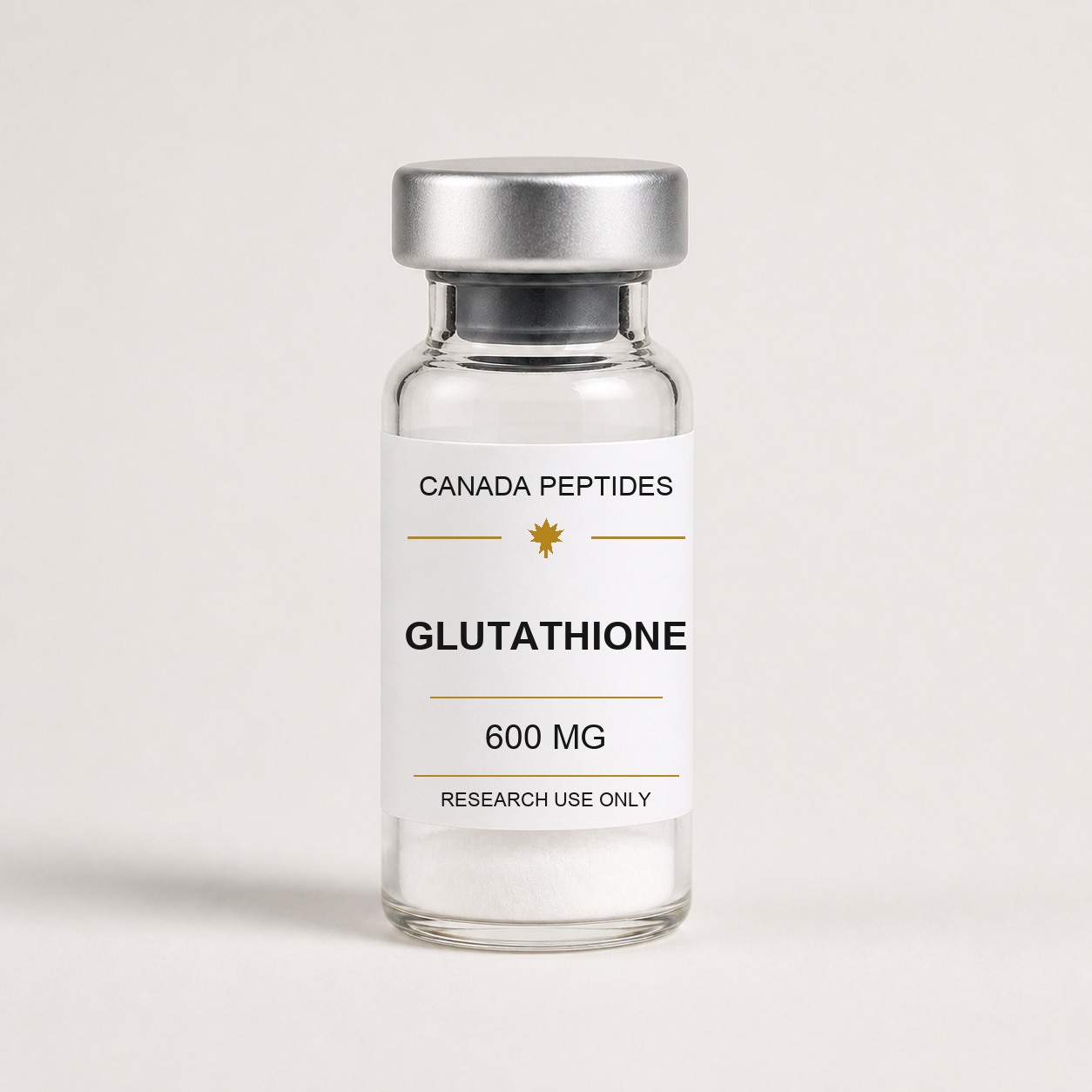
With 600 mg reconstituted in 2 mL of bacteriostatic water, concentration is 300 mg/mL:
0.17 mL (17 units on a U-100 syringe) ≈ 50 mg
0.33 mL (33 units) ≈ 100 mg
0.67 mL (67 units) ≈ 200 mg
1.00 mL (100 units) = 300 mg
2.00 mL (full vial) = 600 mg
At 300 mg/mL a single syringe unit is 3 mg, so small-volume measurement is comparatively forgiving — the opposite of the microgram-scale secretagogues. Reconstituting in 3 mL gives 200 mg/mL if larger, easier-to-read volumes are preferred.
Stability is the real constraint. The free thiol oxidises to the disulfide GSSG in aqueous solution, accelerated by dissolved oxygen, trace metal ions, light and warmth. Lyophilised powder is comparatively stable; solution is not. A partly oxidised vial no longer contains the labelled quantity of reduced glutathione, so analytical assumptions degrade along with potency. Refrigerate immediately, protect from light, minimise headspace, and treat working solutions as short-lived. Route selection carries its own consequences: see subcutaneous vs intramuscular injection.
What glutathione dosage appears in published human research?
Intravenous protocols cluster at 600 mg twice daily (Sechi 1996, open-label, n=9) and 1,400 mg three times weekly (Hauser 2009, randomised pilot). Intranasal work used 300 mg/day and 600 mg/day (Mischley 2017). Oral trials used 250 mg/day and 1,000 mg/day over six months (Richie 2015). Different routes, different handling — not milligram-equivalent.
Why is the half-life relevant to dosing frequency?
Because it is roughly 14 minutes in plasma after intravenous administration. No practical injection cadence maintains a plasma level. What repeated administration plausibly influences is the intracellular synthesis pool over weeks — which is why the oral trials measuring body stores ran for six months, and why their effect disappeared after a one-month washout.
Is there pharmacokinetic data for subcutaneous or intramuscular glutathione?
No. Human characterisation exists for the intravenous route; the depot routes have no comparable published dataset. Circulating figures are convention rather than evidence and should be labelled as such in any protocol documentation.
How does the 600 mg vial reconstitute?
600 mg in 2 mL of bacteriostatic water gives 300 mg/mL; 600 mg in 3 mL gives 200 mg/mL. See the dosing math guide.
Does oxidation change the effective dose?
Yes. Reduced glutathione converts to GSSG in solution over time, so a reconstituted vial's reduced-glutathione content declines even where total peptide mass does not. Refrigeration, light protection and minimal air exposure slow but do not stop the process.
Glutathione dosage — research dosing notes — Canada Peptides