September 23, 2026·6 min read·glutathione, side effects, safety, antioxidant, tripeptide, peptide research, canada
Glutathione side effects — what the research reports
Glutathione side effects by evidence tier: what oral, intravenous, intranasal and inhaled trials recorded, the regulatory alerts on unapproved IV use, and why the vial matters as much as the molecule.
Glutathione is an endogenous tripeptide — γ-Glu-Cys-Gly — present at millimolar concentration in every cell, which is the first thing said in its favour whenever tolerability comes up. It is a fair point about the molecule and a weak one about the product: the serious adverse-event reports attached to glutathione come from unapproved intravenous use and from contaminated injectable material, not from the tripeptide's biochemistry. This page separates the controlled trials, by route, from the regulatory alerts and the theoretical concerns. It is a research reference beside the Glutathione profile, not advice.
What the oral trials reported
Richie and colleagues' randomised, placebo-controlled trial in the European Journal of Nutrition (2015) gave 250 mg or 1,000 mg of oral glutathione daily for six months to healthy adults and reported increased glutathione in blood and buccal cells with no serious adverse events; occasional gastrointestinal upset is the recurring minor finding in oral studies. A 2018 trial of a liposomal formulation in the European Journal of Clinical Nutrition, at 500 and 1,000 mg daily for four weeks, reported the same tolerability. The 2012 placebo-controlled skin trial in the Journal of Dermatological Treatment, 500 mg daily for four weeks, likewise recorded no adverse events of note.
Set against these is the 1992 finding in the European Journal of Clinical Pharmacology that a 3 g oral dose did not raise plasma glutathione at all — a bioavailability question rather than a safety one, but a reminder that an oral dose the gut breaks into amino acids is a mild exposure by definition. Oral tolerability is the best-supported tier and the one least relevant to an injectable vial.
What the intravenous trials reported
The 1991 pharmacokinetic study in the European Journal of Clinical Investigation infused gram-scale glutathione into healthy volunteers, followed plasma glutathione and cysteine, and reported the roughly 10–15-minute plasma half-life that the half-life calculator models; it did not report adverse effects. The controlled clinical record is the 2009 randomised, double-blind pilot in Movement Disorders: 21 patients with Parkinson's disease received 1,400 mg intravenously three times weekly for four weeks, and the authors reported no serious adverse events attributable to glutathione while the efficacy endpoint was not met. The earlier open-label study, 600 mg twice daily for 30 days in nine patients, also reported tolerability without incident. Small trials alongside cisplatin and oxaliplatin chemotherapy reported the same.
That is a genuine intravenous safety record, and it is small: a few dozen patients, short courses, in clinical settings with pharmaceutical-grade material. The Glutathione research overview discusses what those trials showed about efficacy, and the Glutathione dosage notes tabulate the amounts by route.
Intranasal and inhaled
The Phase IIb study of intranasal glutathione in Parkinson's disease, published in the Journal of Parkinson's Disease in 2017, gave 300 or 600 mg daily for three months, showed CNS uptake on magnetic-resonance spectroscopy, and did not separate from placebo on the primary clinical endpoint; tolerability was acceptable. Inhaled glutathione is the one route with a specific adverse signal: bronchospasm has been reported in some asthmatic subjects, and a 2013 multicentre inhaled trial in cystic fibrosis found no benefit on its primary endpoint. Inhaled data does not bear on injection, but it shows that a route can carry its own reaction even for an endogenous molecule.
The regulatory alerts
The serious reports come from outside the trials. Intravenous glutathione for skin whitening, widely offered in parts of Asia and increasingly in North American clinics, was the subject of a 2011 Philippine Food and Drug Administration advisory describing severe skin reactions, thyroid dysfunction, kidney dysfunction and, in reports, Stevens–Johnson syndrome, and stating that the use is unapproved. No controlled trial of intravenous glutathione for pigmentation exists.
In 2019 the U.S. FDA alerted clinicians to serious adverse events — nausea, vomiting, hypotension and respiratory distress — in patients who received compounded glutathione injections made from a bulk active ingredient with high endotoxin levels. That was a manufacturing-quality event rather than a pharmacological one, and it is the clearest illustration in the peptide literature of why the vial can matter more than the molecule.
Theoretical concerns
Glutathione is a strong reducing agent and the conjugating substrate for many drug-metabolism reactions. At high dose it could in principle interfere with therapies that depend on oxidative stress, including some chemotherapy and radiotherapy — the reason its use alongside platinum drugs was studied cautiously — and could alter the handling of drugs cleared through glutathione S-transferases. N-acetylcysteine feeds the same pathway, so a design using both is dosing one system twice. None of these has been demonstrated in a controlled setting; formal interaction studies at supplementation doses do not exist.
Purity as a confound
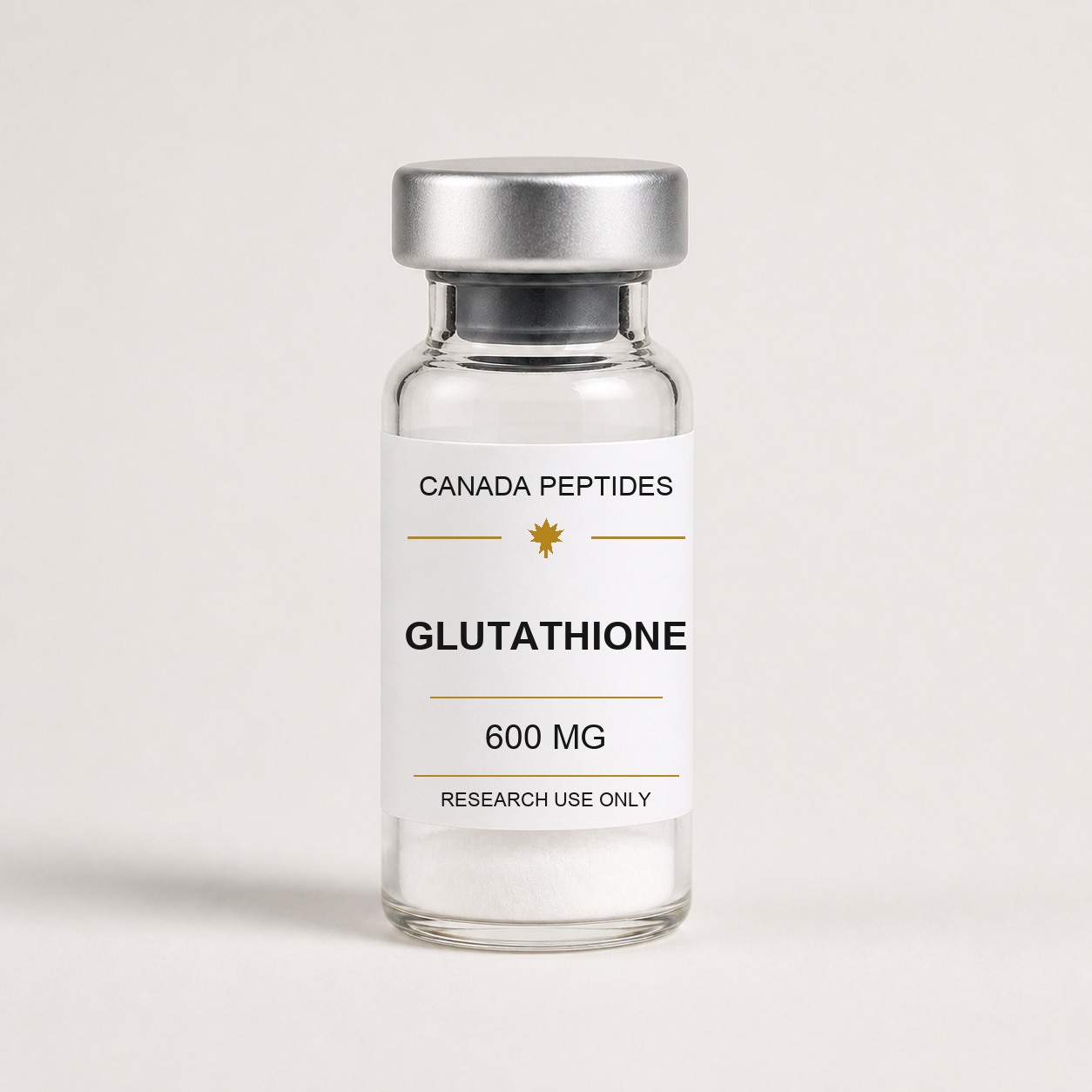
Glutathione's free thiol oxidises in solution to the disulfide GSSG, and moisture starts the process in the powder. A vial reconstituted and stored for weeks, left with a large air headspace or shipped warm will contain a rising GSSG fraction; a yellow tint, cloudiness or precipitate marks it. A good certificate of analysis reports GSSG content alongside HPLC purity and endotoxin, and reading it is the only way to separate compound effects from product effects — the 2019 FDA alert is the case study. See lab testing and COAs and the cold-chain and shelf-life guide. The 600 mg glutathione vial sold here is third-party HPLC tested by lot.
Regulatory and sport status
Glutathione's Canadian status depends on route. As an oral ingredient it appears in Health Canada's Natural Health Products Ingredients Database and licensed oral products carry an NPN; no injectable glutathione holds a Drug Identification Number or market authorisation, and research-grade material is sold in Canada for laboratory use only. In the United States glutathione sits in category 1 of the FDA's section 503A bulk-substance evaluation, meaning it may be compounded while review continues, and it is a lawful dietary-supplement ingredient. Glutathione is not on the WADA Prohibited List, though intravenous infusions above 100 mL in a 12-hour period are prohibited under M2 regardless of the substance infused.
Frequently asked questions
Does glutathione have a documented side-effect profile?
By route, yes, and small. Oral trials up to 1,000 mg daily for six months reported occasional gastrointestinal upset; the 2009 intravenous Parkinson's trial reported no serious adverse events at 1,400 mg three times weekly; inhaled glutathione has been associated with bronchospasm in some asthmatics.
Where do the serious adverse-event reports come from?
From unapproved intravenous use for skin whitening, described in a 2011 Philippine FDA advisory, and from a 2019 U.S. FDA alert about compounded injections made with endotoxin-contaminated bulk material.
Does the oral safety data apply to injections?
No. Most of an oral dose is broken into amino acids before it reaches circulation, so it is a different exposure from an intravenous or intramuscular dose of the intact tripeptide.
Is glutathione approved for injection in Canada?
No. Oral glutathione is a licensed natural health product ingredient; no injectable product holds a DIN.
Is this medical advice?
No. This page summarises published research for laboratory reference. It is not medical advice, not a safety assurance, and not a dosing recommendation. Glutathione is sold here for research use only.
Glutathione side effects — what the research reports — Canada Peptides