September 23, 2026·6 min read·hcg, human chorionic gonadotropin, side effects, safety, peptide research, canada
HCG side effects — what the research reports
hCG side effects by evidence tier: the approved-product monograph (OHSS, gynaecomastia, oedema, injection-site reactions), the small adjunct trials, and the gaps for research-grade material.
HCG side effects — what the research reports — Canada Peptides
Human chorionic gonadotropin has the most complete safety record of anything in this catalogue, because it has been a prescribed medicine for the better part of a century. That is both the strength and the catch: the adverse-reaction profile is real and regulator-reviewed, and it belongs to specific approved products, given under supervision at labelled doses. This page keeps the tiers separate: what the monograph reports, what the small off-label studies add, what uncontrolled self-report claims, and what none of it says about research-grade material. It sits beside the HCG profile as a research reference, not advice.
Where the safety record comes from
Urinary-derived pharmaceutical hCG has been an approved medicine since the 1930s; recombinant choriogonadotropin alfa followed in the early 2000s. In Canada, Pregnyl (Organon) and Ovidrel (EMD Serono) hold DINs and Health Canada market authorisations for fertility indications. The adverse-reaction sections of those monographs, plus decades of post-marketing experience, are the top evidence tier — and they describe products manufactured to a monograph, potency-tested and sterile-filled. The hCG research overview covers the endocrinology behind the effects.
What the approved-product monographs report
Women. The principal serious risk is ovarian hyperstimulation syndrome — ovarian enlargement, ascites and fluid shifts that can, rarely, be life-threatening. hCG's day-long half-life means a trigger dose stimulates the ovary for days, which is why it is the principal cause of OHSS in assisted reproduction and why the trigger is monitored by ultrasound — and why kisspeptin, which produces a short, self-limiting LH surge, was trialled as an alternative. Arterial and venous thromboembolic events have been reported with gonadotropin therapy, usually with hyperstimulation.
Men. Sustained LH-receptor stimulation raises oestradiol alongside testosterone via aromatase. Gynaecomastia, oedema, mood changes and acne are the labelled consequences, and testicular pain is reported. By raising both, hCG also feeds back to suppress pituitary LH further.
Boys. In cryptorchidism, a historical indication, premature puberty and testicular changes were the concerns that pushed practice toward surgery.
All uses. Injection-site reactions, headache and fatigue are common across indications; urinary-derived hCG can rarely provoke antibody formation. hCG also cross-reacts with pregnancy tests and some LH immunoassays for days after a dose.
What the small off-label studies add
The studies behind the testosterone-adjunct use — the 2005 randomised study in healthy men (Journal of Clinical Endocrinology & Metabolism) using 125, 250 or 500 IU every other day for three weeks, and the 2013 clinical series (Journal of Urology) using 500 IU every other day over a year — were designed around endocrine and semen endpoints, not tolerability. They were small, not sized to detect adverse events, and add little beyond the observation that low doses were administered for weeks to a year under monitoring. The predictable effects in men — the oestradiol rise and everything that follows from it — apply at any dose that stimulates the receptor.
The hCG-diet record
Controlled trials from the 1970s to the 1990s, summarised in a 1995 meta-analysis (British Journal of Clinical Pharmacology), found hCG added nothing to the very-low-calorie diet it was paired with. Those diets carried risks of gallstones, electrolyte disturbance and cardiac arrhythmia, and the FDA's position — a required labelling statement since 1975, and warning letters against over-the-counter "homeopathic hCG" diet products in 2011 — is that hCG contributes nothing to them except risk. Health Canada has issued advisories about hCG diet products, which are not authorised for weight loss in Canada.
What the data does not cover
The monograph record supports a specific claim — approved hCG, at labelled doses, under supervision, has a well-characterised adverse-reaction profile — and nothing broader. There is no controlled safety data for:
research-grade material, whose source, potency and sterility are outside every dataset above;
repeated low-dose subcutaneous cycles beyond the one-year 2013 series;
the "axis recovery" use after androgen exposure, which rests on case series rather than trials;
co-administration with other peptides, including kisspeptin, which no study has combined with it;
receptor down-regulation under very frequent dosing, reported in some studies but not characterised.
Reports outside the literature
Community and vendor sources describe water retention, gynaecomastia-type symptoms, mood changes and injection-site soreness with research-market hCG. These overlap with the labelled effects, which makes them plausible, but they are uncontrolled self-reports with no denominator: they cannot establish incidence, causation or severity, nor distinguish an effect of the hormone from an effect of the vial.
Potency and purity as a confound
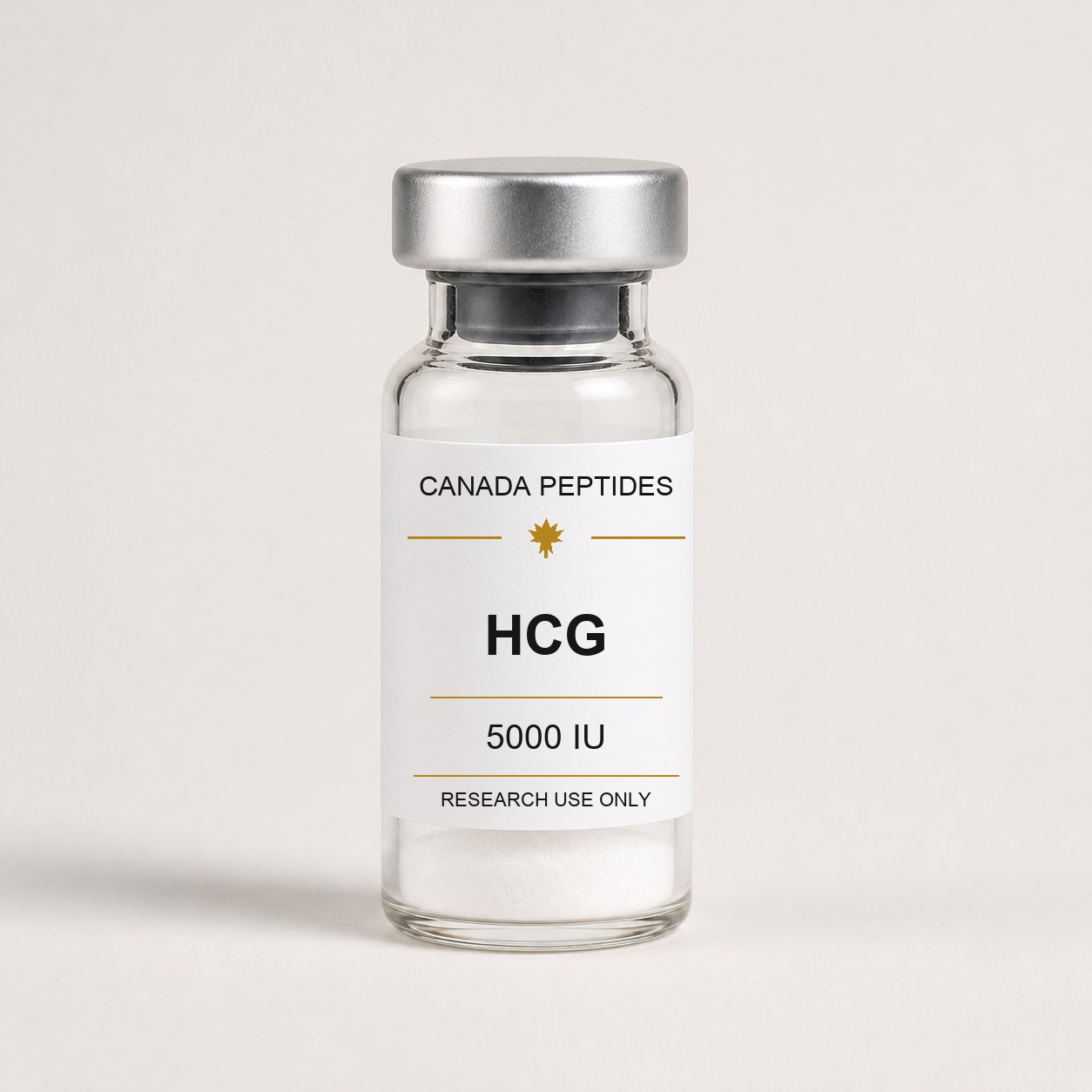
hCG is a glycoprotein, not a synthetic peptide, and that changes what a certificate of analysis can say. Potency is reported by immunoassay or bioassay rather than HPLC purity, glycoform composition depends on the producing source, and the molecule is denatured by heat, agitation and freeze–thaw cycling. Loss of potency shows up as loss of activity rather than as anything visible, so material warmed or frozen in transit can look normal and behave differently. Some share of any reaction to unregulated hCG plausibly traces to mis-potency, endotoxin load or degradation rather than to the hormone. Third-party testing is the only way to separate the two — see lab testing and COAs and the cold-chain and shelf-life guide. The 5,000 IU vial sold here is third-party tested with a certificate of analysis available on request.
Regulatory and sport status
hCG is an approved prescription drug in Canada — but the approval attaches to Pregnyl and Ovidrel and to nothing else. Research-grade hCG has no DIN, has not been reviewed by Health Canada, and is not the approved drug; it is sold in Canada strictly for laboratory research. In the United States it is likewise an approved prescription drug, absent from the FDA's 503A bulk-substances lists for that reason. The WADA Prohibited List names chorionic gonadotropin under S2 as prohibited at all times in males, since its effect in males is to stimulate endogenous testosterone; tested athletes should verify the current List.
Frequently asked questions
What are the labelled side effects of hCG?
In women, ovarian hyperstimulation syndrome is the principal serious risk, with thromboembolic events reported rarely. In men, the oestradiol rise alongside testosterone can cause gynaecomastia, oedema, mood changes and acne, and testicular pain is reported. Injection-site reactions, headache and fatigue are common across uses. That record belongs to approved products under medical supervision.
Does the approved-product safety record apply to research-grade hCG?
No. The monograph data describe products manufactured to a standard and potency-tested. Research-grade material has no DIN, and its source, potency and sterility are outside every dataset cited here.
Why is OHSS the main concern with hCG and not with kisspeptin?
hCG's terminal half-life of roughly 24–36 hours means a trigger dose stimulates the ovary for days. Kisspeptin produces an endogenous LH surge that switches itself off, which is why the 2015 IVF study in women at high risk of OHSS reported no severe cases with a kisspeptin-54 trigger.
Is hCG prohibited in sport?
Yes for male athletes: WADA lists chorionic gonadotropin under S2, prohibited at all times in males. Athletes should check the current List directly.
Is this medical advice?
No. Research-grade hCG sold here is for laboratory use only, not for human or veterinary use, and is not the approved prescription product. This page reports what monographs and published studies observed; it is not a safety assurance, a dosing recommendation or medical advice, and the absence of reported effects is not evidence of safety.