July 31, 2026·5 min read·MOTS-c, dosage, mitochondrial peptides, reconstitution, research
MOTS-c dosage — research dosing notes
What the literature actually reports on MOTS-c dosage: the rodent mg/kg ranges from Lee 2015 and Reynolds 2021, the human trial regimens, half-life context, and reconstitution math for a 10 mg vial.
MOTS-c is a 16-amino-acid peptide (MRWQEMGYIFYPRKLR, molecular weight ≈2,174.6 g/mol) encoded by a short open reading frame inside the mitochondrial 12S rRNA gene. Because it is a mitochondrial-derived peptide rather than a nuclear-encoded hormone, almost everything published about MOTS-c dosage comes from animal work expressed in mg/kg — not from fixed human milligram amounts. This page collects what the literature actually reports, the arithmetic used to prepare a reconstituted vial, and the reasons those rodent figures do not translate into a human protocol.
The doses reported in the published research
Four sources carry most of the weight, and they disagree by more than an order of magnitude — which is itself the most useful fact about MOTS-c dosage.
Lee et al., Cell Metabolism (2015). The founding paper. Mice received 5 mg/kg/day by intraperitoneal injection for 7 days in the acute insulin-sensitivity experiments, and 0.5 mg/kg/day intraperitoneally for 8 weeks in the high-fat-diet obesity-prevention arm. Cell work used 10 µM. The mechanism proposed there — inhibition of the folate cycle and de novo purine synthesis, accumulation of AICAR, and downstream AMPK activation — is why MOTS-c is usually filed alongside metabolic rather than anabolic compounds.
Reynolds et al., Nature Communications (2021). The aging and physical-performance work. Mice at 2, 12, and 22–23.5 months received 15 mg/kg/day intraperitoneally, in schedules ranging from daily for two weeks to intermittent (three times weekly) dosing continued into late life. Note the 30-fold spread between this figure and the 0.5 mg/kg chronic arm above; both produced reported effects on their respective endpoints.
CB4211 (NCT03998514). CohBar's engineered MOTS-c analog — not MOTS-c itself — is the only mitochondrial-derived peptide to have completed a registered human trial. The Phase 1a/1b study enrolled 88 subjects and used once-daily subcutaneous injection: single ascending doses, then 7 days in healthy volunteers, then 28 days in subjects with non-alcoholic fatty liver disease. Topline results announced in August 2021 reported the compound was well tolerated with no serious adverse events, alongside exploratory reductions in ALT, AST, and glucose. No later-phase CB4211 trial has been reported.
NCT07505745. A Phase 2a randomised, double-blind, placebo-controlled study of MOTS-c in adults with prediabetes and overweight/obesity (sponsor: Hudson Biotech, 120 participants estimated, start February 2026, recruiting as of this writing). The design is a fixed-dose once-daily subcutaneous regimen over 12 weeks, with the Matsuda index from an OGTT as the primary efficacy endpoint. The registry record does not disclose the milligram dose, so no human figure can honestly be quoted from it yet.
Half-life and cadence
There is no published human pharmacokinetic profile for exogenously administered MOTS-c. What exists is indirect: circulating MOTS-c rises with acute exercise and returns toward baseline within a few hours, which is consistent with the short residence time expected of a small, unmodified, unconjugated peptide. That short window is the stated rationale behind the once-daily cadence used in both the CB4211 trial and the current Phase 2a design, and behind the daily rodent schedules. It is also why MOTS-c is not comparable to a DAC-modified or albumin-binding peptide, where weekly administration is the design goal — see the MOTS-c research overview for where it sits against other longevity-adjacent compounds.
Reynolds et al. additionally tested intermittent (3×/week) schedules in aged mice, so daily is not the only cadence with published support — but on rodent physical-performance endpoints, not human outcomes.
Reconstitution arithmetic for a 10 mg vial
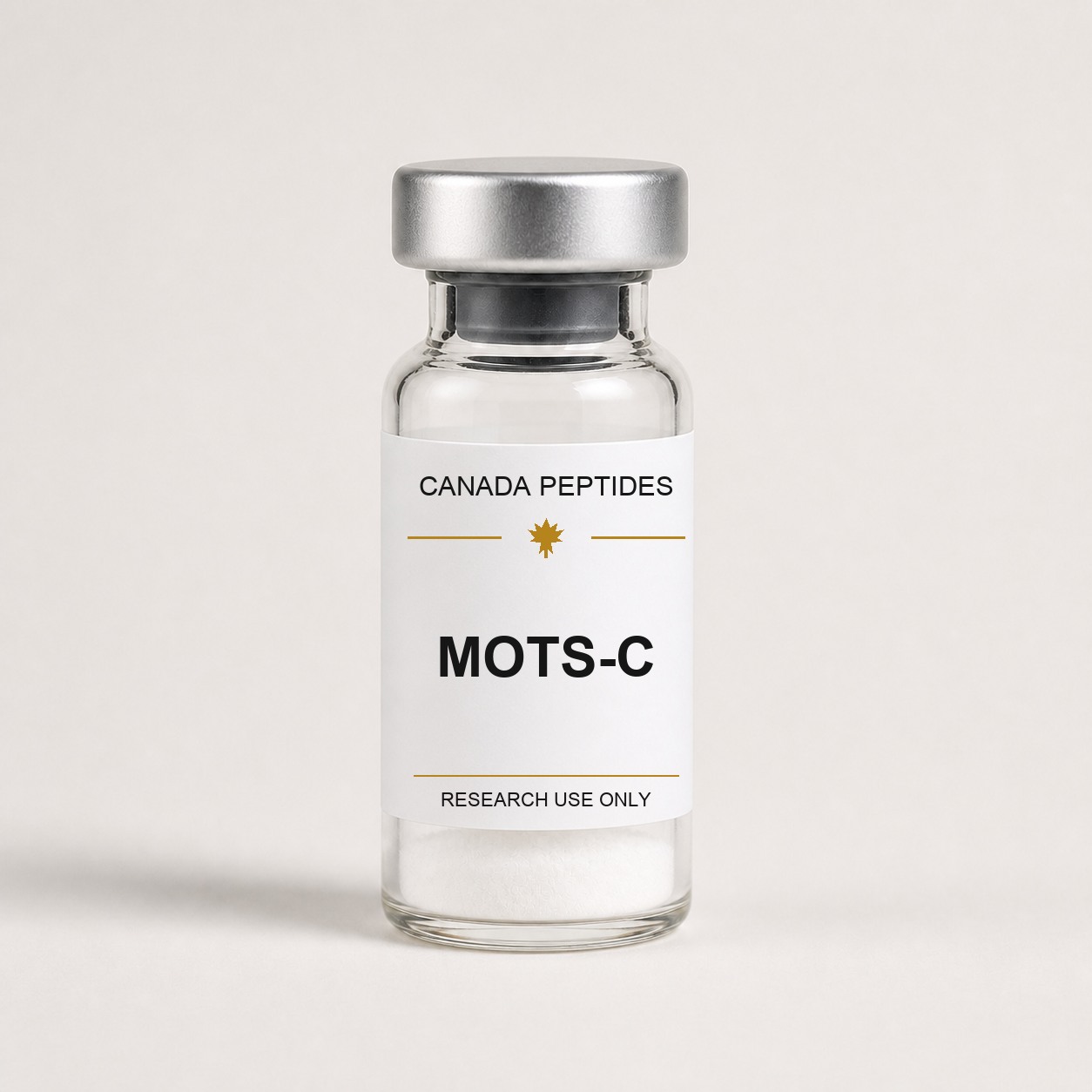
Reconstitution math is deterministic and independent of any dosing question — it is simply how much peptide sits in a given volume of solvent. For a MOTS-C 10 MG vial:
10 mg ÷ 2 mL bacteriostatic water = 5 mg/mL, so 0.1 mL (10 units on a U-100 syringe) contains 500 mcg.
10 mg ÷ 5 mL = 2 mg/mL, so 0.1 mL contains 200 mcg and 0.25 mL contains 500 mcg.
Larger solvent volumes buy resolution on the syringe barrel at the cost of a shorter in-solution shelf life once the vial is opened.
Add solvent slowly down the vial wall, never directly onto the lyophilized cake, and do not shake. Full procedure in Reconstitution 101; the mg → mcg → syringe-unit conversions are worked through in Dosing math.
Why rodent mg/kg does not become a human number
Allometric scaling is a formal method for converting animal doses to human-equivalent doses, used to set a first-in-human starting dose after toxicology, formulation, and regulatory review. It is not a calculator for arriving at a protocol outside that setting. Three specific problems apply to MOTS-c: the published rodent work used intraperitoneal injection, a route with different absorption kinetics than the subcutaneous route used in the human trials; the effective rodent range spans 0.5 to 15 mg/kg with no dose-response study reconciling the ends; and no human exposure-response data exist to anchor either end. Anyone quoting a specific human MOTS-c dose in milligrams is extrapolating, not citing.
The honest summary: the mechanism is well characterised, the preclinical metabolic data are consistent, human data begin and end with one Phase 1 analog study and one Phase 2a trial still enrolling.
Frequently asked questions
What dose of MOTS-c is used in the published studies?
Rodent studies report 0.5 mg/kg/day (Lee 2015, chronic), 5 mg/kg/day (Lee 2015, acute), and 15 mg/kg/day (Reynolds 2021, daily or 3×/week). No human milligram dose has been published for MOTS-c itself; the Phase 2a trial's fixed dose is not disclosed in its registry record.
How often was MOTS-c administered?
Once daily in most rodent arms and in both human trials of the analog and the peptide. Reynolds et al. also tested a three-times-weekly schedule in aged mice.
What is the half-life of MOTS-c?
Not established in humans for exogenous administration. Endogenous levels rise with exercise and fall back within hours, consistent with a short-lived unmodified peptide, but that is inference rather than measured pharmacokinetics.
Has MOTS-c been tested in people?
The analog CB4211 completed a Phase 1a/1b trial (NCT03998514) with a reported favourable tolerability profile. MOTS-c itself is in an ongoing Phase 2a trial (NCT07505745) in prediabetes and overweight/obesity. Neither supports any efficacy claim.
How should this vial be reconstituted?
2 mL of bacteriostatic water into a 10 mg vial gives 5 mg/mL; 5 mL gives 2 mg/mL. Choose the concentration that puts your intended measurement volume in a readable part of the syringe barrel, and store reconstituted peptide refrigerated.