August 18, 2026·6 min read·PT-141, bremelanotide, melanocortin, MC4R, research overview
PT-141 (Bremelanotide) — a research overview
A research overview of the PT-141 peptide (bremelanotide): MC4R mechanism, RECONNECT Phase 3 trial data, pharmacokinetics, and the tolerability limits reported in the published literature.
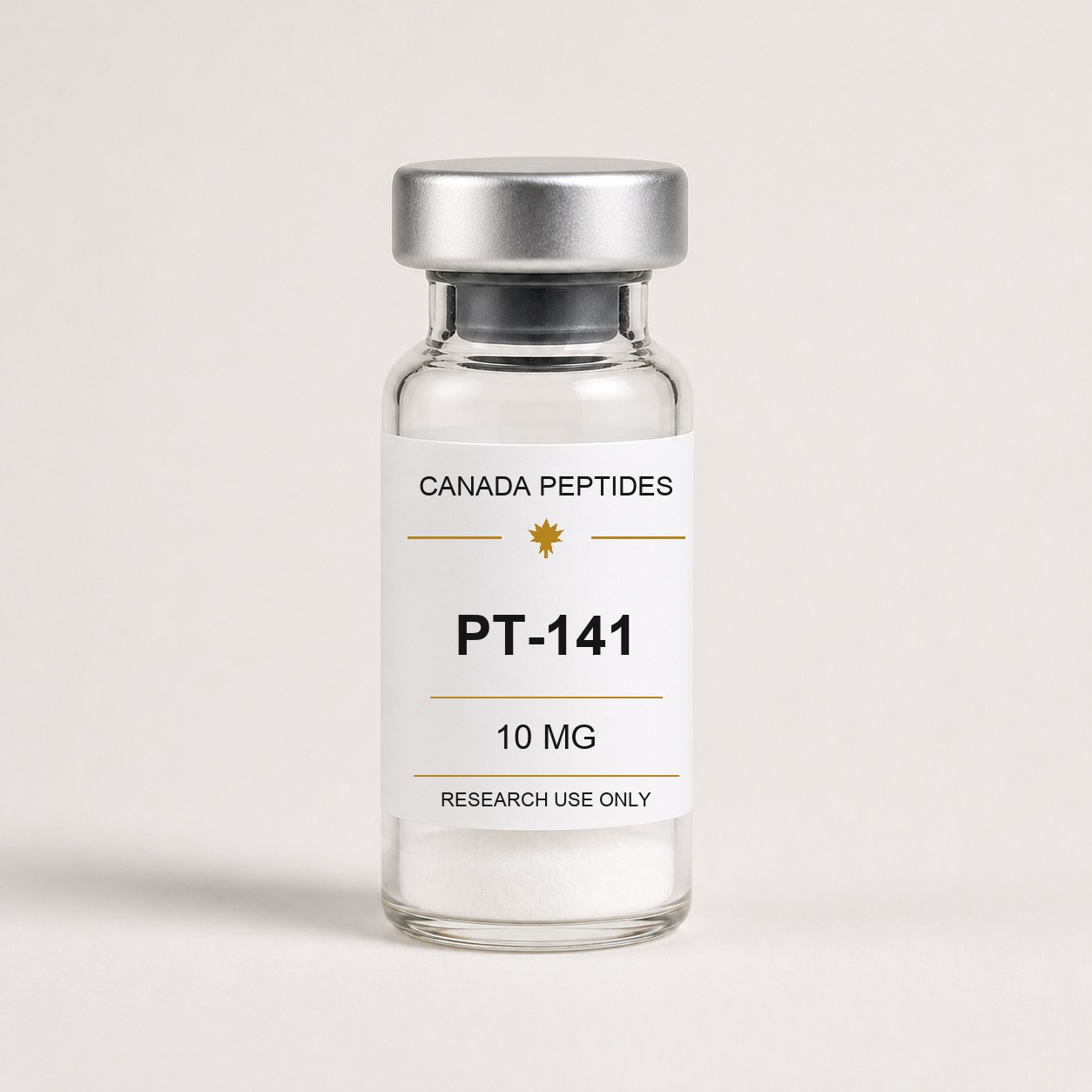
PT-141 — generic name bremelanotide — is a synthetic cyclic heptapeptide that acts on the melanocortin receptor family, principally MC4R in the central nervous system. It is one of the few compounds in the research-peptide catalogue with a completed Phase 3 programme and a regulatory approval behind it: the FDA approved it in June 2019, marketed as Vyleesi, for generalized acquired hypoactive sexual desire disorder (HSDD) in premenopausal women. That approval makes the literature on PT-141 unusually concrete compared with most peptides in this space — but it also narrows what the data actually support.
Mechanism — a central, not vascular, pathway
PT-141 descends from melanotan II. Investigators studying MT-II noticed that the compound produced sexual-response effects distinct from its pigmentary action, and isolated an active metabolite that retained the former while largely shedding the tanning effect. The result binds several melanocortin receptor subtypes — MC1R, MC3R, MC4R — with MC4R agonism in the hypothalamus and limbic system understood to be the operative pathway.
This distinguishes PT-141 from the PDE5 inhibitor class. PDE5 inhibitors act peripherally on vascular smooth muscle via nitric-oxide signalling. PT-141 acts upstream, in the neural circuitry that generates desire and arousal. Preclinical microdialysis work in rats indicates MC4R activation in the medial preoptic area raises extracellular dopamine, and that the dopaminergic response is required for the downstream behavioural effect.
What the trial data show
The pivotal evidence is the RECONNECT programme — two identically designed, randomized, double-blind, placebo-controlled Phase 3 trials enrolling roughly 1,250 premenopausal women with generalized acquired HSDD, dosed on demand over 24 weeks with an optional extension to 52 weeks.
The results were statistically significant and modest in magnitude. Bremelanotide 1.75 mg subcutaneous improved the FSFI desire-domain score by approximately 0.35 points more than placebo, and reduced FSDS-DAO distress scores by about 0.33 points more than placebo, both at P < 0.001. Notably, the trials did not show a significant increase in the number of satisfying sexual events — the endpoint many readers assume such a drug would move. The effect that reached significance was on desire and on the distress associated with its absence.
The 52-week extension data reported a stable adverse-event profile with no new safety signals emerging over longer exposure.
Pharmacokinetics
Subcutaneous bremelanotide is essentially completely bioavailable. Tmax falls at roughly 1 hour (range 0.5–1.0 h) and the elimination half-life is short — approximately 2.7 hours, with a reported range of 1.9–4.0 hours. Plasma protein binding is low at about 21%. Clearance proceeds via ordinary peptide catabolism — multiple amide-bond hydrolyses — with roughly 65% of the dose recovered in urine and 23% in feces.
The short half-life is what makes the labelled regimen episodic rather than continuous: 1.75 mg subcutaneously at least 45 minutes before anticipated activity, no more than one dose in 24 hours, and no more than eight doses in a month. That eight-dose ceiling is not arbitrary — it is the exposure boundary the safety data were built around.
Tolerability and the dose-dependence problem
The tolerability profile is the compound's principal limitation, and it is frankly reported in the label.
Nausea affected 40% of treated patients, with median onset within an hour and duration around two hours; pretreatment with ondansetron was not effective. Roughly 13% required antiemetic therapy and 8% discontinued for nausea. Flushing occurred in about 20% versus under 1% on placebo. Injection-site reactions ran near 13% and headache near 11%.
Blood pressure is the historically significant signal. Transient increases of roughly 6 mmHg systolic and 3 mmHg diastolic occur, peaking 2–4 hours post-dose and generally resolving within 12 hours. The label contraindicates use in uncontrolled hypertension or known cardiovascular disease. This is not a theoretical concern: Palatin's original intranasal formulation was placed on clinical hold by the FDA in 2007 after dose-dependent blood pressure elevations appeared in Phase 3 male erectile-dysfunction trials, and that route was abandoned. The subcutaneous, on-demand, low-dose regimen is the form that survived that history — a useful reminder that route and cadence, not just the molecule, determined the safety profile.
Focal hyperpigmentation — the residual MC1R activity — is strongly dose-frequency dependent: reported in about 1% at eight or fewer monthly doses, but 38% with daily dosing, and resolution after discontinuation was not confirmed in all cases. Risk is higher in darker skin. LiverTox rates bremelanotide's likelihood of clinically apparent liver injury as category D, a possible rare cause, on the basis of a single reported case of acute hepatitis that resolved on withdrawal.
Where the data are thin
Two gaps matter for anyone reading the literature honestly. The approval is restricted to premenopausal women; the male erectile-dysfunction programme never reached approval, and it was the intranasal male trials that generated the blood-pressure hold. Claims about PT-141 in men rest on earlier-phase and off-label material, not on a completed pivotal programme.
And the effect sizes are small. A 0.35-point shift on a desire subscale is a real, replicated finding and also a modest one, and the absence of a significant effect on satisfying-event count is part of the same record. Sources describing PT-141 in dramatic terms are not describing RECONNECT.
What is PT-141?
PT-141 is bremelanotide, a synthetic cyclic heptapeptide and melanocortin receptor agonist acting principally at MC4R. It was derived from melanotan II and approved by the FDA in 2019 as Vyleesi for hypoactive sexual desire disorder in premenopausal women.
How does PT-141 differ from PDE5 inhibitors?
Mechanistically they operate at different levels. PDE5 inhibitors act peripherally on vascular smooth muscle via nitric-oxide signalling. PT-141 acts centrally on hypothalamic and limbic melanocortin circuits, with preclinical work implicating downstream dopamine release.
What is PT-141's half-life?
Approximately 2.7 hours following subcutaneous administration, with a reported range of 1.9–4.0 hours and Tmax near 1 hour. Subcutaneous bioavailability is close to 100%.
What adverse effects appear in the published literature?
Nausea is the most common at around 40%, followed by flushing at roughly 20%, injection-site reactions near 13% and headache near 11%. Transient blood-pressure elevation of about 6/3 mmHg is documented, and the labelling contraindicates use in uncontrolled hypertension or known cardiovascular disease. Focal hyperpigmentation is dose-frequency dependent.
Is PT-141 approved for men?
No. FDA approval covers premenopausal women only. The male erectile-dysfunction programme, run with an intranasal formulation, was halted in 2007 after dose-dependent blood-pressure elevations and never reached approval.