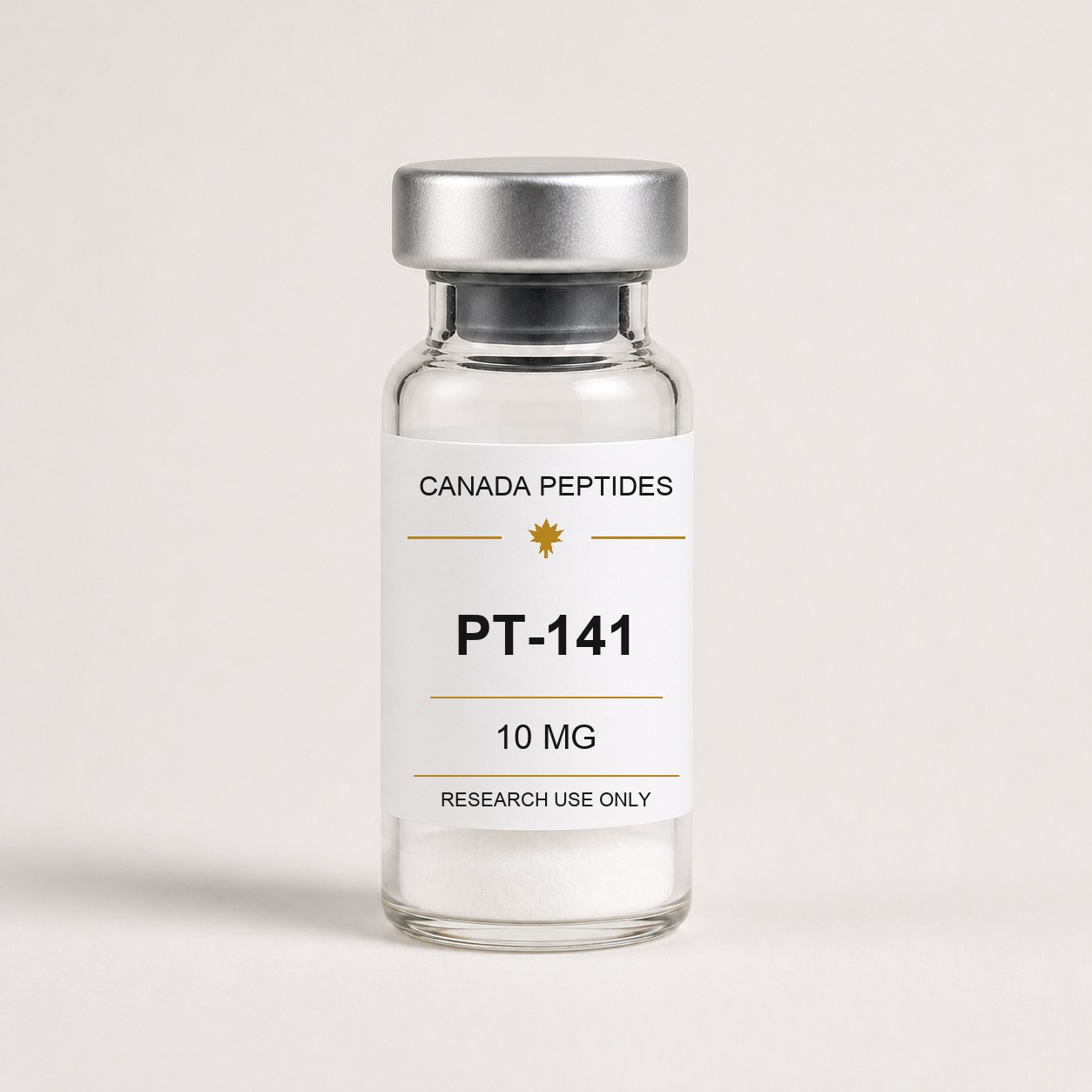
Synthetic α-MSH analogue and melanocortin receptor agonist (bremelanotide), engineered for central melanocortin signalling rather than the peripheral vascular pathway PDE5 inhibitors act on. 10 mg lyophilised vial, supplied for laboratory research use only.
Price$50.00CAD
Protocol
Reconstitute with 2 mL of bacteriostatic water for a working concentration of 5 mg/mL (5000 mcg per mL). The dose characterised in the clinical literature is 1.75 mg subcutaneously — 0.35 mL, or 35 units on a U-100 syringe — used episodically rather than daily, with no more than one administration in 24 hours and no more than eight in a month. Store the reconstituted vial refrigerated at 2–8 °C; use within thirty days. Rotate injection sites. Research use only until supplied with an applicable prescription.
No reviews yet. Be the first to review PT-141 10 MG.
Buy PT-141 10 MG in Canada — Research Peptide | Canada Peptides
Ships across Canada
Domestic shipping, priced in CAD
Handling guides
Reconstitution, dosing & storage
Secure checkout
Encrypted payment via Stripe
SKU
pt-141-10mg
Domain
Foundational
Weight
30 g
What is PT-141?
PT-141 — generic name bremelanotide — is a synthetic cyclic heptapeptide and a melanocortin receptor agonist. It is an analogue of alpha-melanocyte-stimulating hormone (α-MSH), the endogenous ligand for the melanocortin receptor family, and it is closely related to Melanotan II: the same cyclic peptide backbone, with a carboxyl group in place of Melanotan II's C-terminal amide.
This page covers the 10 mg lyophilised vial — what's in it, the reconstitution arithmetic, and how it's handled. It is supplied for laboratory research use only.
Approved medicine and research-grade material are not the same thing
Bremelanotide is the active ingredient in an FDA-approved prescription medicine in the United States, approved in 2019 under the brand name Vyleesi as a single-use 1.75 mg subcutaneous autoinjector for one narrow indication: acquired, generalised hypoactive sexual desire disorder in premenopausal women.
That approved labelling is also explicit about what the medicine is not authorised for. Its stated Limitations of Use exclude postmenopausal women, exclude men, and exclude use for enhancing sexual performance. Any framing of this compound around male use or performance is outside the approved indication entirely — a distinction worth knowing before reading anyone's marketing, ours included.
That the molecule is approved somewhere is a statement of fact about the molecule, and it is worth being precise about what it does not mean. This vial is not Vyleesi and not a generic of it. An approved medicine carries a regulator-reviewed product monograph, a prescribing information sheet, an identification number, GMP manufacturing with lot-level oversight, and a pharmacist standing between the product and the person using it.
Research-grade PT-141 — what this vial is — has none of that. No monograph, no prescribing information, no regulatory review, no approved indication. If you are looking for bremelanotide as a medicine, the route is a licensed prescriber, not a research supplier. That is not what this page is for.
The vial arrives as a dry white cake at the bottom of the glass. That is the expected appearance: freeze-drying removes the water so the peptide stays stable in transit and in storage. It is reconstituted immediately before use.
What the research literature reports
PT-141 is studied on the melanocortin pathway, and the activity described in the approved labelling is deliberately unselective:
Non-selective melanocortin agonism — the reported potency order is MC1R > MC4R > MC3R > MC5R > MC2R, with MC1R and MC4R described as the most relevant at therapeutic dose levels. This is a rank order, not selectivity: the compound engages the receptor family broadly.
MC1R and pigmentation — MC1R is the melanocyte receptor, which is the mechanistic link to the hyperpigmentation signal described below. It is the same receptor Melanotan II is studied on.
Central, not vascular — the literature contrasts melanocortin agonists with PDE5 inhibitors such as sildenafil, which act peripherally on vascular smooth muscle. PT-141 is studied on central nervous system signalling, which places it in a different pharmacological class rather than making it a variation on the same one.
Mechanism formally unknown — this is the part vendors skip. The FDA-approved labelling states that the mechanism by which bremelanotide produces its effect is not known. A proposed account from animal work involves presynaptic MC4R activation in the hypothalamic medial preoptic area and downstream dopamine release, but that remains a hypothesis from preclinical models, not an established mechanism.
Reported pharmacokinetics for the subcutaneous route:
Parameter
Reported value
Time to peak (Tmax)
~1 hour
Elimination half-life
~2.7 hours (range 1.9–4.0)
Bioavailability
~100%
Volume of distribution
~25 L
Plasma protein binding
~21%
Elimination
~65% urine, ~23% faeces
The short half-life is the reason the studied administration pattern is episodic rather than scheduled daily. An intranasal formulation was developed earlier in the compound's history and abandoned in favour of the subcutaneous route; the reason given in the peer-reviewed literature is wide variability in intranasal bioavailability, which made exposure hard to predict from dose.
Reconstituting a 10 mg vial
Reconstitution is arithmetic. Adding 2 mL of bacteriostatic water to a 10 mg vial gives:
10 mg ÷ 2 mL = 5 mg/mL = 5000 mcg per mL
From there, the volume for a given amount is that amount divided by 5000 mcg/mL. On a standard U-100 insulin syringe (100 units = 1 mL):
Amount
Volume
U-100 syringe
500 mcg
0.10 mL
10 units
1 mg
0.20 mL
20 units
1.75 mg
0.35 mL
35 units
Add the water slowly down the inside wall of the vial rather than jetting it onto the powder, and let the cake dissolve on its own — swirl gently, don't shake. The full walkthrough is in the reconstitution guide, the dosing math guide covers mg/mcg/unit conversions, and the dosage calculator will run these numbers for any vial size and water volume.
Changing the solvent volume changes the concentration, not the peptide. The same 10 mg vial in 5 mL gives 2 mg/mL, so every volume above multiplies by 2.5. Match the water volume to how much you'll realistically use inside the reconstituted shelf life.
How many aliquots is a 10 mg vial?
Reconstituted with 2 mL of bacteriostatic water, a 10 mg vial yields:
20 aliquots at 500 mcg each
10 aliquots at 1 mg each
roughly 5 at the 1.75 mg amount used in the clinical literature
The binding constraint is usually not the arithmetic but the shelf life of the reconstituted solution — see storage below.
Storage and handling
Before reconstitution: the lyophilised vial is the stable form. Refrigerate at 2–8 °C; it tolerates ambient-temperature shipping, which is why it ships dry.
After reconstitution: refrigerate at 2–8 °C and use within approximately 30 days. Bacteriostatic water contains 0.9% benzyl alcohol, which is what makes multi-draw use possible; sterile water has no preservative and is single-use only. Keep vials out of light, do not freeze the reconstituted solution, and discard anything cloudy, discoloured, or containing particulate.
Cold-chain detail and shelf-life reasoning are in the storage guide.
Is PT-141 legal in Canada?
Bremelanotide is not authorised for sale in Canada in any form. It does not appear in Health Canada's Drug Product Database under either its ingredient name or the Vyleesi brand name, which means no Canadian DIN and no Health Canada-approved product monograph. Some peptide vendors claim bremelanotide is an approved prescription medicine in Canada; that claim is contradicted by the database and you should treat it as false wherever you see it.
It is also not a controlled substance under the Controlled Drugs and Substances Act — the statute and its schedules name neither bremelanotide, nor PT-141, nor melanocortin agonists as a class.
Those two facts together are what place it in the research-chemical category, and neither implies the third thing people assume. Not being scheduled under the CDSA is not permission to sell it for human use: an unapproved drug remains unapproved under the Food and Drugs Act. It can be sold and shipped domestically for laboratory research use, and it cannot be sold, marketed, or supplied as a therapeutic product for human consumption. Everything on this page is written for that context. We ship within Canada only.
PT-141 and anti-doping
Bremelanotide is not named on the current WADA Prohibited List, and no melanocortin agonist appears on it as a class.
Worth understanding is why category S0 (non-approved substances) does not capture it, because S0 is what catches most research peptides. S0 covers substances with no current approval by any governmental regulatory health authority for human therapeutic use — BPC-157 is a named example. Bremelanotide holds an FDA approval, and S0's test is "any" authority, so the absence of Canadian authorisation does not pull it back in.
That is as far as the claim goes, and we will not go further. Section S2 carries a catch-all for substances of similar chemical structure or biological effect, sports have their own rules, and the list is revised annually. Any athlete subject to anti-doping rules should verify current status directly against the WADA Prohibited List rather than relying on a product page — including this one.
Tolerability in the research literature
The adverse-event profile from the registrational trials is the best-documented part of this compound's record, and it is not subtle:
Reported effect
Bremelanotide
Placebo
Nausea
40.0%
1.3%
Flushing
20.3%
0.3%
Injection-site reactions
13.2%
8.4%
Headache
11.3%
1.9%
Vomiting
4.8%
0.2%
Nausea typically began within about an hour, lasted around two hours, and tended to lessen after the second administration; pre-treatment with ondansetron was not effective against it.
Two further signals matter mechanistically. Blood pressure rose while heart rate fell — up to roughly 6 mmHg systolic and 3 mmHg diastolic, peaking two to four hours after administration, with heart rate down by as much as 5 bpm, generally resolving within 12 hours. That is why the approved labelling is contraindicated in uncontrolled hypertension and known cardiovascular disease.
And focal hyperpigmentation — darkened patches on the face, gums, and breasts, consistent with the compound's MC1R activity — was frequency-dependent: about 1% at up to eight administrations per month, rising to 38% when given daily for eight consecutive days, with higher risk in darker skin. The important detail is that resolution after stopping was not confirmed in all cases. This effect may be permanent.
None of that is a safety assessment of research-grade material, which sits outside any regulatory review entirely. It is what the published record describes about the molecule, and the two items above are the ones we would not want anyone to encounter for the first time after the fact.
PT-141 vs Melanotan II
The two are close structural relatives on the same receptor family, differing at the C-terminus — Melanotan II carries an amide there, bremelanotide a carboxyl. The literature treats them as separate compounds studied for different things: Melanotan II on the pigmentation pathway, PT-141 on central melanocortin signalling. Note that PT-141 is not free of pigmentation activity — MC1R sits at the top of its reported potency order, which is exactly why the hyperpigmentation signal above shows up in its own trial record. Researchers isolating one variable generally do not treat the two as interchangeable.
What is PT-141?
PT-141 (bremelanotide) is a synthetic cyclic heptapeptide and non-selective melanocortin receptor agonist, with a reported potency order of MC1R > MC4R > MC3R > MC5R > MC2R. It is an analogue of α-MSH and a close structural relative of Melanotan II. This vial is supplied for laboratory research use only.
Is PT-141 approved for men?
No. Where bremelanotide is approved as a medicine — the United States, under the brand name Vyleesi — the labelling explicitly limits it to premenopausal women and states it is not indicated for men and not for enhancing sexual performance. It is not authorised for sale in Canada in any form, and this vial is research-grade material rather than a medicine.
How is PT-141 different from PDE5 inhibitors?
The literature places them in different pharmacological classes. PDE5 inhibitors such as sildenafil act peripherally on vascular smooth muscle; PT-141 is studied on central melanocortin receptor signalling. Its mechanism is not fully characterised — the approved labelling states the mechanism of effect is unknown.
How do you reconstitute a 10 mg PT-141 vial?
Add bacteriostatic water slowly down the vial wall and let the cake dissolve without shaking. With 2 mL, a 10 mg vial gives 5 mg/mL (5000 mcg per mL) — so 1 mg is 0.2 mL, or 20 units on a U-100 insulin syringe.
How many aliquots are in a 10 mg vial?
Reconstituted with 2 mL, a 10 mg vial yields about 20 aliquots at 500 mcg, 10 at 1 mg, or roughly 5 at the 1.75 mg amount reported in the clinical literature. The reconstituted solution keeps about 30 days refrigerated.
What is the half-life of PT-141?
Reported subcutaneous pharmacokinetics show a peak at roughly one hour and an elimination half-life of about 2.7 hours, within a range of 1.9 to 4.0 hours. Bioavailability is near 100% and plasma protein binding around 21%.
What side effects are reported in the literature?
Nausea dominates the trial record at 40% versus 1.3% on placebo, followed by flushing (20.3%), injection-site reactions (13.2%), headache (11.3%), and vomiting (4.8%). Blood pressure rose by up to about 6/3 mmHg while heart rate fell by up to 5 bpm, peaking two to four hours after administration. Focal hyperpigmentation of the face, gums, and breasts was reported in about 1% at up to eight administrations per month and 38% with daily administration for eight days, and did not resolve in all cases after stopping.
Is PT-141 legal in Canada?
Bremelanotide is not authorised for sale in Canada — it has no DIN and does not appear in Health Canada's Drug Product Database — and it is not a controlled substance under the CDSA. Not being scheduled is not permission to sell it for human use: it may be sold domestically for laboratory research only, and may not be marketed or supplied for human consumption.
Is PT-141 banned in sport?
Bremelanotide is not named on the current WADA Prohibited List, and category S0 does not apply to it because S0 covers substances with no approval from any regulatory health authority and bremelanotide holds an FDA approval. That said, the list is revised annually and section S2 carries a similarity catch-all, so athletes should verify current status against the WADA list directly.
Is PT-141 the same as Melanotan 2?
No. They are close structural relatives differing at the C-terminus — Melanotan II carries an amide, bremelanotide a carboxyl — and the literature studies them for different things: Melanotan II on pigmentation, PT-141 on central melanocortin signalling. PT-141 still has MC1R activity at the top of its potency order, which is why hyperpigmentation appears in its own trial record.
How should PT-141 be stored?
Keep the lyophilised vial refrigerated at 2–8 °C. Once reconstituted, refrigerate and use within about 30 days, keep it out of light, and do not freeze it. Discard any solution that turns cloudy or shows particulate.
Do you ship PT-141 across Canada?
Yes — Canada-wide, priced in CAD. We do not ship to the United States or internationally.