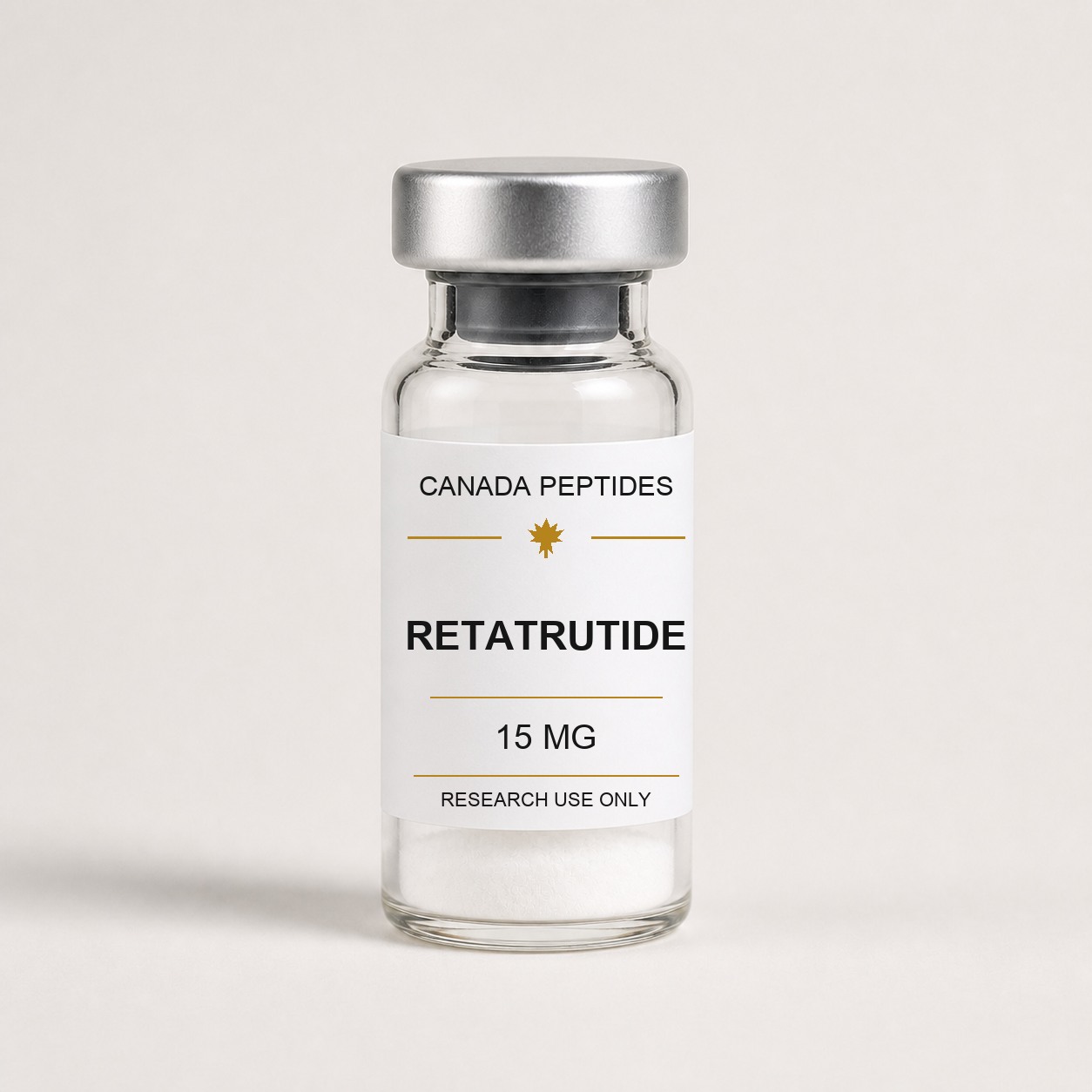
The 15 mg vial: the one that empties on schedule
Every vial in a range has a reason to exist, and this one's is arithmetic. A 20 mg vial at 2 mg weekly reaches its 30-day reconstituted shelf life with half its contents unused; a 10 mg vial at 4 mg weekly is gone in under three weeks. At mid-protocol amounts, 15 mg is the size that runs out at roughly the same time the solution does.
It is also the strength that matches the 15 mg pen cartridge — the same amount of peptide, in the format you draw with a syringe rather than dial on a device.
For the compound itself — receptor pharmacology, research background, comparisons across the range — see the retatrutide hub.
What's in this vial
| Spec | Detail |
|---|
| Contents | 15 mg retatrutide, lyophilised (freeze-dried) powder |
| Form | Sealed single vial, sterile stoppered |
| Purity | ≥98% by HPLC |
| Receptors | GLP-1 / GIP / glucagon (triple agonist) |
| Ships | Canada-wide, priced in CAD |
| Not included | Bacteriostatic water, syringes — ordered separately |
Reconstituting a 15 mg vial
15 mg is the one strength in the range where the solvent volume is a real choice rather than a default, because 2 mL would give an awkward 7.5 mg/mL. Two volumes give clean numbers instead:
15 mg ÷ 1.5 mL = 10 mg/mL — the round-number option, matching the 20 mg vial's concentration:
| Amount | Volume | U-100 syringe |
|---|
| 2 mg | 0.20 mL | 20 units |
| 4 mg | 0.40 mL | 40 units |
| 5 mg | 0.50 mL | 50 units |
15 mg ÷ 3 mL = 5 mg/mL — the fine-resolution option, matching the 10 mg vial:
| Amount | Volume | U-100 syringe |
|---|
| 2 mg | 0.40 mL | 40 units |
| 4 mg | 0.80 mL | 80 units |
At 10 mg/mL a single syringe unit is 0.1 mg; at 5 mg/mL it is 0.05 mg. Neither volume changes how much peptide is in the vial — only how much liquid it is dissolved in — so this is a bookkeeping decision about how precisely you want to read small adjustments, not a potency one. The dosage calculator will run either set, and the dosing math guide covers the conversions.
Add the water slowly down the inside wall of the vial and let the cake dissolve on its own; swirl gently, don't shake.
How many aliquots is a 15 mg vial?
Independent of solvent volume, 15 mg divides into:
- 7 aliquots at 2 mg
- ~3.75 at 4 mg
- 3 aliquots at 5 mg
The number that matters is how those land against the roughly 30-day refrigerated shelf life of the reconstituted solution. At a weekly cadence, 4 mg gives just under four weeks — the vial and the solution reach their limits together, which is the whole argument for this size. At 2 mg weekly you would be better served by the 10 mg vial; above 5 mg weekly, by the 20 mg.
Storage and handling
Refrigerate the lyophilised vial at 2–8 °C. Once reconstituted, refrigerate and use within about 30 days. Bacteriostatic water (0.9% benzyl alcohol) permits multiple draws; sterile water is single-use. Don't freeze reconstituted solution, keep it out of light, and discard anything cloudy, discoloured, or containing particulate. See the storage guide and the reconstitution walkthrough.
Vial or pen at 15 mg?
This is the only strength we stock in both formats, so it is worth being plain about the trade. The pen costs substantially more and buys you dose-dialling and fewer handling steps. The vial costs less and gives you the choice of concentration described above, which the pen's fixed cartridge does not. Neither contains more peptide than the other — 15 mg is 15 mg.
Regulatory status: investigational everywhere
Retatrutide is an investigational compound with no marketing approval from Health Canada, the FDA, or any other regulator anywhere. It remains in clinical development, has never been authorised for human use, and there is no approved version of it and no prescription route to it. This vial is supplied for laboratory research use only and ships within Canada only.
Retatrutide and anti-doping
WADA's S0 (non-approved substances) category covers any pharmacological substance with no current approval from any governmental health authority for human therapeutic use, explicitly including drugs under clinical development. Retatrutide has no such approval.
By that definition it falls inside S0, which is prohibited at all times, in and out of competition. Tested athletes should treat retatrutide as off-limits and confirm against the WADA Prohibited List directly.
Frequently asked questions
How many doses are in a 15 mg retatrutide vial?
15 mg divides into about 7 aliquots at 2 mg, roughly 3.75 at 4 mg, or 3 at 5 mg — independent of how much bacteriostatic water you add. At 4 mg weekly the vial empties in just under four weeks, which is about the same as the 30-day refrigerated shelf life of the reconstituted solution.
How do you reconstitute a 15 mg retatrutide vial?
Add bacteriostatic water slowly down the vial wall and let the cake dissolve without shaking. 1.5 mL gives 10 mg/mL, so 2 mg is 0.2 mL or 20 units on a U-100 syringe. 3 mL gives 5 mg/mL instead, halving the concentration and doubling the volume per amount for finer resolution.
Why not just use 2 mL like the other vials?
You can — it simply gives 7.5 mg/mL, so amounts land on awkward syringe marks (2 mg is about 27 units). 1.5 mL or 3 mL produce round numbers, which is why they are the recommended volumes for this strength.
Should I buy the 15 mg vial or the 15 mg pen?
They contain the same 15 mg of peptide. The pen costs more and gives you dose-dialling with fewer handling steps; the vial costs less and lets you choose your own reconstitution concentration. The peptide is identical.
How does the 15 mg vial compare to the 10 mg and 20 mg?
It sits between them and is sized so that a mid-range weekly cadence finishes the vial at about the same time the reconstituted solution reaches its 30-day limit. The 10 mg suits lower amounts and finer titration; the 20 mg suits higher amounts or a longer run at mid-range.
Is retatrutide approved anywhere?
No. Retatrutide is investigational and holds no marketing approval from Health Canada, the FDA, or any other regulator. It remains in clinical development and is supplied here for laboratory research use only.
Is retatrutide banned in sport?
Yes, in effect. WADA's S0 category covers substances with no approval from any health authority for human use, including drugs in clinical development — which describes retatrutide. S0 substances are prohibited at all times, in and out of competition.
Do you ship retatrutide across Canada?
Yes — Canada-wide, priced in CAD, with a flat $25 shipping rate. We do not ship to the United States or internationally.