September 23, 2026·6 min read·ghrp-2, dosage, growth hormone secretagogue, peptide research, canada
GHRP-2 dosage — research dosing notes
What the literature reports on GHRP-2 dosage: the 100 µg diagnostic bolus, µg/kg doses by route, the eight-month paediatric courses, the ~1 h half-life and 5 mg vial reconstitution math.
GHRP-2 dosage — research dosing notes — Canada Peptides
GHRP-2, or pralmorelin, is a synthetic hexapeptide growth hormone secretagogue and the only member of the classic GHRP family with a marketing approval anywhere — in Japan, as a single-dose diagnostic for growth hormone deficiency. That history gives it a wider dosing literature than any of its relatives: four routes, adults and children, single boluses and eight-month courses. This page collects what those studies administered, the half-life context behind their cadences, and the reconstitution arithmetic for the 5 mg vial sold here. It is a research reference beside the GHRP-2 profile, not a protocol and not medical advice.
Half-life and the shape of the GH pulse
The pharmacokinetic anchor is the Phase 1 study in children by Pihoker and colleagues (Journal of Clinical Endocrinology & Metabolism, 1998), which gave GHRP-2 intravenously and subcutaneously and modelled a plasma half-life on the order of an hour. The pharmacodynamic picture is consistent across the adult literature: growth hormone peaks 15 to 30 minutes after an intravenous dose and returns to baseline within a few hours. GHRP-2 produces one discrete pulse, not a sustained elevation — the pattern the pulsatile release entry describes — and the half-life calculator plots how quickly a single exposure decays.
Every cadence in the literature is built around that pulse: a single bolus for diagnosis, once or twice daily in the paediatric growth studies, infusion when investigators wanted a steady signal. More frequent is not better: continuous or frequent GHRP administration has been reported to attenuate the GH response over days to weeks, one reason the paediatric studies dosed intermittently.
The diagnostic bolus: 100 µg intravenous
The best-defined GHRP-2 dose is the one attached to the Japanese product. Chihara and colleagues (European Journal of Endocrinology, 2007) validated a test in which a single 100 µg intravenous bolus provokes a GH response that is sampled and compared against cut-off values, benchmarked against insulin-tolerance testing in adults. That figure is a fixed, weight-independent dose chosen to produce a maximal, measurable GH peak once, under supervision; it says nothing about repeated administration.
Doses by route in the pharmacology literature
Because GHRP-2 has measurable absorption by routes most peptides lack, the adult studies span roughly three orders of magnitude, tracking the fall in bioavailability from vein to gut:
Intravenous: about 1 µg/kg as a bolus, the standard probe dose in comparative work. Arvat and colleagues (Peptides, 1997) used this design to compare GHRP-2 with hexarelin, GHRH, TRH and hCRH in healthy adults, measuring GH alongside prolactin, ACTH and cortisol.
Intravenous infusion: Laferrère and colleagues (Journal of Clinical Endocrinology & Metabolism, 2005) infused 1 µg/kg per hour in healthy men to study food intake, choosing infusion over bolus to hold plasma levels steady across a meal.
Subcutaneous: single doses of a few micrograms per kilogram in adult studies, and 0.3 to 3 µg/kg in children.
Intranasal: tens of micrograms per kilogram, used in early paediatric work.
Oral: hundreds of micrograms per kilogram, reflecting low but non-zero absorption.
The route changes the peak, the timing and the fraction of the dose that reaches circulation, so a µg/kg number carries its route with it.
The paediatric courses
The longest repeated-dose human record belongs to children. Mericq and colleagues (Journal of Clinical Endocrinology & Metabolism, 1998) gave GH-deficient children graded subcutaneous doses of roughly 0.3 to 3 µg/kg once or twice daily for eight months and reported increased growth velocity in some but not all subjects; Pihoker's Phase 1 study established the dose–response in the same population. These are small studies in a specific endocrine disorder, in patients monitored throughout; they are the only months-long human dosing data GHRP-2 has, and they do not describe adults.
Reconstitution arithmetic for a 5 mg vial
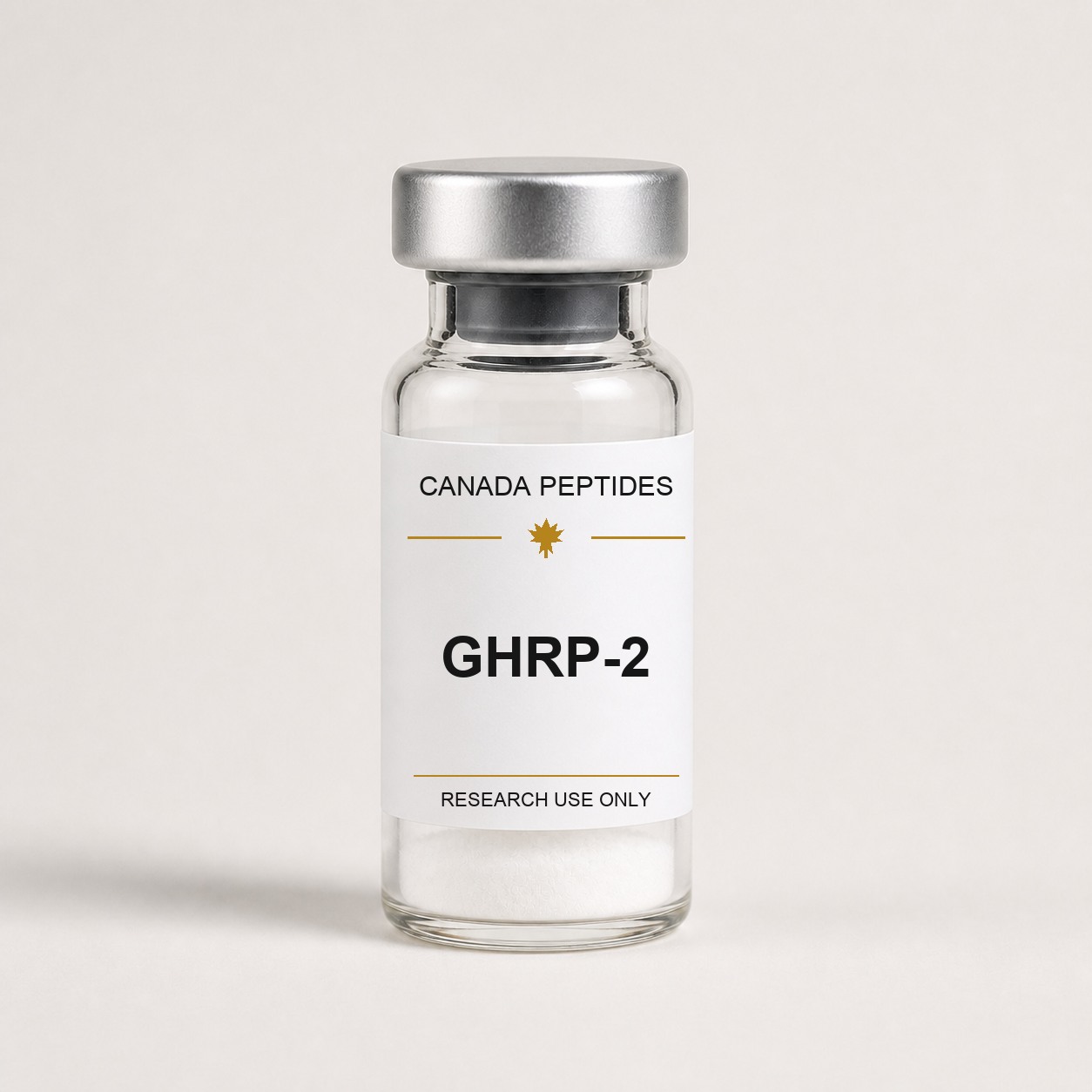
GHRP-2 5MG ships as a lyophilised powder, and the concentration after reconstitution is set entirely by how much bacteriostatic water is added: mass ÷ diluent = concentration. On a U-100 insulin syringe, 100 units = 1 mL, so each unit is 0.01 mL.
5 mg ÷ 2 mL = 2.5 mg/mL, or 25 µg per unit. The 100 µg diagnostic bolus would occupy 4 units at this strength.
5 mg ÷ 1 mL = 5 mg/mL, or 50 µg per unit; small quantities become hard to read on the barrel.
5 mg ÷ 2.5 mL = 2 mg/mL, or 20 µg per unit, so 100 µg is exactly 5 units — the arithmetic that gives round numbers on the syringe.
Record the diluent volume first, since every downstream figure depends on it; the dosage calculator does the conversion and the vial planner works out how many measured draws a vial yields. Add water slowly down the vial wall, do not shake, and return the vial to the dark immediately — the tryptophan and naphthylalanine residues make GHRP-2 more light-sensitive than most peptides. The reconstitution walkthrough shows the procedure and the dosing-math guide covers the syringe-unit conversions.
What is not in the literature
The figure that circulates most widely — 100 to 200 µg subcutaneously two or three times daily — is a community convention, not a trial finding. No published study has established a subcutaneous dose–response in adults for body composition, recovery, sleep or any other chronic endpoint. The GHRP-2 vs GHRP-6 comparison and the secretagogues primer set out how the class was dosed across the literature; the research overview covers the mechanism.
GHRP-2 has no Health Canada market authorisation or DIN and is sold in Canada for research use only; its approval in Japan as a diagnostic has no bearing on its status here. In 2023 the U.S. FDA placed it in category 2 of its 503A compounding evaluation, and the World Anti-Doping Agency lists pralmorelin by name under S2, prohibited at all times.
Frequently asked questions
What is the half-life of GHRP-2?
On the order of an hour, from pharmacokinetic modelling in the 1998 paediatric Phase 1 study. GH peaks 15 to 30 minutes after an intravenous dose and returns to baseline within a few hours, so every published regimen is built around discrete pulses.
What dose is used in the Japanese diagnostic test?
A single 100 µg intravenous bolus, weight-independent, followed by GH sampling and comparison against validated cut-offs (Chihara et al., 2007). It is a one-time supervised endocrine test, not a repeated-dose regimen.
What doses appear in the pharmacology studies?
About 1 µg/kg intravenously, a few µg/kg subcutaneously, tens of µg/kg intranasally and hundreds of µg/kg orally, tracking the drop in bioavailability by route. The 2005 feeding study infused 1 µg/kg per hour. All are single-exposure study parameters.
How was GHRP-2 dosed over longer periods?
Only in children: 0.3 to 3 µg/kg subcutaneously once or twice daily for eight months in GH-deficient patients (Mericq et al., 1998). No study has dosed adults repeatedly for months.
How is a 5 mg vial reconstituted?
With bacteriostatic water, and the volume sets the concentration: 2 mL gives 2.5 mg/mL (25 µg per U-100 unit), 2.5 mL gives 2 mg/mL (20 µg per unit). The reconstitution and dosing-math guides cover the full method.
Is this medical advice?
No. GHRP-2 is a research-grade compound for laboratory use only, not for human or veterinary use. Every number here reports what a study or product label recorded; none is a recommendation, a protocol or a validated dose.