September 23, 2026·6 min read·hcg, human chorionic gonadotropin, dosage, international units, peptide research, canada
HCG dosage — research dosing notes
What the labelling and literature report on hCG dosing: why it is measured in IU, the 24–36 hour half-life, approved-product regimens, the 125–500 IU studies, and IU/mL arithmetic for a 5,000 IU vial.
HCG dosage — research dosing notes — Canada Peptides
Human chorionic gonadotropin — hCG — is the placental glycoprotein hormone that binds the same receptor as luteinising hormone. It is not a short synthetic peptide: at roughly 36–40 kDa it is one of the largest molecules in this catalogue, it has been an approved fertility medicine for decades, and it is measured in International Units rather than milligrams. This page collects what the approved-product labelling and the published studies report about how hCG was given, the half-life context behind those cadences, and the IU-per-millilitre arithmetic for the vial sold here. It is a research reference beside the HCG profile, not a protocol and not medical advice.
Why hCG is measured in International Units
hCG's activity depends on its glycoform composition, so potency is defined by bioassay against the WHO International Standard and expressed in IU. 5,000 IU is well under a milligram of protein, and the mass that delivers one IU varies by product and purity, so there is no fixed IU-to-milligram factor — unlike somatropin, whose WHO standard fixes 3 IU per mg. The peptide unit converter explains why it declines to convert hCG IU into mg. A syringe unit is unrelated to an IU: one insulin-syringe unit is a volume, and says nothing about IU until the concentration is known.
Half-life and cadence
Native LH circulates for under an hour. hCG's extra sialylated carbohydrate and the C-terminal extension on its β-subunit slow clearance dramatically: after injection its elimination is biphasic with a terminal half-life of roughly 24 to 36 hours, so a single dose stimulates the LH receptor for several days. That is what makes it usable as a once-off ovulation trigger and as a two- or three-times-weekly Leydig-cell stimulus, and why very frequent exposure has been reported to down-regulate the receptor in some studies. The half-life calculator models the accumulation that follows from a day-long half-life at the intervals the literature used.
Labelled regimens of the approved products
The Pregnyl labelling gives 5,000–10,000 IU as a single intramuscular injection for ovulation induction, timed 34–36 hours before oocyte retrieval or insemination. For hypogonadotropic hypogonadism in men it gives a range of schedules from 500–1,000 IU three times weekly to 4,000 IU three times weekly for several months, followed by maintenance at lower doses. Recombinant choriogonadotropin alfa (Ovidrel) is labelled at 250 µg subcutaneously as a single trigger, pharmacologically equivalent to roughly 5,000–6,500 IU of urinary hCG.
These figures attach to products with Health Canada DINs, manufactured to a monograph and prescribed under monitoring; they are not figures for research-grade material.
Research protocols outside the label
The published off-label studies used far lower amounts. Coviello and colleagues (Journal of Clinical Endocrinology & Metabolism, 2005) randomised healthy men to 125, 250 or 500 IU every other day, given subcutaneously alongside 200 mg testosterone enanthate weekly for three weeks, and found the two higher doses maintained intratesticular testosterone during exogenous testosterone. Hsieh and colleagues (Journal of Urology, 2013) reported a clinical series using 500 IU every other day in men on testosterone therapy, with semen parameters preserved over a year of follow-up. Both were small studies, not registration trials.
The weight-loss literature is the negative case. Trials following the 1954 Simeons protocol used 125 IU daily for six weeks with a very-low-calorie diet; the 1995 meta-analysis in the British Journal of Clinical Pharmacology found no effect beyond the diet itself.
Route varies: the older labelling and most fertility protocols used intramuscular injection, while the recombinant product and the low-dose adjunct studies used the subcutaneous route with comparable pharmacokinetics. The subcutaneous versus intramuscular article covers the difference.
Reconstitution arithmetic for a 5,000 IU vial
The arithmetic is the same as for any lyophilised vial, with IU in place of milligrams: concentration = labelled units ÷ diluent volume. For the HCG 5000 IU vial:
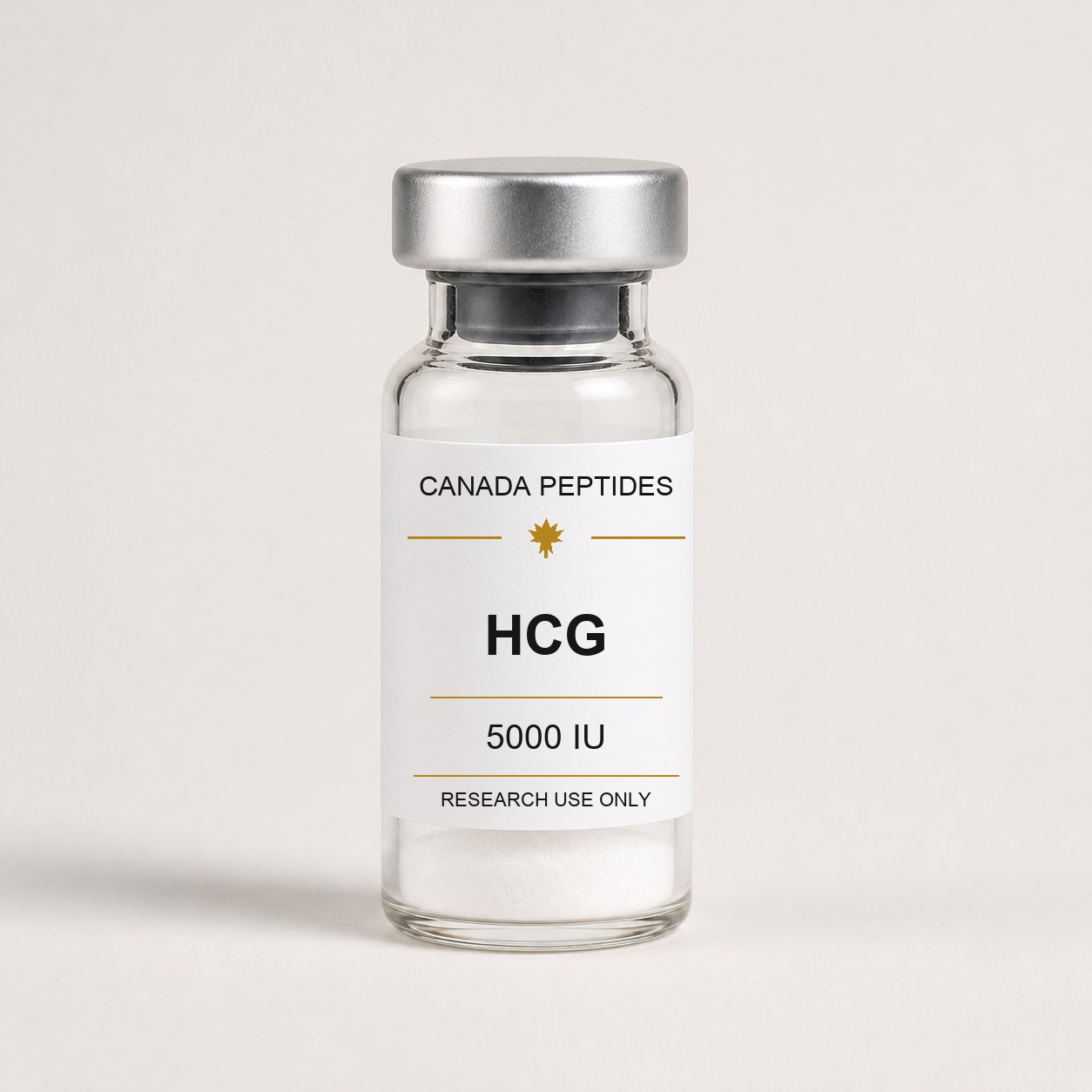
5,000 IU ÷ 1 mL bacteriostatic water = 5,000 IU/mL, so 0.1 mL — 10 units on a U-100 insulin syringe (100 units = 1 mL) — holds 500 IU, and each unit holds 50 IU.
5,000 IU ÷ 2 mL = 2,500 IU/mL, so 10 units hold 250 IU and 5 units hold 125 IU — the increments the adjunct studies used.
Diluent is added slowly down the vial wall and the vial swirled, never shaken: hCG is denatured by heat, agitation and freeze–thaw cycling, and loss of potency is invisible. The reconstitution 101 guide shows the procedure, and the dosing math guide works through IU/mL alongside the mg-based cases. The dosage calculator accepts IU directly; the vial planner, which is built around milligram-labelled vials, does not take an IU-labelled product, so the lines above are the planning arithmetic for this one. Reconstituted solution is refrigerated at 2–8 °C and never frozen.
Data maturity and status
The evidence is of regulatory standard in the fertility indications, small but consistent for the testosterone-adjunct use, decisively negative for weight loss, and essentially absent for the "axis recovery" use discussed after androgen exposure. None of it was generated with research-grade material. The hCG research overview covers the endocrinology behind these regimens.
In Canada, approved hCG products (Pregnyl, Ovidrel) hold Health Canada market authorisations and DINs as prescription drugs; the research-grade vial sold here has no DIN, is not the approved product, and is supplied strictly for laboratory research. Under the WADA Prohibited List, chorionic gonadotropin is prohibited at all times in males under S2.
Frequently asked questions
What doses of hCG appear in the labelling and the research?
The Pregnyl labelling gives 5,000–10,000 IU as a single ovulation trigger and 500–4,000 IU three times weekly for male hypogonadotropic hypogonadism. The 2005 randomised study used 125, 250 or 500 IU every other day, the 2013 series 500 IU every other day, and the disproven weight-loss trials 125 IU daily. These are facts about approved products and published studies, not recommendations.
Why can't hCG IU be converted to milligrams?
Because IU measures biological activity against a WHO reference preparation, and the protein mass that delivers one IU varies with glycoform composition, product and purity. Somatropin is the exception, with a fixed 3 IU per mg; for hCG the IU figure on the label is the figure to work from.
How is a 5,000 IU vial reconstituted?
With 1 mL of bacteriostatic water the concentration is 5,000 IU/mL, so 10 U-100 syringe units hold 500 IU; with 2 mL it is 2,500 IU/mL and 10 units hold 250 IU. The vial is swirled rather than shaken, and the solution refrigerated and never frozen.
What is the half-life of hCG?
Roughly 24–36 hours terminal after injection, compared with under an hour for native LH. That is why a single trigger dose acts for days and why the published cadences are every other day to three times weekly rather than daily.
Is research-grade hCG the same as Pregnyl?
No. Pregnyl and Ovidrel are Health Canada-approved prescription drugs with DINs, manufactured to a monograph and potency-tested. Research-grade hCG has no DIN and has not been reviewed by Health Canada; it is sold for laboratory research only.
Is this medical advice?
No. Research-grade hCG sold here is for laboratory use only, not for human or veterinary use. The labelled regimens belong to approved products prescribed by physicians, and the study figures describe what was administered under ethics approval; none of it is a protocol, a recommendation or medical advice.