August 3, 2026·5 min read·Semax, dosage, nootropic peptides, reconstitution, research
Semax dosage — research dosing notes
What the literature actually reports on Semax dosage: the 0.1% and 1% intranasal concentrations, the 6,000 µg/day post-stroke regimen, half-life context, and reconstitution math for a 5 mg vial.
Semax is a synthetic heptapeptide — Met-Glu-His-Phe-Pro-Gly-Pro — built from the ACTH(4-7) fragment with a C-terminal Pro-Gly-Pro tail added to slow enzymatic breakdown. Developed in Russia and registered there as a prescription intranasal solution, it holds no FDA or EMA approval for any indication. That history explains why the Semax dosage literature is shaped so differently from the GLP-1 literature: the numbers come from Russian clinical practice and Russian-language trials rather than Western dose-ranging studies, and nearly all describe an intranasal solution rather than a reconstituted vial.
The two registered concentrations are the unit of dosing
Nearly every figure you will encounter traces back to two formulations: a 0.1% intranasal solution and a 1% intranasal solution. The arithmetic is the hinge for reading any Semax paper.
0.1% = 1 mg/mL = 1,000 µg/mL
1% = 10 mg/mL = 10,000 µg/mL
A nasal dropper delivers roughly 25–50 µL per drop, which is why secondary descriptions of the Russian labelling put one drop of the 0.1% solution at about 50 µg and one drop of the 1% at about 500 µg. Doses in that literature are usually expressed as drops per nostril per instillation, several instillations per day — a cadence, not a single daily bolus.
The regimens reported in the clinical literature
Acute and post-stroke work. The largest body of human data sits in Russian cerebrovascular research, covering both the acute period of hemispheric ischemic stroke and rehabilitation. Secondary descriptions of the Russian labelling for the 1% solution give acute-stroke daily totals of roughly 6,000–12,000 µg, split across three to four instillations at 3–4 hour intervals for up to about 10 days, with higher totals and shorter intervals for severe presentations. Treat those as label practice reported at second hand, not trial-verified endpoints — we have not read the primary Russian labelling directly.
Rehabilitation-stage trial (2018; PMID 29798983). The clearest single regimen in the accessible literature. 110 post-stroke patients (43 men, 67 women, mean age 58.0 ± 9.7) received 6,000 µg/day for 10 days, repeated as a second 10-day course after a 20-day interval, split into early-rehabilitation (89 ± 9 days post-stroke) and late-rehabilitation (214 ± 22 days) groups against untreated subgroups. Reported outcomes: increased and sustained plasma BDNF, faster functional improvement, better Barthel index and MRC motor scores, with the early-rehabilitation arm doing best. The published abstract does not describe randomization or placebo control — a real limit on how much weight those effect sizes can carry.
Preclinical. The animal work uses µg/kg, not fixed milligram amounts. Shevchenko et al. (Bioorganicheskaia Khimiia, 2006; PMID 16523722) gave rats tritium-labelled Semax intranasally at 50 µg/kg in 20 µL, and the hippocampal BDNF/trkB expression work (PMID 16996037) sits in the same register. Rodent µg/kg figures do not convert into human protocols, and nothing here attempts that conversion.
Half-life: why the schedules are cadence-driven
The pharmacokinetics are the most misread part of Semax dosage. The intact peptide does not persist — it degrades rapidly, and in the Shevchenko tracer work the tripeptide Pro-Gly-Pro predominated in biological samples over Semax itself. In that study, brain radioactivity two minutes after an intranasal dose was about 0.093% of the introduced dose per gram of tissue, roughly 80% of it still intact Semax.
The peptide therefore reaches brain tissue quickly and leaves circulation quickly, while the reported downstream effects — neurotrophin expression, BDNF/trkB signalling — operate on a transcriptional timescale of hours. That mismatch is why published regimens are written as repeated small instillations across a day and as 10-day courses, not as a steady-state concentration to be maintained. Reading Semax dosing as if it were a long-acting analog gets the logic backwards.
Reconstitution math for a 5 mg vial
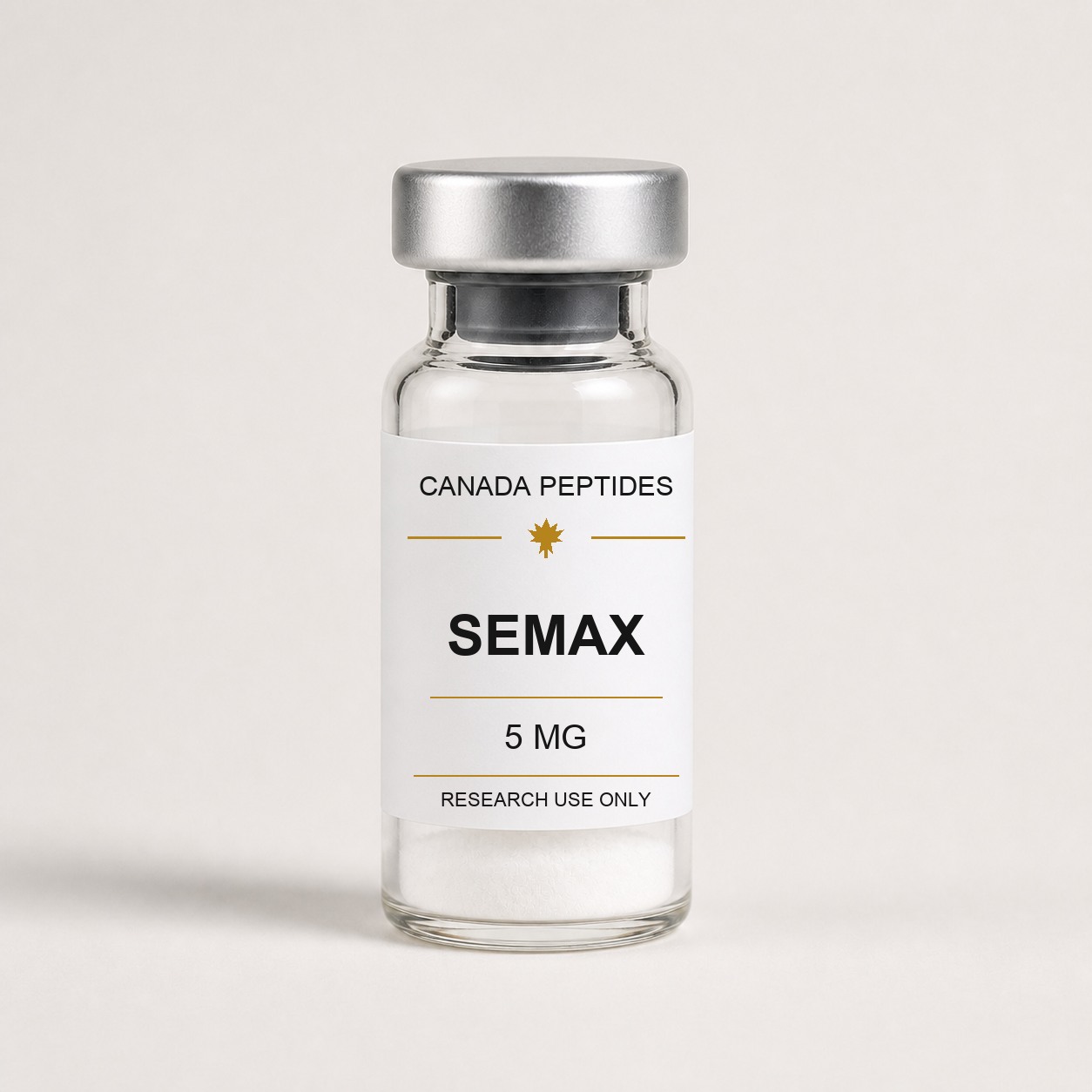
For laboratory preparation of a lyophilized Semax 5 mg vial: 5 mg = 5,000 µg total peptide.
Diluent volume
Concentration
Equivalent
0.05 mL contains
5 mL
1,000 µg/mL
0.1%
50 µg
2 mL
2,500 µg/mL
0.25%
125 µg
1 mL
5,000 µg/mL
0.5%
250 µg
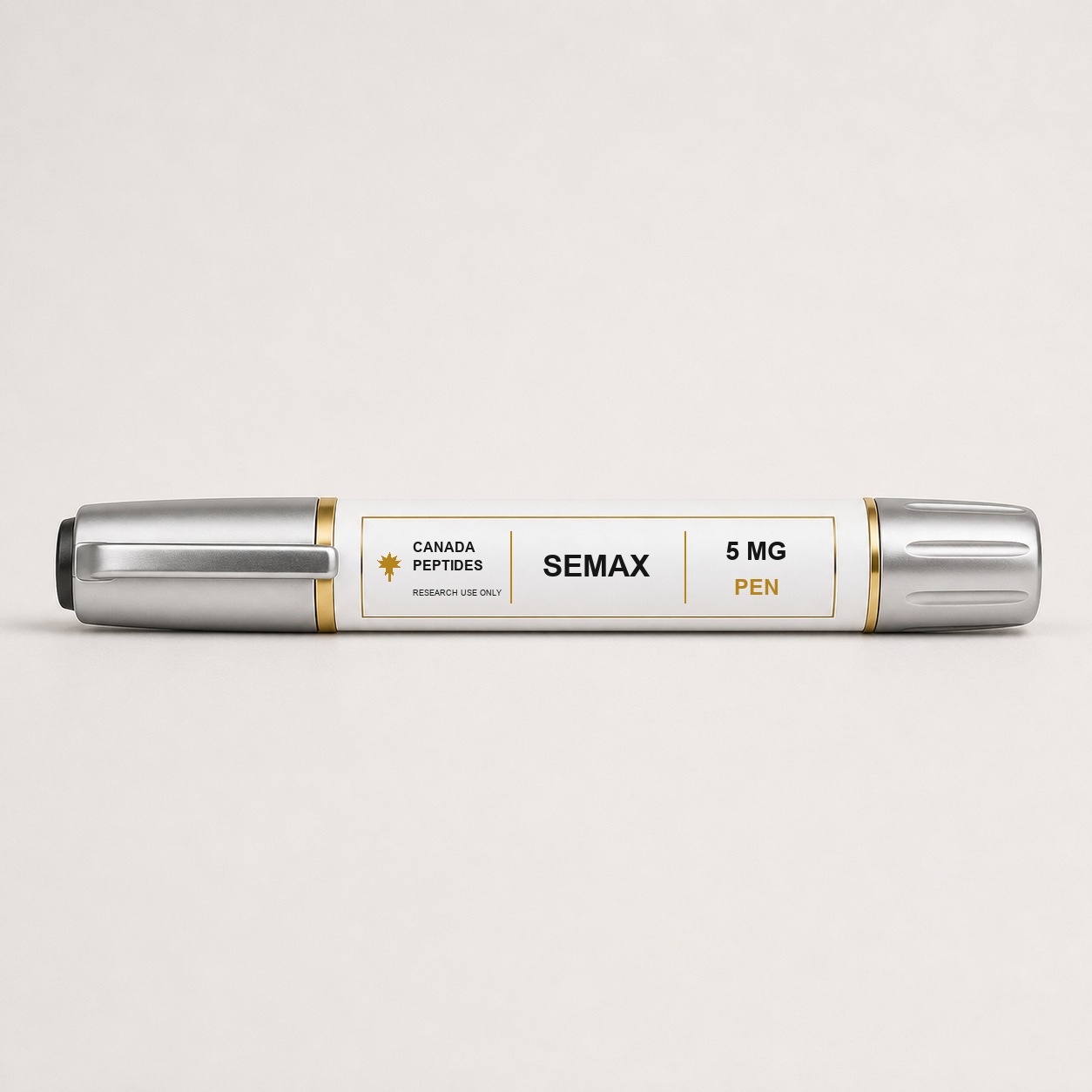
Reconstituting the full 5 mg vial into 5 mL of bacteriostatic water lands exactly on the 0.1% concentration of the registered intranasal product — a useful anchor when comparing a prepared vial against a figure quoted from the clinical literature. On a U-100 insulin syringe, 0.05 mL reads as 5 units and 0.10 mL as 10 units. Method, diluent choice, and how graduations map to volume are covered in reconstitution 101 and dosing math. A Semax 5 mg pen format is also stocked; the same total-peptide arithmetic applies.
What the dosing literature does not establish
There is no Western regulatory dose, no published dose-response curve in healthy subjects, and no long-term safety dataset that would justify extrapolating any of the above. The stroke regimens were studied in an acute clinical population under supervision. Reviews have raised Semax as a candidate in ADHD and Rett syndrome (PMID 16996699), but candidacy is a hypothesis, not a dose. For weighing this kind of evidence see how to read a peptide study; for mechanism and background, the Semax research overview.
Frequently asked questions
What is a typical Semax dosage in the published research?
The most clearly documented human regimen is 6,000 µg/day for 10 days, repeated after a 20-day interval, in a post-stroke rehabilitation study of 110 patients. Descriptions of the Russian labelling for acute stroke report daily totals of roughly 6,000–12,000 µg of the 1% solution, divided across three to four instillations. These are supervised clinical-population figures, not general-use recommendations.
How much Semax is in one drop?
With a nasal dropper delivering roughly 25–50 µL, one drop of the 0.1% solution is about 50 µg and one drop of the 1% about 500 µg. The exact amount depends on the dropper, which is why volume-based figures are more reliable than drop counts.
What is the half-life of Semax?
The intact heptapeptide clears very rapidly — the tracer literature finds the metabolite Pro-Gly-Pro predominating in biological samples shortly after dosing. Reported effects nonetheless extend over hours, attributed to downstream neurotrophic signalling rather than to peptide persistence.
Is Semax approved anywhere?
It is registered as a prescription intranasal medicine in the Russian Federation. It is not approved by the FDA, the EMA, or Health Canada, and material sold for research is not a medicine.
Semax dosage — research dosing notes — Canada Peptides