July 25, 2026·6 min read·tirzepatide, dosage, pharmacokinetics, GLP-1, GIP, reconstitution
Tirzepatide dosage — research dosing notes
A literature overview of tirzepatide dosage: the 2.5 mg initiation step, four-week titration cadence, and 5/10/15 mg maintenance levels used in the trials, the ~5-day half-life behind once-weekly dosing, and reconstitution math for lyophilized vials. Research context only, not medical advice.
Tirzepatide is a synthetic 39-amino-acid dual agonist at the glucose-dependent insulinotropic polypeptide (GIP) and glucagon-like peptide-1 (GLP-1) receptors, carrying a C20 fatty diacid side chain that binds reversibly to serum albumin. Nearly every published tirzepatide dataset comes from once-weekly subcutaneous administration on a fixed escalation schedule, so "tirzepatide dosage" in the literature is really two linked questions: what titration cadence the trials used, and what pharmacokinetics justify that cadence. This page summarizes both, along with the reconstitution arithmetic that applies to lyophilized vials. It is a literature overview for laboratory research context — not a protocol, not a human dosing recommendation, and not medical advice.
The pharmacokinetics behind a weekly interval
The regulatory pharmacology is unusually well characterized. Tirzepatide's elimination half-life is approximately 5 days (reported as 5–6 days in obesity and obstructive-sleep-apnea populations), median time to peak plasma concentration is 24 hours with a range of 8 to 72 hours, absolute subcutaneous bioavailability is about 80%, and the compound is 99% bound to plasma albumin. Steady-state concentrations are reached after roughly four weeks of once-weekly administration. Metabolites are excreted in urine and feces; intact tirzepatide is not recovered in either.
Two design consequences follow. A half-life measured in days flattens the peak-to-trough profile enough that a seven-day interval holds concentrations in a narrow band — the albumin binding, not the peptide backbone, buys that duration. And the four-week step interval used across the trial program is not arbitrary: it approximates the time to steady state at each level, so every step is assessed at its plateau rather than on the way up.
The titration cadence in the trial record
The registrational program converged on one escalation pattern, reproduced in the approved labeling:
Period
Once-weekly dose
Role
Weeks 1–4
2.5 mg
Initiation only — not characterized as a maintenance level
Weeks 5–8
5 mg
First maintenance level
Week 9 onward
+2.5 mg per step, minimum 4 weeks per step
Escalation toward the assigned or maximum tolerated dose
Maintenance
5, 10, or 15 mg
The levels carried through the efficacy trials
Ceiling
15 mg
Highest dose studied and labeled
Tolerability was managed through the interval, not through sub-2.5 mg fractions. SURMOUNT-3 permitted one de-escalation and re-escalation cycle in 2.5 mg increments during the first 24 weeks for participants with gastrointestinal symptoms, with dose adjustment closed off thereafter. Labeled missed-dose handling follows the same logic: a dose more than four days late is skipped rather than doubled, and any change of injection day preserves at least 72 hours between doses.
What each maintenance level produced
Dose-response across the three maintenance levels is consistent but not linear.
In SURMOUNT-1 (72 weeks, 2,539 adults with obesity or overweight without type 2 diabetes), mean weight reduction rose with dose across 5, 10, and 15 mg — Lilly reported a range of 16.0% to 22.5% across the dose arms in the efficacy-estimand analysis, against roughly 2.4% on placebo. A longer-term analysis followed participants to week 176: mean nadir weight reduction of about 23.1% at a mean of 22 months, with approximately 19.4% still maintained at week 176.
In SURPASS-2 (40 weeks, 1,879 adults with type 2 diabetes on metformin), mean HbA1c reductions were 2.01, 2.24, and 2.30 percentage points at 5, 10, and 15 mg respectively, compared with 1.86 points for semaglutide 1 mg.
In SURMOUNT-5 (72 weeks, 751 participants), tirzepatide titrated to a maximum tolerated 10 or 15 mg produced a 20.2% mean weight reduction versus 13.7% for semaglutide at 1.7 or 2.4 mg — the first head-to-head comparison of the two.
The pattern worth noting is the shape of the curve: the increment from 5 to 10 mg is larger than the increment from 10 to 15 mg, while gastrointestinal adverse events track both dose and escalation speed. Higher is not uniformly better in the published record. See tirzepatide side effects for the tolerability profile that constrains the top of the range.
Reconstitution arithmetic
Lyophilized material has no concentration until diluent is added, so the reconstitution volume sets every subsequent measurement. The arithmetic is one division:
volume (mL) = target mass (mg) ÷ concentration (mg/mL), where concentration = vial mass ÷ diluent volume. On a U-100 insulin syringe, units = mL × 100.
For a 5 mg vial:
Bacteriostatic water added
Resulting concentration
Volume for 2.5 mg
Volume for 5 mg
1.0 mL
5 mg/mL
0.50 mL (50 units)
1.00 mL (100 units)
2.0 mL
2.5 mg/mL
1.00 mL (100 units)
—
Smaller diluent volumes concentrate the solution and shrink the measured volume; larger volumes spread the same mass across more graduations. Full worked conversions are in the dosing math guide, and technique and diluent selection are covered in reconstitution 101.
What the data does not establish
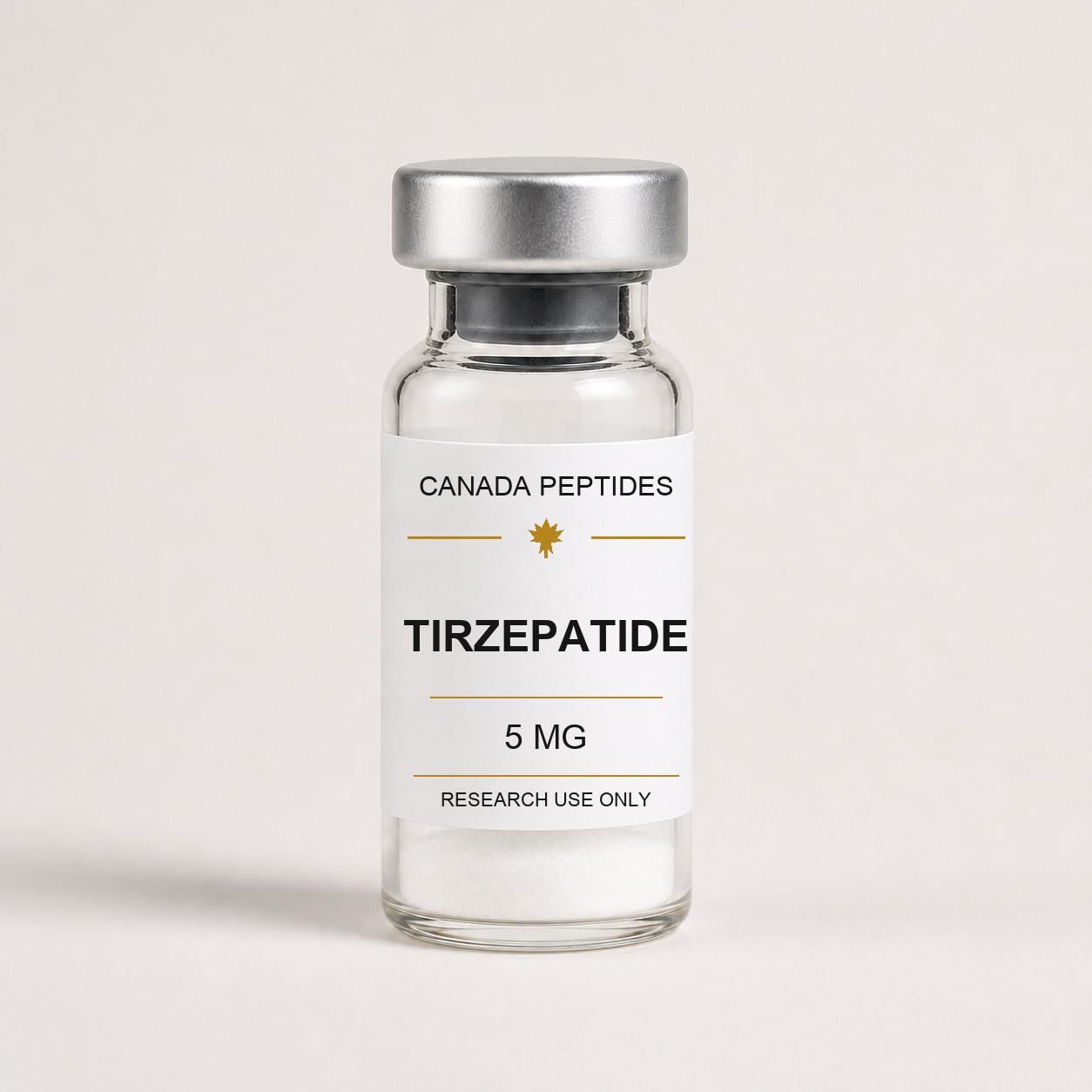
Every cadence above comes from supervised clinical trials in defined patient populations, with monitoring and discontinuation criteria attached. None of it transfers to unsupervised settings, and no published schedule exists for research use outside those trials. The evidence also stops at 15 mg weekly — doses above the studied ceiling have no efficacy or safety characterization behind them. Research-grade material differs from a finished pharmaceutical product in purity, fill accuracy, and concentration verification, which is why a certificate of analysis matters before any calculation is worth performing. Mechanism and the wider evidence base sit in the tirzepatide research overview; the compound page is tirzepatide 5 mg.
Frequently asked questions
Why is tirzepatide dosed once weekly in the literature?
Because its elimination half-life is roughly 5 days and it is 99% albumin-bound, plasma concentrations decline slowly enough that a seven-day interval keeps exposure within a relatively narrow band. Steady state is reached after about four weeks of weekly administration.
Why do trials wait four weeks between dose increases?
Four weeks approximates the time to steady state at a given dose. Escalating sooner means judging a dose level before concentrations have plateaued, and gastrointestinal adverse events in the trials tracked escalation speed as well as absolute dose.
Is 2.5 mg a maintenance dose?
No. In the trial program and the approved labeling, 2.5 mg is an initiation step used for the first four weeks and is not characterized as a maintenance level. The maintenance levels studied are 5, 10, and 15 mg.
Does more diluent change the amount of compound delivered?
No. Diluent volume changes concentration, not the mass in the vial. Adding 2 mL instead of 1 mL to a 5 mg vial halves the concentration and doubles the volume needed for the same mass — the arithmetic changes, the peptide quantity does not.
Tirzepatide dosage — research dosing notes — Canada Peptides