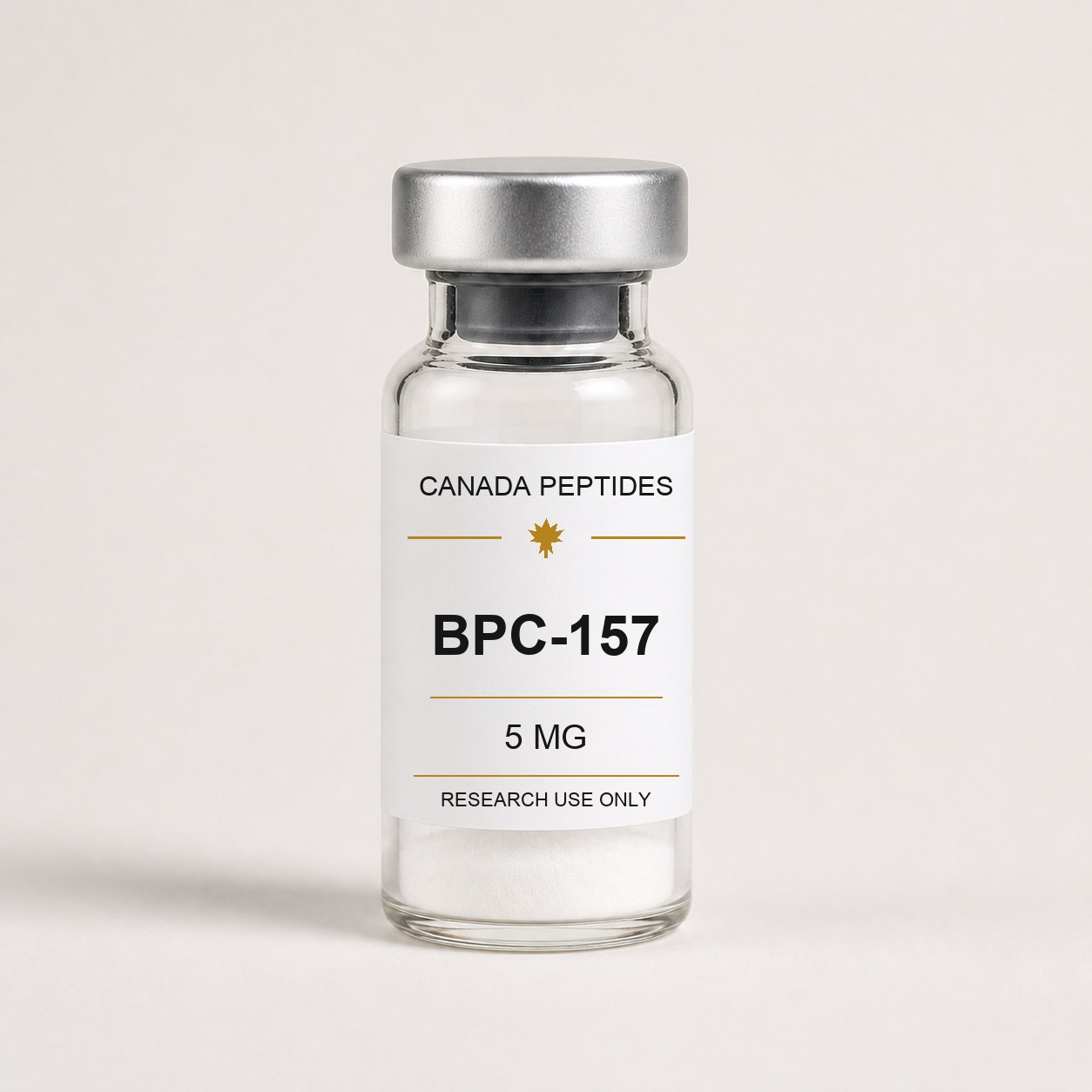
What is BPC-157?
BPC-157 (Body Protection Compound 157) is a synthetic pentadecapeptide — a chain of fifteen amino acids whose sequence corresponds to a fragment of a protein found in human gastric juice. It is a research compound: it holds no marketing approval from Health Canada, the FDA, or any other regulator, and it is supplied here for laboratory research use only.
This page covers the 5 mg lyophilised vial specifically — what's in it, how it's reconstituted, and how it's handled. For the compound itself, the research background, and the wider range, see the BPC-157 in Canada hub.
What's in this vial
| Spec | Detail |
|---|
| Contents | 5 mg BPC-157, lyophilised (freeze-dried) powder |
| Form | Sealed single vial, sterile stoppered |
| Purity | ≥98% by HPLC |
| Ships | Canada-wide, priced in CAD |
| Not included | Bacteriostatic water, syringes — ordered separately |
The vial arrives as a dry white cake or powder at the bottom of the glass. That is the expected appearance: lyophilisation removes the water so the peptide stays stable in transit and in storage. It is reconstituted immediately before use.
What the research literature reports
Most published BPC-157 work is preclinical — cell culture and rodent models, not human clinical trials. Within that literature, the mechanisms most frequently described are:
- Angiogenic signalling — upregulation of VEGFR2, the receptor pathway associated with new blood-vessel formation in tissue models.
- Fibroblast and collagen activity — effects on the cells involved in connective-tissue organisation in tendon and ligament models.
- Gastrointestinal models — the compound's origin as a gastric-juice-derived sequence is why much of the early literature sits in GI research.
- Stability in acidic conditions — a property that has driven interest in oral-route research.
Because the human evidence base is essentially absent, none of this establishes what BPC-157 does in people. It describes what researchers have observed in models. This vial is sold for that kind of work — not as a treatment for any condition.
Reconstituting a 5 mg vial
Reconstitution is arithmetic, and the 5 mg vial makes it straightforward. Adding 2 mL of bacteriostatic water to 5 mg gives a working concentration of:
5 mg ÷ 2 mL = 2.5 mg/mL = 2500 mcg per mL
From there, the volume drawn for a given amount is that amount divided by 2500 mcg/mL. On a standard U-100 insulin syringe (100 units = 1 mL):
| Target amount | Volume | U-100 syringe |
|---|
| 250 mcg | 0.10 mL | 10 units |
| 500 mcg | 0.20 mL | 20 units |
Add the water slowly down the inside wall of the vial rather than jetting it onto the powder, and let the cake dissolve on its own — swirl gently if needed, don't shake. The full walkthrough is in the reconstitution guide, and the dosage calculator will run these numbers for any vial size and water volume you choose.
How many doses is a 5 mg vial?
At the two amounts most commonly described in the literature, a 5 mg vial reconstituted with 2 mL of bacteriostatic water yields:
- 20 aliquots at 250 mcg each
- 10 aliquots at 500 mcg each
The practical limit is not the arithmetic but the shelf life of the reconstituted solution — see storage below. Match your water volume to how much you'll realistically use within that window.
Storage and handling
Before reconstitution: the lyophilised vial is the stable form. Refrigerate at 2–8 °C; it tolerates shipping at ambient temperature, which is why it's shipped dry.
After reconstitution: refrigerate at 2–8 °C and use within approximately 30 days. Bacteriostatic water contains 0.9% benzyl alcohol, which is what makes multi-draw use possible; sterile water has no preservative and is single-use only. Keep vials out of light, don't freeze the reconstituted solution, and discard anything cloudy, discoloured, or containing particulate.
Detail on cold chain and shelf life is in the storage guide.
Is BPC-157 legal in Canada?
BPC-157 is not an approved drug in Canada. Health Canada has not authorised it for human use, and it carries no DIN or NPN. It is also not listed as a controlled substance under the Controlled Drugs and Substances Act.
That combination is what places it in the research-chemical category: it can be sold and shipped domestically for laboratory research use, and it cannot be sold, marketed, or supplied as a therapeutic product for human consumption. Everything on this page is written for that context. We ship within Canada only.
BPC-157 and anti-doping
Any athlete subject to anti-doping rules should know that BPC-157 has been prohibited by WADA since 2022 under category S0 (non-approved substances).
S0 is prohibited at all times — in competition and out of it. There is no washout window that makes it compliant, and an anti-doping rule violation does not depend on whether performance was affected. Tested athletes should treat BPC-157 as off-limits and confirm current status against the WADA Prohibited List directly.
Tolerability in the research literature
Rodent studies have generally reported BPC-157 to be well tolerated at the doses examined, and the published preclinical toxicity signal is limited. That is a genuinely thin evidence base, not a safety finding: there are no long-term human safety data, no established human dose, and no regulatory review of the compound anywhere. Unknown is not the same as safe, and any page telling you otherwise is guessing.
BPC-157 alone, or the TB-500 blend?
This SKU is standalone BPC-157. The BPC-157 + TB-500 repair blend pairs it with thymosin beta-4 fragment, a peptide studied on a different pathway — actin-binding and cell migration rather than VEGFR2 angiogenic signalling. Research protocols that use both are pairing complementary mechanisms rather than doubling one. Take the standalone vial if you want to isolate a single variable, which is usually the point.
Frequently asked questions
What is BPC-157 used for?
BPC-157 is a research compound. Published work is overwhelmingly preclinical — rodent and cell-culture models examining angiogenic signalling, connective-tissue organisation, and gastrointestinal protection. It is not approved for human use in Canada or anywhere else, and it is supplied here for laboratory research only.
How do you reconstitute a 5 mg BPC-157 vial?
Add bacteriostatic water slowly down the vial wall and let the lyophilised cake dissolve without shaking. With 2 mL of bacteriostatic water, a 5 mg vial gives 2500 mcg per mL — so 250 mcg is 0.1 mL, or 10 units on a U-100 insulin syringe.
How many doses are in a 5 mg vial?
Reconstituted with 2 mL of bacteriostatic water, a 5 mg vial yields roughly 20 aliquots at 250 mcg or 10 at 500 mcg. The reconstituted solution keeps about 30 days refrigerated, which is usually the binding constraint rather than the arithmetic.
Is BPC-157 legal in Canada?
It is not an approved drug — Health Canada has not authorised it for human use and it has no DIN. It is also not a controlled substance under the CDSA. It may be sold domestically for research use only, and it may not be marketed or supplied for human consumption.
Is BPC-157 banned in sport?
Yes. WADA has prohibited BPC-157 since 2022 under category S0 (non-approved substances), which applies at all times, both in and out of competition. Athletes under anti-doping rules should avoid it entirely.
How should BPC-157 be stored?
Keep the lyophilised vial refrigerated at 2–8 °C. Once reconstituted, refrigerate and use within about 30 days, keep it out of light, and do not freeze it. Discard any solution that turns cloudy or shows particulate.
Do you ship BPC-157 across Canada?
Yes — Canada-wide, priced in CAD, with a flat $25 shipping rate. We do not ship to the United States or internationally.