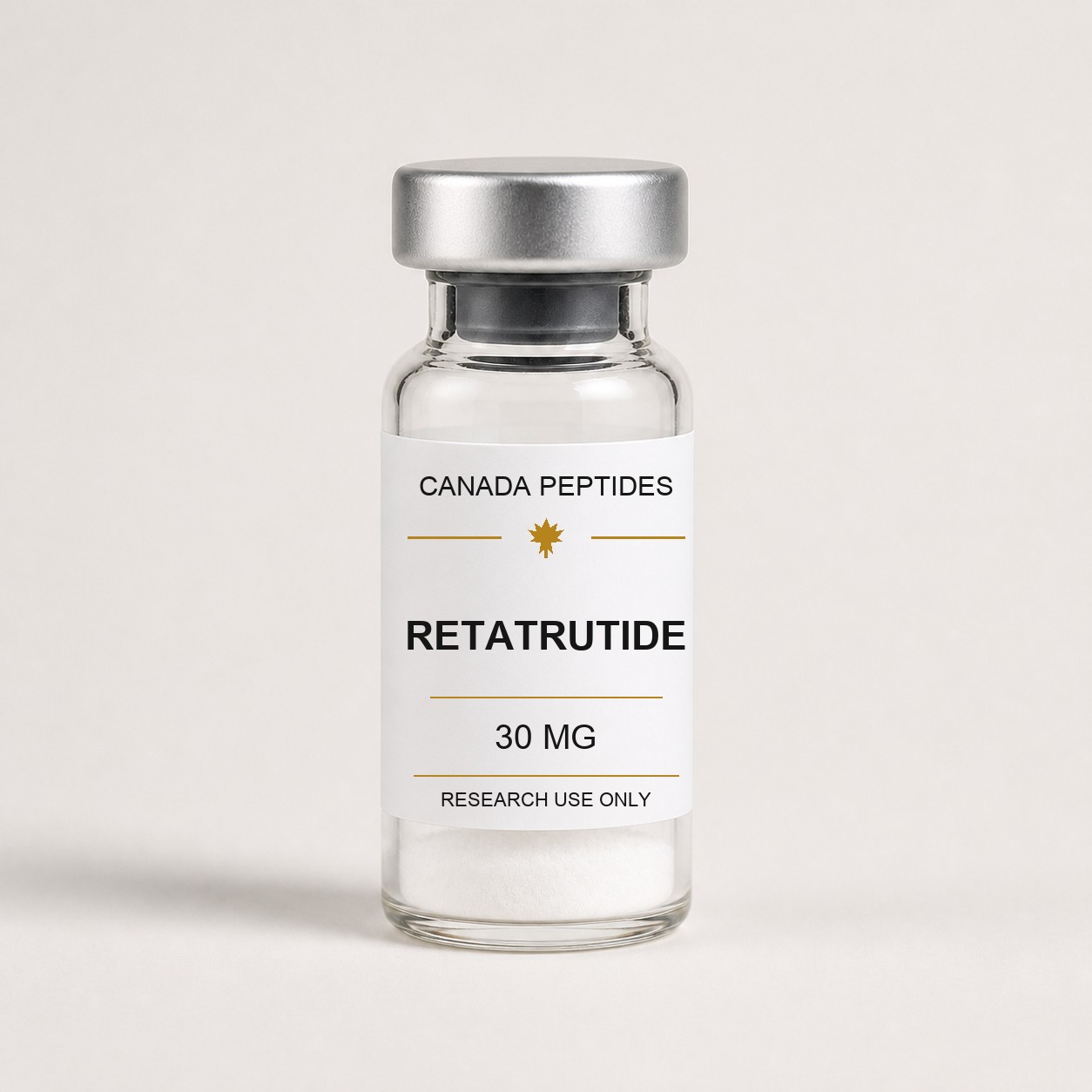
The 30 mg vial: the reservoir
This is the largest retatrutide vial we stock, and it is the most economical per milligram — but it is genuinely the wrong choice for most early protocols, and it's worth being straight about why before you buy it.
A reconstituted vial keeps about 30 days refrigerated. At 2 mg weekly, a 30 mg vial will reach that limit with roughly three quarters of its contents unused, and the per-milligram saving evaporates. This vial earns its price at higher weekly amounts, where it compresses prep time and reload frequency into a single reconstitution.
For the compound itself — receptor pharmacology, research background, comparisons — see the retatrutide hub.
What's in this vial
| Spec | Detail |
|---|
| Contents | 30 mg retatrutide, lyophilised (freeze-dried) powder |
| Form | Sealed single vial, sterile stoppered |
| Purity | ≥98% by HPLC |
| Receptors | GLP-1 / GIP / glucagon (triple agonist) |
| Ships | Canada-wide, priced in CAD |
| Not included | Bacteriostatic water, syringes — ordered separately |
Reconstituting a 30 mg vial — pick your water volume
The 30 mg vial is the one where the water volume is a real decision rather than a default, because 2 mL produces awkward arithmetic:
30 mg ÷ 2 mL = 15 mg/mL
At 15 mg/mL, 2 mg works out to 0.133 mL — 13.3 units on a U-100 syringe, which is not a mark you can read. Amounts that land cleanly are the multiples of 1.5 mg:
| Amount | Volume at 15 mg/mL | U-100 syringe |
|---|
| 3 mg | 0.20 mL | 20 units |
| 6 mg | 0.40 mL | 40 units |
Using 3 mL of bacteriostatic water instead gives 10 mg/mL, and every whole milligram lands on a round mark — 2 mg is 0.2 mL (20 units), 4 mg is 0.4 mL (40 units), the same clean scale as the 20 mg vial. The cost is a larger total volume in the vial.
Neither is more correct; the right answer depends on the amounts your protocol actually uses. Work it through with the dosage calculator before you add any water — the decision is irreversible once the powder is dissolved.
How many doses is a 30 mg vial?
The vial holds 30 mg regardless of water volume, so the aliquot count depends only on the amount:
- 15 aliquots at 2 mg
- 10 aliquots at 3 mg
- 5 aliquots at 6 mg
Read that against the ~30-day refrigerated shelf life of the reconstituted solution. On a weekly cadence, only the higher amounts empty the vial inside its window — at 2 mg weekly you would use about 8 mg of 30 mg before the rest expires.
Storage and handling
Refrigerate the lyophilised vial at 2–8 °C. Once reconstituted, refrigerate and use within about 30 days — a constraint that bites harder here than on any smaller vial, since there is more material to lose. Bacteriostatic water (0.9% benzyl alcohol) permits multiple draws; sterile water is single-use. Don't freeze reconstituted solution, keep it out of light, and discard anything cloudy or containing particulate. See the storage guide and reconstitution walkthrough.
Regulatory status: investigational everywhere
Retatrutide is an investigational compound with no marketing approval from Health Canada, the FDA, or any other regulator anywhere. It remains in clinical development, has never been authorised for human use, and there is no approved version of it and no prescription route to it. This vial is supplied for laboratory research use only and ships within Canada only.
Retatrutide and anti-doping
WADA's S0 (non-approved substances) category covers any pharmacological substance with no current approval from any governmental health authority for human therapeutic use, explicitly including drugs under clinical development. Retatrutide has no such approval.
By that definition it falls inside S0, which is prohibited at all times, in and out of competition. Tested athletes should treat retatrutide as off-limits and confirm against the WADA Prohibited List directly.
Frequently asked questions
How many doses are in a 30 mg retatrutide vial?
The vial holds 30 mg regardless of how much water you add — about 15 aliquots at 2 mg, 10 at 3 mg, or 5 at 6 mg. The binding constraint is the ~30-day refrigerated shelf life of the reconstituted solution, so at low weekly amounts much of the vial will expire unused.
How much bacteriostatic water should I use for a 30 mg retatrutide vial?
It depends on your amounts. 2 mL gives 15 mg/mL, where only multiples of 1.5 mg land on readable syringe marks — 2 mg would be 13.3 units. 3 mL gives 10 mg/mL, where every whole milligram lands on a round mark. Decide before adding water; it cannot be undone.
Is the 30 mg retatrutide vial better value?
Per milligram, yes — but only if your protocol uses it inside the ~30-day reconstituted shelf life. At 2 mg weekly you would use roughly 8 mg before the rest expires, which makes the smaller 10 mg or 20 mg vials cheaper in practice despite the higher per-milligram price.
Is retatrutide approved anywhere?
No. Retatrutide is investigational and holds no marketing approval from Health Canada, the FDA, or any other regulator. It remains in clinical development and is supplied here for laboratory research use only.
Is retatrutide banned in sport?
Yes, in effect. WADA's S0 category covers substances with no approval from any health authority for human use, including drugs in clinical development — which describes retatrutide. S0 substances are prohibited at all times, in and out of competition.
Do you ship retatrutide across Canada?
Yes — Canada-wide, priced in CAD, with a flat $25 shipping rate. We do not ship to the United States or internationally.