September 23, 2026·6 min read·hgh-fragment-176-191, dosage, growth hormone fragment, aod-9604, peptide research, canada
HGH Fragment 176-191 dosage — research dosing notes
What the literature reports on HGH Fragment 176-191 dosage: rodent mg/kg protocols, the oral AOD-9604 trial doses, the missing half-life, and reconstitution math for a 5 mg vial.
HGH Fragment 176-191 dosage — research dosing notes — Canada Peptides
HGH Fragment 176-191 is the last sixteen residues of human growth hormone — Tyr-Leu-Arg-Ile-Val-Gln-Cys-Arg-Ser-Val-Glu-Gly-Ser-Cys-Gly-Phe, about 1,815 Da, with one disulfide bridge — synthesised as a standalone peptide. At the level of sequence it is the same molecule that Metabolic Pharmaceuticals developed as AOD-9604 and took into human obesity trials, which gives its dosing record an unusual shape: a set of rodent mg/kg studies from Frank Ng's group at Monash University, and a human record that consists entirely of oral tablets. Nothing has been published on the injectable fragment in people.
This page collects what those sources report, the reconstitution arithmetic for the 5 mg vial sold here, and why neither dataset produces a validated injectable dose. It is a research reference beside the HGH Fragment 176-191 profile and the AOD-9604 vs HGH Fragment 176-191 comparison; it is not a protocol and not advice.
What the rodent studies administered
The fragment literature begins with the observation that growth hormone's lipolytic and anti-lipogenic actions map to its C-terminal tail. Ng's group reported the anti-lipogenic activity of the synthetic 177–191 sequence in Biochemistry and Molecular Biology International (1993) and characterised the predecessor fragment AOD9401 in Hormone Research (2000).
Heffernan and colleagues, Endocrinology (2001), dosed obese mice and β3-adrenergic-receptor knockout mice with the fragment daily and reported reduced fat mass and increased fat oxidation, preserved in the knockout animals. A companion paper in the International Journal of Obesity (2001) compared chronic treatment with the fragment against intact growth hormone. Across these protocols the fragment was given once daily, by intraperitoneal injection or oral gavage, at weight-based amounts in the region of 0.25 to 2 mg/kg per day, for two to three weeks. Glucose tolerance was not impaired and IGF-1 did not rise at those doses — the findings that separated the fragment from the parent hormone.
Two features of that record are easy to miss: the route was intraperitoneal or oral, not subcutaneous, and the doses were per kilogram of mouse. Neither converts into a human milligram figure without the allometric, toxicological and formulation work that precedes a first-in-human trial.
What the human trials administered
The human data belong to AOD-9604, the pharmaceutical code for the same sixteen residues. Between roughly 2001 and 2007 Metabolic Pharmaceuticals ran a Phase 1 and Phase 2 programme in which the peptide was given as an oral tablet once daily, at doses reported from 1 mg to 30 mg, for up to twelve weeks. The earlier, smaller trials reported modest weight differences with no dose–response relationship, so the twelve-week Phase 2b study — about three hundred obese adults — concentrated on 1 mg daily. It did not meet its primary weight-loss endpoint, and development for obesity stopped.
The tolerability side of that programme was pooled by Stier, Vos and Kenley, Journal of Endocrinology and Metabolism (2013): six trials, roughly nine hundred participants, adverse events comparable to placebo, no effect on glucose, insulin or IGF-1, and no antibody formation. It is the only controlled human dosing record the compound has, and every line of it is oral.
A 2015 rabbit study (Kwon and Park, Annals of Clinical and Laboratory Science) injected AOD-9604 into the knee joint weekly in a collagenase osteoarthritis model — a single small local study that adds nothing to the systemic dosing picture.
Half-life and cadence
No human pharmacokinetic study of the injectable fragment has been published. Rodent data indicate rapid clearance, as expected for a small unmodified peptide, and the oral trials produced low systemic exposure that the company never reported in detail. The half-life figures attached to injectable material online are therefore not derived from measurement, which is why this page does not link a half-life calculator for the compound.
What the literature does support is cadence: once daily in the chronic rodent protocols and in every human trial. Oral bioavailability of a 1.8 kDa peptide is expected to be a small fraction of the amount swallowed, so the 1–30 mg tablet range describes an uncharacterised exposure, not a systemic dose that could be matched by another route.
Reconstitution arithmetic for a 5 mg vial
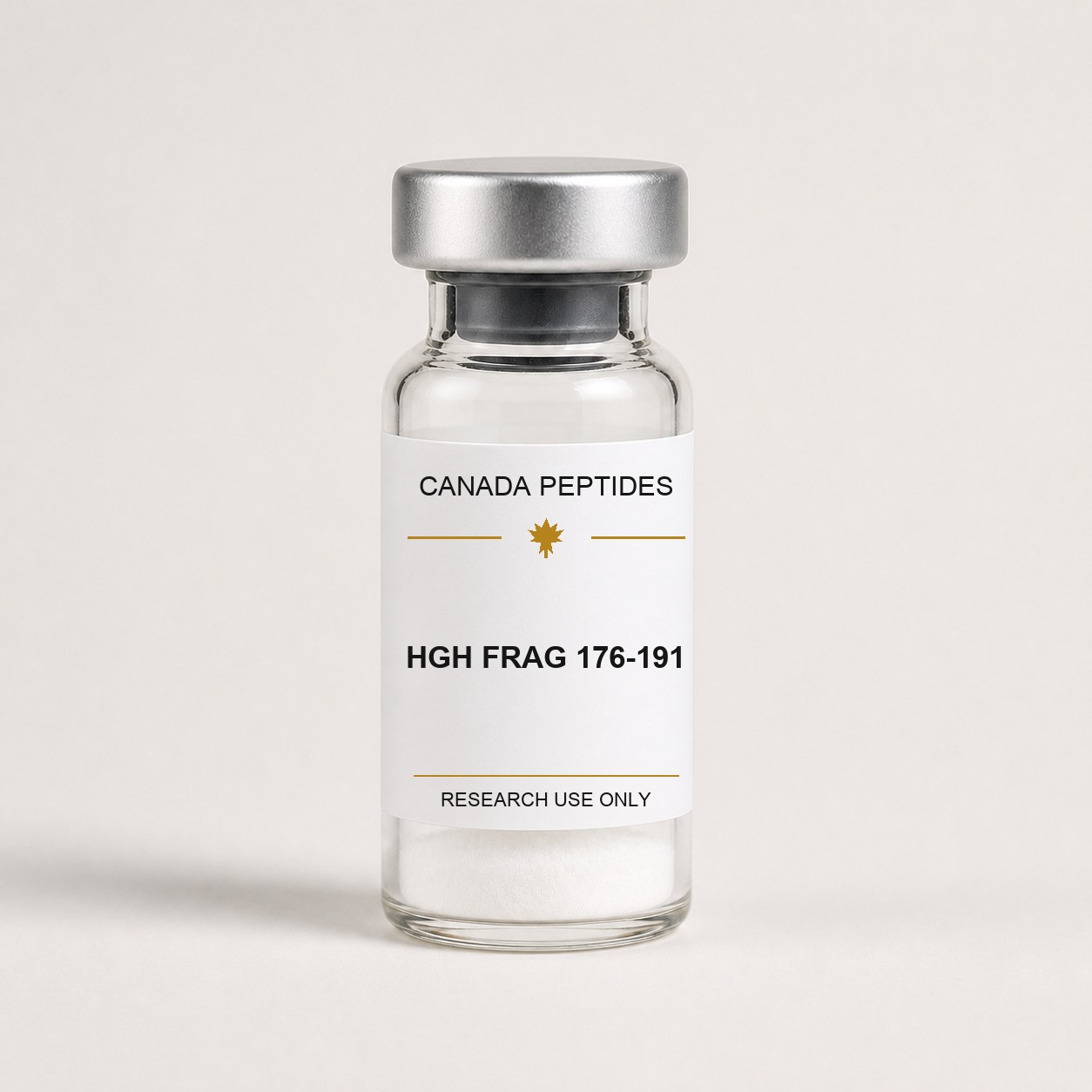
Reconstitution is deterministic and independent of any dosing question: concentration equals peptide mass divided by diluent volume. For the HGH FRAG 176-191 5MG vial:
5 mg ÷ 2 mL bacteriostatic water = 2.5 mg/mL (2,500 µg/mL). On a U-100 syringe, 100 units = 1 mL, so 10 units (0.1 mL) hold 250 µg and a single unit holds 25 µg.
5 mg ÷ 1 mL = 5 mg/mL, so 10 units hold 500 µg and one unit holds 50 µg.
More diluent buys resolution on the syringe barrel; less buys a smaller volume per measurement. Either way the volume added belongs on the vial label before any arithmetic is done, because every downstream number depends on it. The dosing-math guide works through the mg → µg → syringe-unit conversions, the dosage calculator does the division automatically, and the vial planner turns a concentration into a count of measurements per vial.
The lyophilised powder contains a disulfide bridge; diluent goes slowly down the vial wall, the vial is swirled rather than shaken, and the solution is kept refrigerated and used within weeks. Reconstitution 101 shows the procedure.
Why no published number transfers to the injectable material
Three gaps sit between the literature and a research vial. Route: every human figure is oral and every rodent figure is intraperitoneal or oral, while research-grade material is used subcutaneously, a route for which no dose–response study of this fragment has been published. Mechanism: the fragment does not bind the growth hormone receptor with meaningful affinity and no defined target has been identified, so there is no exposure–response relationship to anchor a dose to. Efficacy: the one adequately sized human trial was negative on its primary endpoint, so even the oral 1 mg figure is a dose at which nothing was demonstrated.
The regulatory position follows from that. HGH Fragment 176-191 has no Health Canada market authorisation or DIN and is sold in Canada for research use only; the U.S. FDA placed AOD-9604 in category 2 for section 503A compounding in September 2023; and WADA names hGH 176-191 and AOD-9604 under S2, so the compound is prohibited for tested athletes at all times.
Frequently asked questions
What doses appear in the published research?
Rodent studies used roughly 0.25 to 2 mg/kg per day by intraperitoneal injection or oral gavage for two to three weeks. Human trials of oral AOD-9604 used 1 mg to 30 mg tablets once daily for up to twelve weeks. No controlled human study of the injectable fragment exists.
What is the half-life of HGH Fragment 176-191?
Unknown in humans. No pharmacokinetic study of the injectable fragment has been published, and rodent data indicate rapid clearance. Figures circulated for the research material are not derived from published data.
How is a 5 mg vial reconstituted?
Mass divided by diluent gives concentration: 5 mg in 2 mL of bacteriostatic water is 2.5 mg/mL, so 10 units on a U-100 syringe hold 250 µg; 5 mg in 1 mL is 5 mg/mL, so 10 units hold 500 µg.
Is this medical advice?
No. HGH Fragment 176-191 is a research-grade material for laboratory use only, not for human or veterinary use. Every number here describes what appeared in a published study; none of it is a protocol, a recommendation or a substitute for a licensed physician.