August 13, 2026·6 min read·KLOW, KPV, GHK-Cu, BPC-157, peptide blends, research overview
KLOW blend — a research overview
The KLOW peptide blend combines GHK-Cu, BPC-157, TB-500 and KPV in one vial. A research overview of what each component's literature supports — and what the blend itself has never been studied for.
KLOW blend — a research overview — Canada Peptides
Canada Peptides
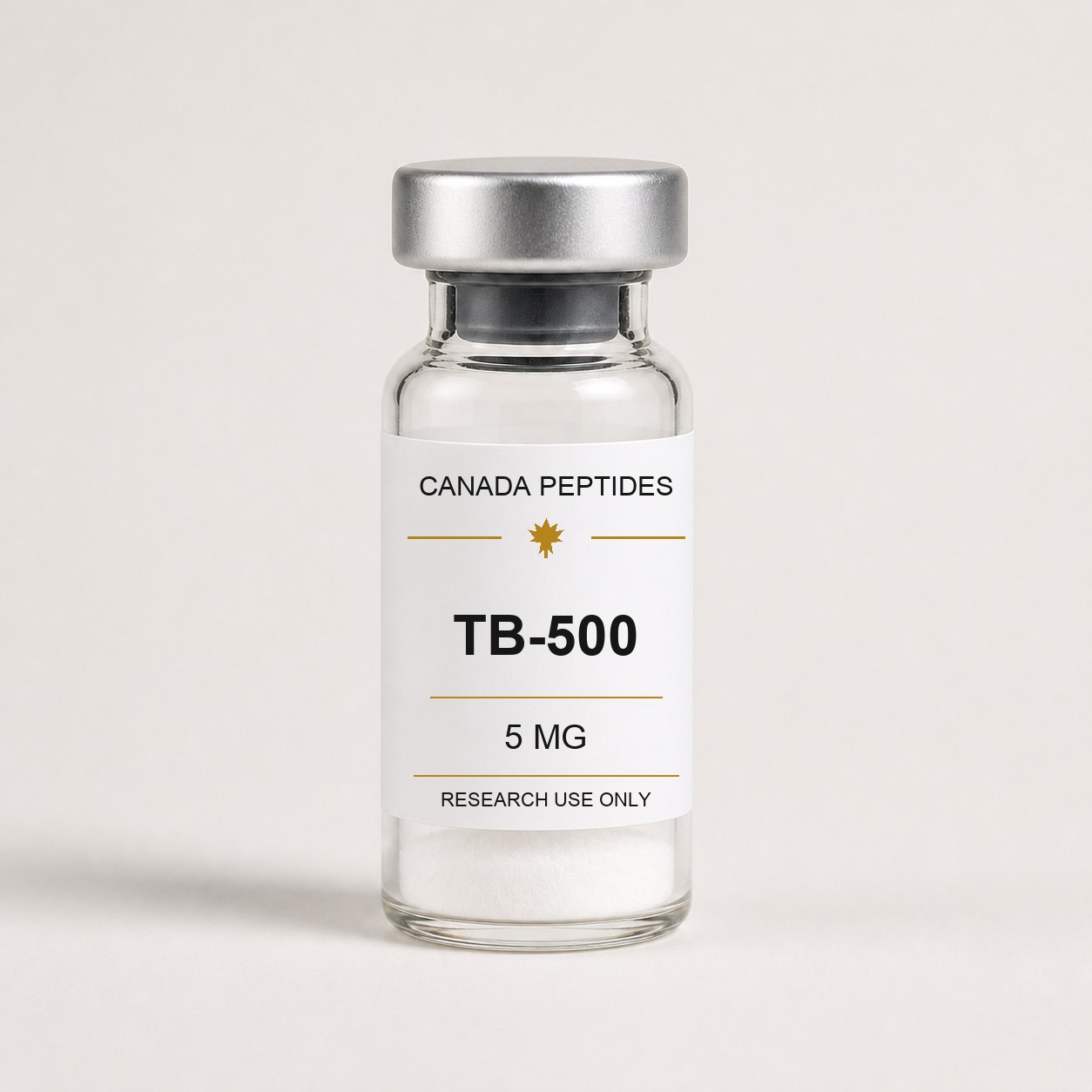
TB-500 5 MG
TISSUE REPAIR
$40.00·Recovery
KLOW is not a compound. It is four separate research peptides — GHK-Cu, BPC-157, TB-500 and KPV — lyophilized into a single vial. The name is the market's shorthand for the GLOW blend plus KPV, and the standard presentation reflects exactly that arithmetic: KLOW 80 mg, conventionally split 50 mg GHK-Cu / 10 mg BPC-157 / 10 mg TB-500 / 10 mg KPV.
That framing is the first thing to get right when evaluating the blend, because it means there is no "KLOW literature." There are four independent literatures of very different maturity, plus one conspicuous gap where the blend's own evidence should be.
What is actually in the vial
Component
What it is
Typical share of an 80 mg vial
GHK-Cu
Glycyl-L-histidyl-L-lysine complexed with copper(II)
~50 mg
BPC-157
A 15-residue sequence derived from a gastric juice protein
~10 mg
TB-500
The acetylated actin-binding fragment (Ac-LKKTETQ) of thymosin β4
~10 mg
KPV
The C-terminal tripeptide (Lys-Pro-Val) of α-MSH
~10 mg
The 5:1:1:1 ratio is a market convention, not a stoichiometry derived from any dose-ranging study. No published work established it as an optimum. It reflects the orders of magnitude each component is customarily handled at in its own literature — GHK-Cu in milligrams in the topical work, the other three in the hundreds-of-micrograms range in animal studies — rather than any tested interaction.
The component KLOW adds: KPV
KPV is the only thing separating KLOW from GLOW, so it carries the blend's entire rationale. It is the C-terminal fragment of α-melanocyte-stimulating hormone, retaining much of the parent hormone's anti-inflammatory signalling while lacking its pigmentary activity — which is why it sits in a different functional bucket than Melanotan 2 despite the shared parent molecule.
Mechanistically the interesting claim in the literature is that KPV appears to act intracellularly, interfering with NF-κB signalling rather than depending on a melanocortin receptor at the cell surface. The most-cited supporting evidence is murine inflammatory bowel disease work — Kannengiesser and colleagues, Inflammatory Bowel Diseases (2008) — reporting reduced inflammatory infiltrate and faster weight recovery in DSS and transfer colitis models, including in mice with non-functional melanocortin-1 receptors.
Two honest caveats. That work is oral and gut-directed; the blend is not. And human clinical data on KPV remain effectively absent. See the KPV research overview for the fuller picture.
The other three, briefly
GHK-Cu has the deepest trail of the four, running back through Loren Pickart's work and into controlled dermatology studies — including copper-tripeptide use on CO2 laser-resurfaced skin and diabetic and surgical wound work. Nearly all of it is topical or wound-bed application. Systemic subcutaneous human data are thin, so the route the blend implies is not the route the evidence was generated in. More in the GHK-Cu research overview.
BPC-157 is the inverse: a very large rodent literature covering tendon, muscle, gut and vascular endpoints, against a human record that is close to empty. As of 2026 no large peer-reviewed Phase I–III trial has been published, and the compound sits on the FDA's Category 2 bulk-substances list in the United States. The BPC-157 research overview covers this in detail.
TB-500 carries a specific attribution problem. The clinical program people cite — the RGN-259 ophthalmic trials in dry eye — used full-length thymosin β4, not the seven-residue TB-500 fragment. The fragment itself has no comparable human trial program. Treating the two as interchangeable overstates the evidence considerably.
Where the blend sits
Against GLOW, KLOW is a single-variable change: the same three-peptide repair layer with an anti-inflammatory tripeptide added on top. The stated rationale — suppress inflammatory signalling so that matrix deposition and repair proceed in better conditions — is biologically coherent and entirely untested as a combination.
Against single vials, the trade is convenience for control. One reconstitution and one injection point replaces four, but the ratio is fixed at the manufacturer's convention. Anything that would require moving one component independently — a dose-response on KPV, or dropping GHK-Cu while holding the rest — is not possible from a blended vial. Researchers who need that flexibility source KPV, GHK-Cu and the rest separately.
There is also a formulation question that public data does not answer: copper(II) is redox-active, and how a copper complex behaves in prolonged storage alongside three other peptides is not something any supplier has published stability data on. Handle blends on the conservative end of the cold-chain guidance, and treat a Certificate of Analysis for a blend as reporting the components, not the mixture's behaviour over time.
Honest data maturity
No study has been published on KLOW as a blend — not a comparison against its components, not a dose-ranging study on the ratio, not a characterization of interactions between the four. Every claim made for the blend is an inference stacked on four separate literatures, three of which are dominated by animal models and routes that do not match how the blend is presented.
That is not an argument that the components are uninteresting; GHK-Cu in particular has real controlled human data behind it. It is an argument for calibrating expectations to what the evidence is: promising preclinical signals, combined on a rationale nobody has tested.
Frequently asked questions
What is in the KLOW peptide blend?
KLOW combines four peptides in one vial: GHK-Cu, BPC-157, TB-500 and KPV. The common 80 mg presentation is split roughly 50 / 10 / 10 / 10 mg. Ratios are a supplier convention rather than a studied optimum, so always read the specific Certificate of Analysis rather than assuming the standard split.
How is KLOW different from GLOW?
GLOW is GHK-Cu, BPC-157 and TB-500. KLOW is those same three plus KPV, an anti-inflammatory α-MSH fragment. That single addition is the whole difference, and it is why KLOW vials are typically 80 mg where GLOW vials are 70 mg.
Is there any research on KLOW itself?
No. There is published preclinical work on each of the four components individually, but no study has evaluated the blend as a blend — not against its components, not at different ratios, and not for interactions between them.
Why does the route of administration matter here?
Because most of the strongest evidence was generated by a different route than the blend implies. GHK-Cu's controlled human data is largely topical and wound-bed; KPV's most-cited work is oral and gut-directed. Evidence does not automatically transfer across routes, and a blend cannot separate them.
Is a blend better than dosing the components separately?
Neither is established as better — the literature does not address the question. Blends reduce handling and injection points; separate vials preserve the ability to change one variable at a time, which is what a research protocol usually needs.