August 28, 2026·6 min read·PT-141, bremelanotide, dosage, melanocortin, reconstitution, research
PT-141 dosage — research dosing notes
What the literature reports on PT-141 dosage: the 1.75 mg subcutaneous regimen from the RECONNECT Phase 3 trials, the ~2.7-hour half-life, the eight-dose monthly ceiling, and reconstitution math for a 10 mg vial.
PT-141 dosage — research dosing notes — Canada Peptides
PT-141 (bremelanotide) is unusual among research peptides in that its dosing is not inferred from rodent mg/kg figures. It is a cyclic heptapeptide melanocortin receptor agonist that completed two Phase 3 trials and was approved by the FDA in June 2019 as Vyleesi, for acquired, generalized hypoactive sexual desire disorder in premenopausal women — meaning a published label, a defined pharmacokinetic profile, and a documented reason for the dose and route in use. This page collects what the literature reports on PT-141 dosage: the trial regimen, the half-life context, the history behind the route change, and reconstitution arithmetic for a 10 mg vial.
The regimen used in the clinical program
The two pivotal trials — Studies 301 and 302, known collectively as RECONNECT — were identical randomised, double-blind, placebo-controlled Phase 3 studies in premenopausal women with HSDD, running 24 weeks with a combined enrolment of roughly 1,250 participants. Both used a single fixed dose of 1.75 mg bremelanotide by subcutaneous injection, taken on demand rather than on a schedule.
The approved label carries three constraints that matter more than the number itself:
Timing: administered approximately 45 minutes before anticipated activity.
Ceiling per day: not more than one dose in any 24-hour period.
Ceiling per month: not more than eight doses per month.
That monthly cap is the most distinctive feature of PT-141 dosing, and it is not arbitrary. Melanocortin agonism produces both the transient cardiovascular effects discussed below and, with frequent exposure, MC1R-mediated pigmentary changes — the label reports focal hyperpigmentation at higher frequency in subjects dosing daily. The ceiling bounds cumulative exposure, which is why PT-141 is an episodic rather than cyclical compound. There is no titration ladder and no loading phase in the approved regimen.
Half-life and why the timing window looks the way it does
Following a single subcutaneous dose, bremelanotide has a mean terminal half-life of approximately 2.7 hours (reported range 1.9–4.0 hours), with mean apparent clearance around 6.5 L/hr. Elimination is by hydrolysis of the cyclic peptide's amide bonds, most of a radiolabeled dose recovered in urine.
A ~2.7-hour half-life is short, which is why the compound is dosed before an anticipated event rather than maintained at steady state, and why the 45-minute pre-dose interval sits inside the absorption phase rather than at a trough. It also bounds the cardiovascular time course: ambulatory monitoring in the label showed mean daytime increases of roughly 1.9 mmHg systolic and 1.7 mmHg diastolic after eight days of dosing, peaking near 2.8 mmHg systolic between four and eight hours post-dose and generally returning to baseline within 12 hours. The label contraindicates use in uncontrolled hypertension or known cardiovascular disease.
The intranasal history is the most instructive part of the dosing record
Before the subcutaneous formulation, Palatin ran an intranasal bremelanotide program in both female sexual dysfunction and male erectile dysfunction. The FDA halted those trials in 2007 after dose-dependent blood pressure elevations, and intranasal development was abandoned in 2008. Reformulated as a lower-dose subcutaneous injection, the compound carried substantially smaller cardiovascular signals through to approval. The lesson generalises: for a melanocortin agonist, route and dose magnitude drive the cardiovascular profile more than compound identity, and extrapolating a "PT-141 dosage" across routes is precisely the inference that produced a clinical hold.
Reconstitution math for a 10 mg vial
Standard research vials of PT-141 are 10 mg lyophilized. The arithmetic is the same as for any peptide — concentration equals mass divided by diluent volume — but the small reference dose makes volume precision consequential.
Bacteriostatic water added
Resulting concentration
Volume containing 1.75 mg
Units on a 100-unit insulin syringe
1 mL
10 mg/mL
0.175 mL
17.5
2 mL
5 mg/mL
0.35 mL
35
5 mL
2 mg/mL
0.875 mL
87.5
At 1 mL of diluent, a 1.75 mg reference amount lands at 17.5 units — under a fifth of a syringe, where a two-unit measurement error exceeds a 10% deviation. Reconstituting to 2 mL doubles the readable volume and halves that relative error, at the cost of more material sitting in solution over time. The full conversion method is in Peptide Dosing Math; sterile handling — diluent choice, injecting down the vial wall, swirling rather than shaking, refrigerated storage — is in How to Reconstitute Peptides.
What the record does not establish
Three gaps are worth naming plainly. Male dosing has no approved reference — the erectile dysfunction program did not reach approval and the intranasal arm was halted, so circulating male figures are not label-derived. Populations outside the trials were not characterised for dosing: the pivotal studies enrolled premenopausal women with a specific diagnosis, and that dataset establishes no exposure profile beyond it. Nothing supports scheduled or chronic dosing — the eight-dose monthly ceiling is the outer edge of what was studied, not a conservative floor.
Tolerability was not incidental either: nausea was reported by roughly 40% of treated subjects, and discontinuation for adverse reactions ran at 18% versus 2% on placebo.
Where PT-141 sits relative to other melanocortin compounds
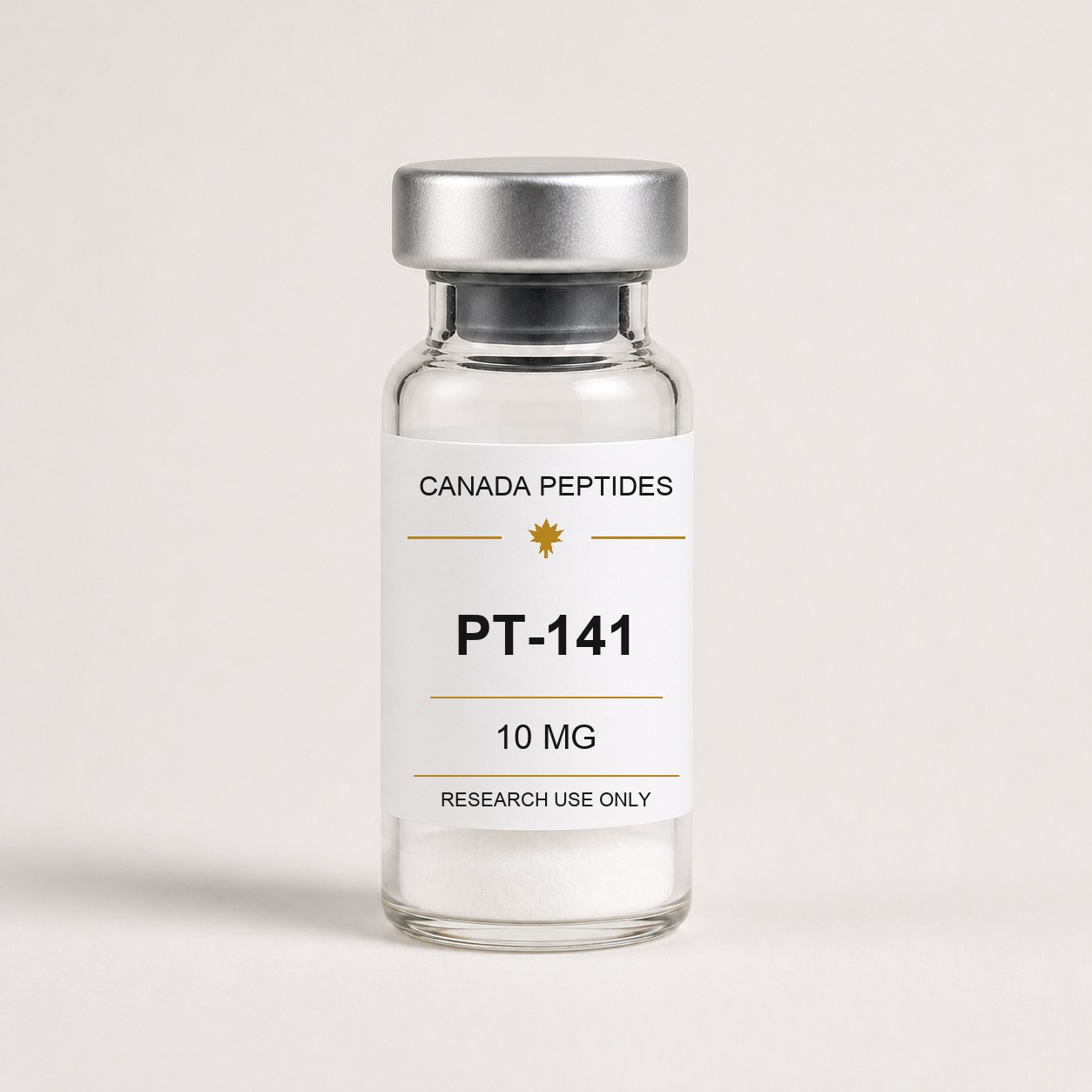
PT-141 is the primary active metabolite of Melanotan II, and both act at melanocortin receptors — hence a shared nausea-and-flushing pattern despite differing selectivity and radically different data maturity. PT-141 has a label and Phase 3 data; Melanotan II does not, and its adverse event profile rests largely on case reports. For mechanism and receptor pharmacology, see the PT-141 research overview. Research-grade material is listed at PT-141 10 mg.
Frequently asked questions
What dose was used in the PT-141 clinical trials?
A single fixed subcutaneous dose of 1.75 mg, taken on demand approximately 45 minutes before anticipated activity, capped at one dose per 24 hours and eight per month — the RECONNECT Phase 3 regimen carried into the FDA label for premenopausal women with HSDD.
Why is there a monthly dose limit rather than a daily schedule?
Because cumulative melanocortin receptor exposure, not single-dose magnitude, drives the pigmentary and cardiovascular concerns — the label reports focal hyperpigmentation at higher frequency with daily dosing. The compound was developed as an episodic agent from the start.
How long does PT-141 stay in circulation?
The mean terminal half-life after subcutaneous administration is approximately 2.7 hours (range 1.9–4.0). Blood pressure and heart rate effects in monitoring studies generally returned to baseline within about 12 hours.
How much bacteriostatic water should a 10 mg vial be reconstituted with?
There is no single correct volume — it is a trade-off. 1 mL yields 10 mg/mL and very small draw volumes; 2 mL yields 5 mg/mL and doubles the syringe volume for the same mass, reducing relative measurement error.
Is there an established PT-141 dosage for men?
No approved reference exists. The male erectile dysfunction program did not reach approval and the intranasal formulation was halted by the FDA in 2007 over dose-dependent blood pressure elevations, so any male figure in circulation is extrapolation rather than label-derived data.