August 13, 2026·6 min read·GLOW, GHK-Cu, BPC-157, TB-500, peptide blends, research overview
GLOW blend — a research overview
The GLOW peptide blend combines GHK-Cu, BPC-157 and TB-500 in one vial. A research overview of what each component's literature actually supports — and what the blend itself has never been studied for.
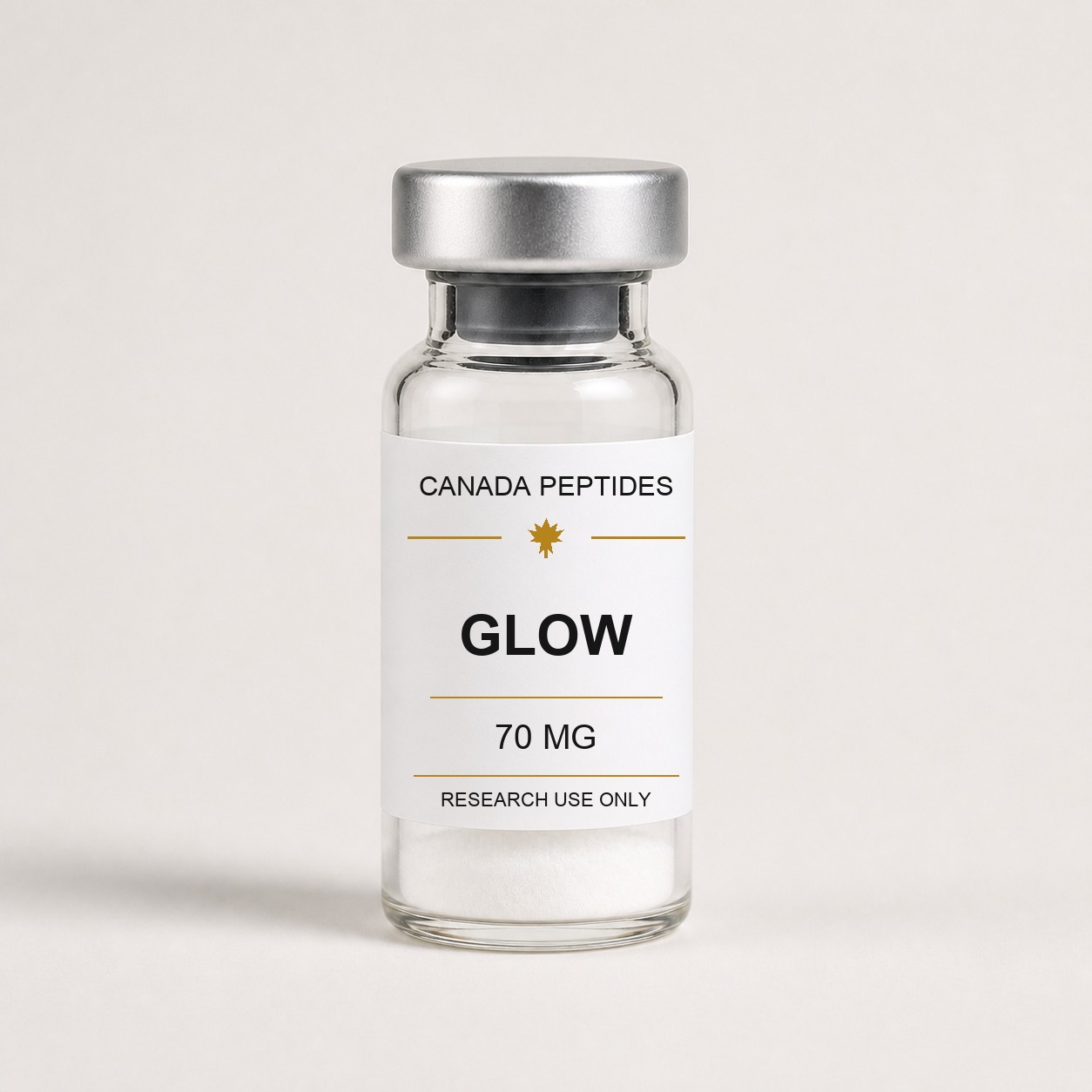
GLOW is not a compound. It is a packaging decision: three separate research peptides — GHK-Cu, BPC-157 and TB-500 — lyophilized together into one vial. Across suppliers the near-universal label is 70 mg total, conventionally split 50 mg GHK-Cu / 10 mg BPC-157 / 10 mg TB-500, which is why GLOW 70 mg is the standard presentation.
That framing matters for anyone evaluating the blend, because it means there is no such thing as "the GLOW literature." There are three independent literatures of very different maturity, and one conspicuous gap where the blend's own evidence should be.
What is actually in the vial
Component
What it is
Typical share of a 70 mg vial
GHK-Cu
The tripeptide glycyl-L-histidyl-L-lysine complexed with copper(II)
~50 mg
BPC-157
A 15-residue sequence derived from a gastric juice protein
~10 mg
TB-500
Usually the acetylated actin-binding fragment of thymosin β4
~10 mg
The ratio is a market convention, not a stoichiometry derived from any dose-ranging study. No published work established 5:1:1 as an optimum. It reflects the fact that GHK-Cu is dosed in milligrams in the topical literature while BPC-157 and TB-500 are handled in the hundreds-of-micrograms range in animal work — so the blend simply scales each to its own customary order of magnitude.
GHK-Cu: the deepest evidence, in a different route
GHK-Cu has the longest research trail of the three, running back to Loren Pickart's identification of the tripeptide in human plasma in the 1970s. The mechanistic case is well characterized: GHK-Cu acts as a copper-delivery and signalling peptide, and gene-expression profiling has shown it modulating large numbers of human genes involved in extracellular-matrix remodelling, antioxidant response and tissue repair. Small controlled cosmetic-dermatology trials of GHK-Cu creams have reported improvements in dermal thickness, collagen density, elasticity and wrinkle parameters against vehicle controls.
The caveat is route. Essentially all of the controlled human GHK-Cu data is topical, using creams applied to facial skin over 8–12 weeks. A subcutaneously reconstituted blend is a different exposure model entirely, and the topical trials do not transfer to it. Our GHK-Cu research overview covers that literature in more detail.
BPC-157: extensive preclinical, thin clinical
BPC-157 is the opposite profile. The preclinical body of work is large — well over a hundred peer-reviewed papers on tendon, ligament, muscle, gut and vascular models — but the overwhelming majority originates from a single research group at the University of Zagreb, and independent replication remains limited. On the human side, as of 2026 there are no published Phase 2 or Phase 3 randomised controlled trials of BPC-157 for any indication; the published human record consists of a small number of pilot studies with tiny sample sizes and no placebo controls. It holds no FDA or EMA approval.
That is not a claim that BPC-157 does nothing. It is a claim about evidence grade: strong, internally consistent animal data is a hypothesis, not a demonstrated human effect.
TB-500: clinical-stage — but check which molecule
Thymosin β4 is the most clinically advanced of the three, and also the one most often described imprecisely. Full-length recombinant Tβ4 has been taken into registrational-scale trials as an ophthalmic solution (RGN-259), including Phase 3 work in dry eye disease with positive results reported from the ARISE-3 trial, plus Phase 2 work in epidermolysis bullosa. None of these programmes has produced an approved product.
The nuance: those trials used full-length Tβ4, applied topically to the ocular surface. What is sold as "TB-500" is usually the shorter acetylated actin-binding fragment, not the parent protein. They share a binding motif; they are not pharmacokinetically interchangeable, and clinical results for one should not be read across to the other. The BPC-157 vs TB-500 comparison unpacks the distinction further.
What has been studied about the blend itself
Nothing published. There are no trials, animal or human, of this specific three-peptide combination. Claims of "synergy" between GHK-Cu, BPC-157 and TB-500 are mechanistic storytelling — plausible on paper, since all three touch angiogenesis and matrix remodelling by different routes, but untested as a combination. Additive, redundant and antagonistic outcomes are all equally consistent with the current evidence base.
Two practical points researchers tend to miss
The copper load is not trivial. A 1:1 GHK-Cu complex has a molecular weight near 404, of which copper (63.55) is roughly 16%. A 50 mg GHK-Cu component therefore carries on the order of 7.9 mg elemental copper per vial. That is arithmetic on the label figure, not a safety statement — but it is a variable worth tracking explicitly in any exposure model, and it is the single largest chemical difference between GLOW and an equivalent-cost set of separate vials.
A blend locks the ratio. Once three peptides share a vial, you cannot vary one without varying the others, which forfeits the ability to attribute any observed effect to a specific component. Separate GHK-Cu, BPC-157 and TB-500 vials cost more and take more handling, but preserve experimental independence. Blends buy convenience at the price of resolution.
Handling
The blend reconstitutes like any lyophilized peptide — bacteriostatic water added slowly down the vial wall, swirled rather than shaken, refrigerated after reconstitution. Copper peptides are the light-sensitive element here, so protect the vial from prolonged light exposure. See reconstitution 101 and dosing math for the concentration arithmetic; note that with a blend, one reconstitution volume fixes the concentration of all three components at once.
For a four-component variant, KLOW adds KPV to the same three-peptide base at 80 mg total — with the same absence of combination-level evidence.
Frequently asked questions
What is the GLOW peptide blend?
A single lyophilized vial combining three research peptides — GHK-Cu, BPC-157 and TB-500 — most commonly at 70 mg total, conventionally split 50/10/10 mg. It is a supplier packaging format, not a distinct compound with its own identity or its own research record.
Is there published research on the GLOW blend?
Not on the combination. Each component has its own literature of varying maturity — GHK-Cu the deepest but almost entirely topical, TB-500's parent protein the most clinically advanced, BPC-157 heavily preclinical — but no published study has examined the three together.
Why is GHK-Cu the largest fraction?
Because GHK-Cu is customarily handled in milligram quantities in its own literature while BPC-157 and TB-500 are handled in microgram-to-low-milligram quantities. The 5:1:1 split reflects those separate conventions rather than any tested combination ratio.
Is TB-500 the same as thymosin beta-4?
Not usually. Thymosin β4 is a 43-residue protein; material sold as TB-500 is typically a shorter acetylated actin-binding fragment of it. Clinical trial results for full-length Tβ4 should not be assumed to apply to the fragment.
Does a blend have any advantage over separate vials?
Cost and handling, mainly — one reconstitution, one storage item. The trade-off is that a fixed ratio removes the ability to vary components independently, which limits what any experiment using it can attribute to a specific peptide.