Sleep architecture
Sleep Peptides in Canada
1 compound in stock
This is the narrowest category on the site, and honestly so: DSIP is the one compound with a genuine sleep-architecture research literature behind it. Rather than pad the category, the related compounds studied around circadian and recovery-phase signalling are cross-linked below. Priced and shipped in CAD, for laboratory and research use only.
Sleep — for sale
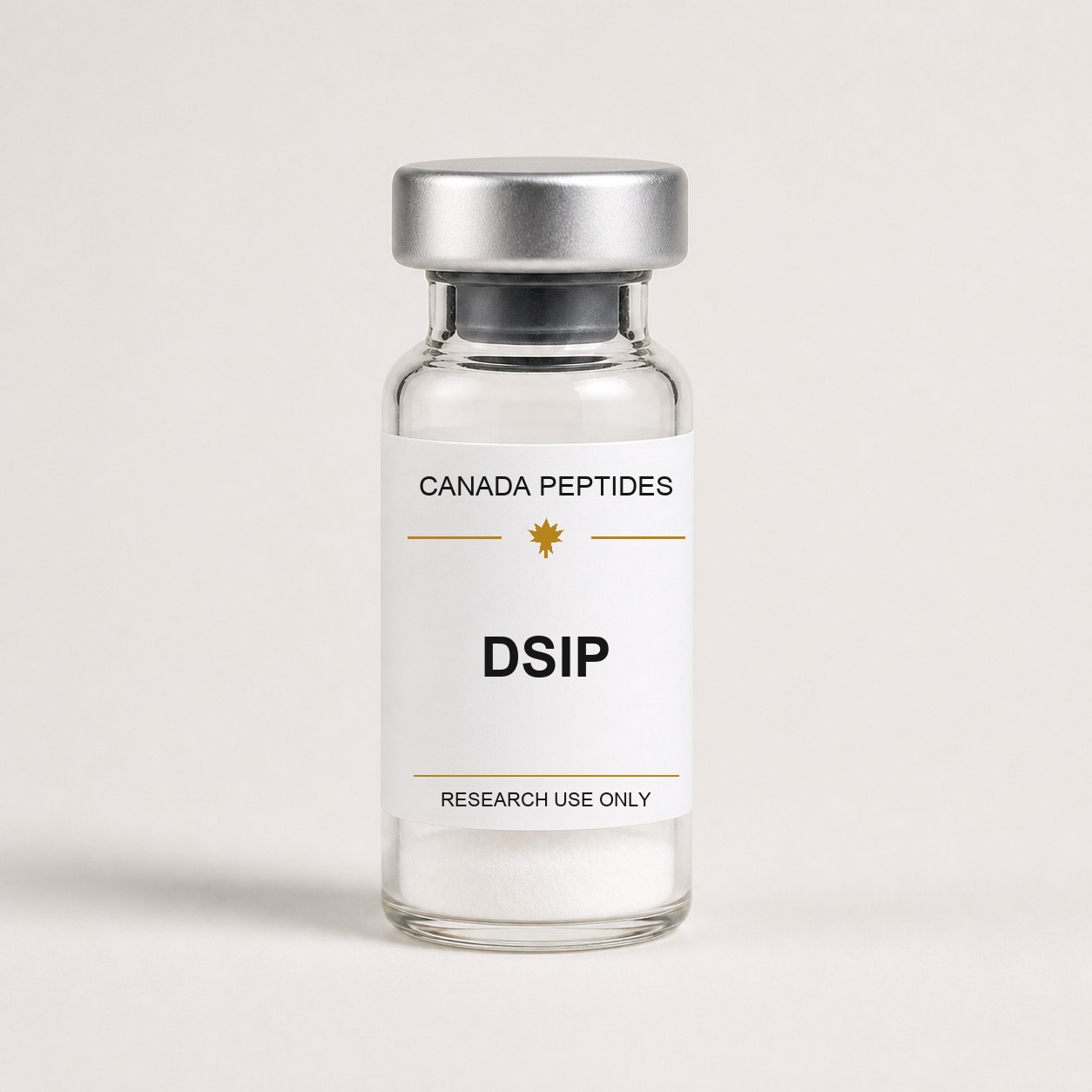
What DSIP is
DSIP — delta sleep-inducing peptide — is a nonapeptide first isolated in the 1970s from rabbit cerebral venous blood during induced sleep. Research interest centres on slow-wave (delta) sleep architecture and on its behaviour as a neuromodulator rather than a sedative. The literature is older and smaller than for the recovery or metabolic categories, which is worth knowing before designing around it.
Adjacent research areas
Sleep research overlaps with the longevity category, since growth-hormone secretagogue studies frequently track sleep-phase GH pulsatility — sleep and longevity peptides covers that intersection. On the anxiolytic side, Selank appears in adjacent literature. The cognitive and sleep protocol sets out how these are combined in research designs.
Further reading
DSIP side effects — what the research reports
DSIP side effects by evidence tier: what the 1980s intravenous human studies recorded, what animal toxicology found, the uncontrolled reports on subcutaneous use, and the forty-year data gap.
DSIP dosage — research dosing notes
A literature review of DSIP dosage: why the human studies all used 25 nmol/kg intravenously, how that converts to micrograms, reconstitution math, and DSIP's minutes-long plasma half-life.
DSIP — a research overview
A measured research overview of DSIP (delta sleep-inducing peptide): its structure, proposed mechanism, the mixed sleep and stress-axis data, and where the DSIP peptide sits versus related compounds.
Sleep peptides FAQ
- What is DSIP?
- DSIP (delta sleep-inducing peptide) is a nonapeptide first isolated in the 1970s from the cerebral venous blood of rabbits during induced sleep. It is studied in research contexts around slow-wave sleep architecture and neuromodulation.
- Can I buy DSIP in Canada?
- Yes. Research-grade DSIP 15 mg is available from Canada Peptides, priced in CAD and shipped within Canada, for laboratory and research use only.
- Why is this category so small?
- Because DSIP is the only compound we stock with a substantive sleep-architecture research literature behind it. Rather than list compounds with tangential sleep relevance, the category stays narrow and cross-links to the longevity and cognitive categories where the research overlaps.
- Is DSIP research use only?
- Yes. DSIP is supplied strictly for laboratory and research use. Nothing on this page is medical advice or a therapeutic claim.
Other categories
- CognitiveSemax, Selank, Cerebrolysin — neuropeptides studied around BDNF signalling and attention.
- EnergyMOTS-c and SLU-PP-332 — mitochondrial-derived signalling and ERR agonism.
- RecoveryBPC-157, TB-500, KPV and glutathione — angiogenic, cytoskeletal and anti-inflammatory pathways.
- MetabolicRetatrutide, semaglutide, tirzepatide and more — GLP-1, GIP and glucagon receptor research.
- LongevityCJC-1295, ipamorelin, GHRP-2/6, epithalon and NAD+ — GH-axis and cellular-ageing research.
- SkinGHK-Cu, GLOW, KLOW and Melanotan 2 — copper-peptide and melanocortin research.
- FoundationalKisspeptin, PT-141 and thymosin alpha-1 — upstream endocrine and immune signalling.
Research & educational use only. This page is informational and does not constitute medical advice or a therapeutic claim.